The End of the Waiting Room
Architecting the Time-Zero Organisation
In both the public and private sectors, we’ve reached a breaking point where "doing things faster" is no longer enough. We are entering an era where success isn't measured by efficiency gains, but by the collapse of latency - the gap between a problem arising and a solution being delivered.
This is the Time-Zero Threshold.
For too long, Intelligent Automation has been dismissed as a simple cost-saving tactic or a way to trim the headcount. This is a dangerous underestimation. When we talk about "Time-Zero", we aren't just talking about speed; we are talking about Time to Safety and Time to Justice.
In this brief, I explore why the Ethical CTO must move beyond traditional business cycles. We look at how Intelligent Automation serves as the digital engine for real-time ethics, ensuring that our institutions can respond to human needs at the exact moment they occur, rather than weeks after the damage is done.
It’s time to stop managing delays and start architecting a future without them.
The Time-Zero Threshold
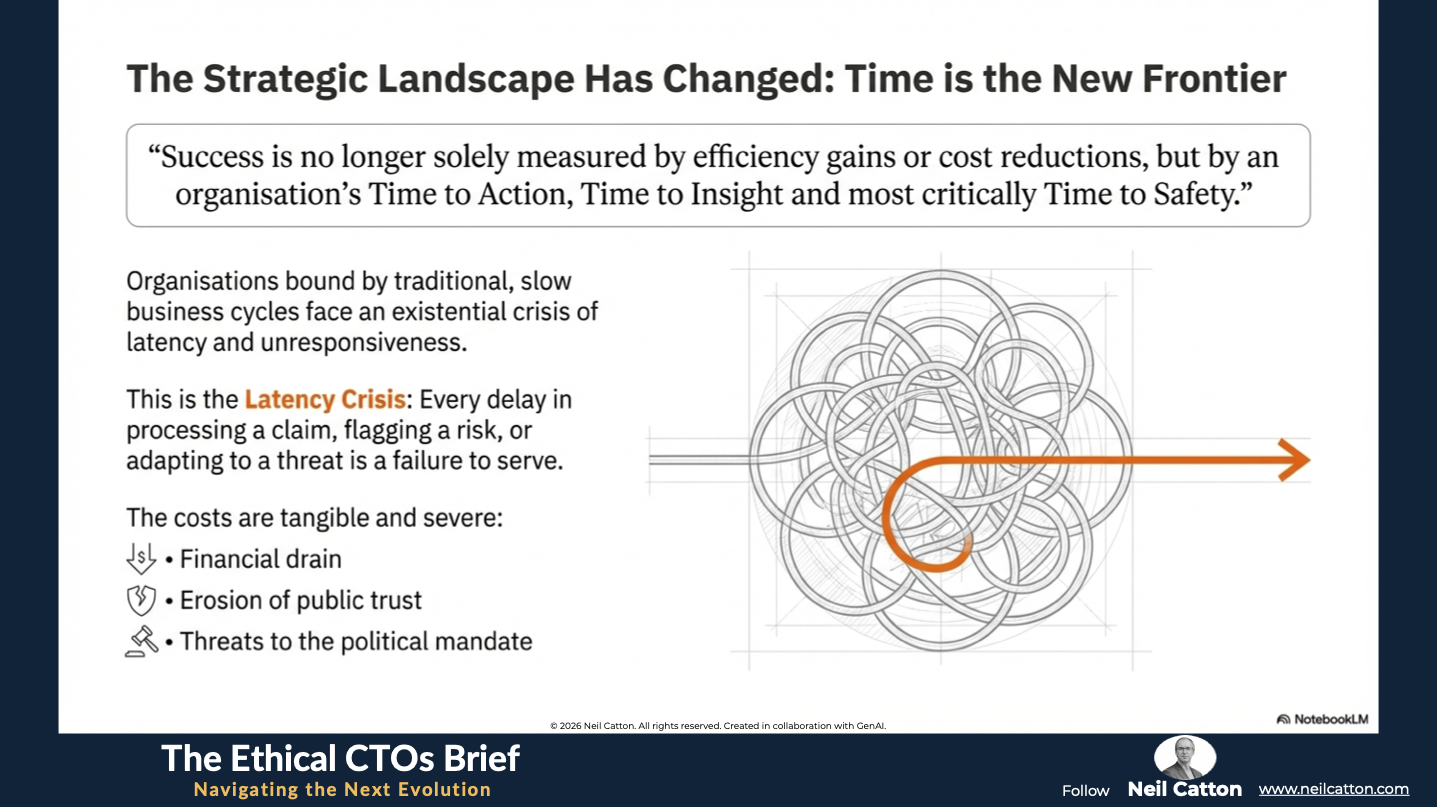
In today’s public and private sectors, the competitive landscape has fundamentally changed. Time is no longer a passive constraint but a strategic asset and the ultimate competitive frontier. Success is no longer solely measured by efficiency gains or cost reductions, but by an organisation’s Time to Action, Time to Insight and most critically Time to Safety. Organisations still bound by the slow pace of traditional business cycles are facing an existential crisis characterised by latency and unresponsiveness.
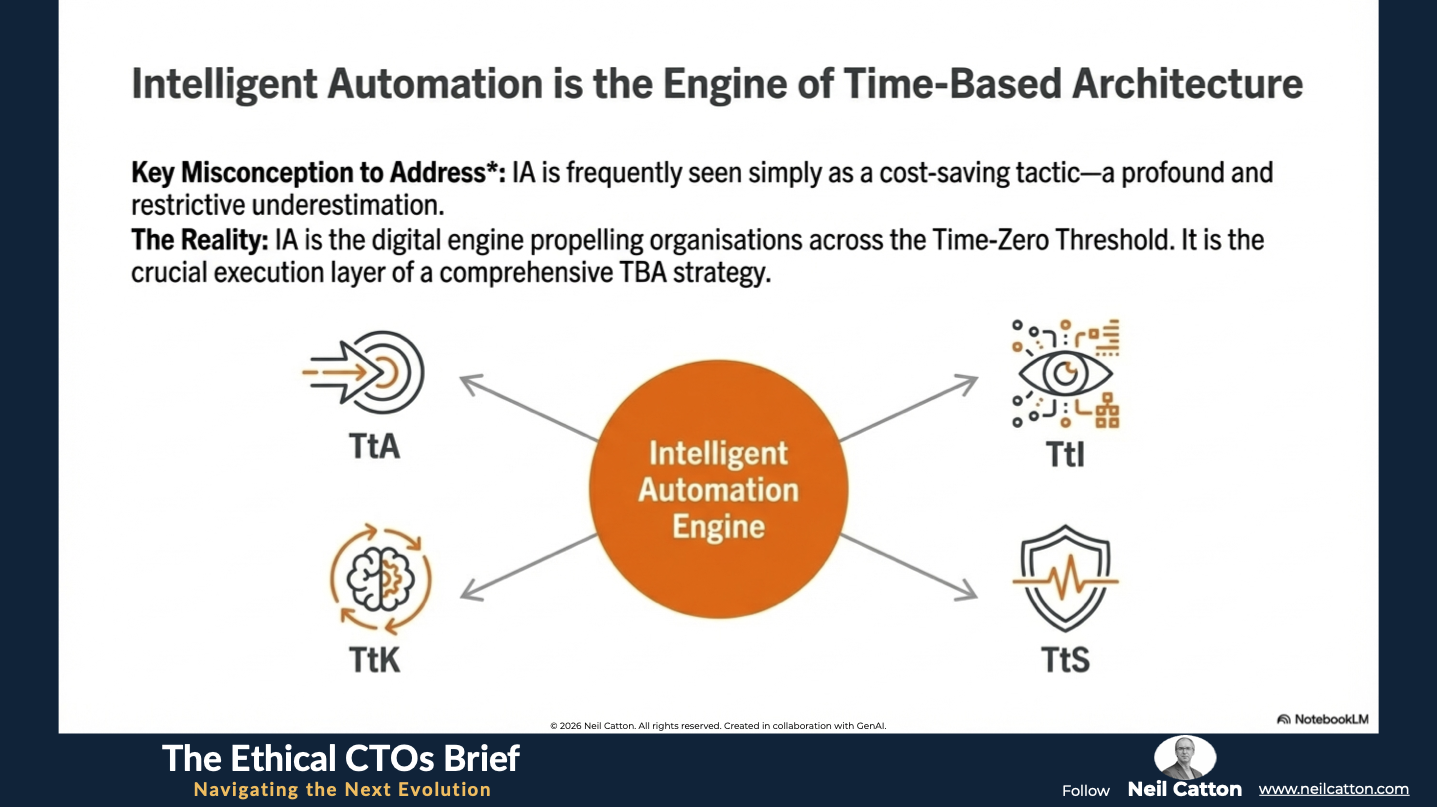
Intelligent Automation (IA) – a sophisticated blend of Robotic Process Automation (RPA), Cognitive Automation (CA) and Machine Learning (ML) – is often misunderstood. It’s frequently seen simply as a cost-saving tactic for the UK public sector, a profound and restrictive underestimation. In reality, IA is the digital engine propelling organisations beyond traditional operational limits and across the Time-Zero Threshold. It’s the crucial execution layer of a comprehensive Time-Based Architecture (TBA) strategy.
This article presents a holistic architectural vision. It explains how Intelligent Automation transcends its traditional role as a mere tool becoming a structural necessity. This core capability enables instantaneous event-driven decision-making while fundamentally embedding real-time ethical accountability. This is crucial for building resilient and trusted public services in the hyper-future.
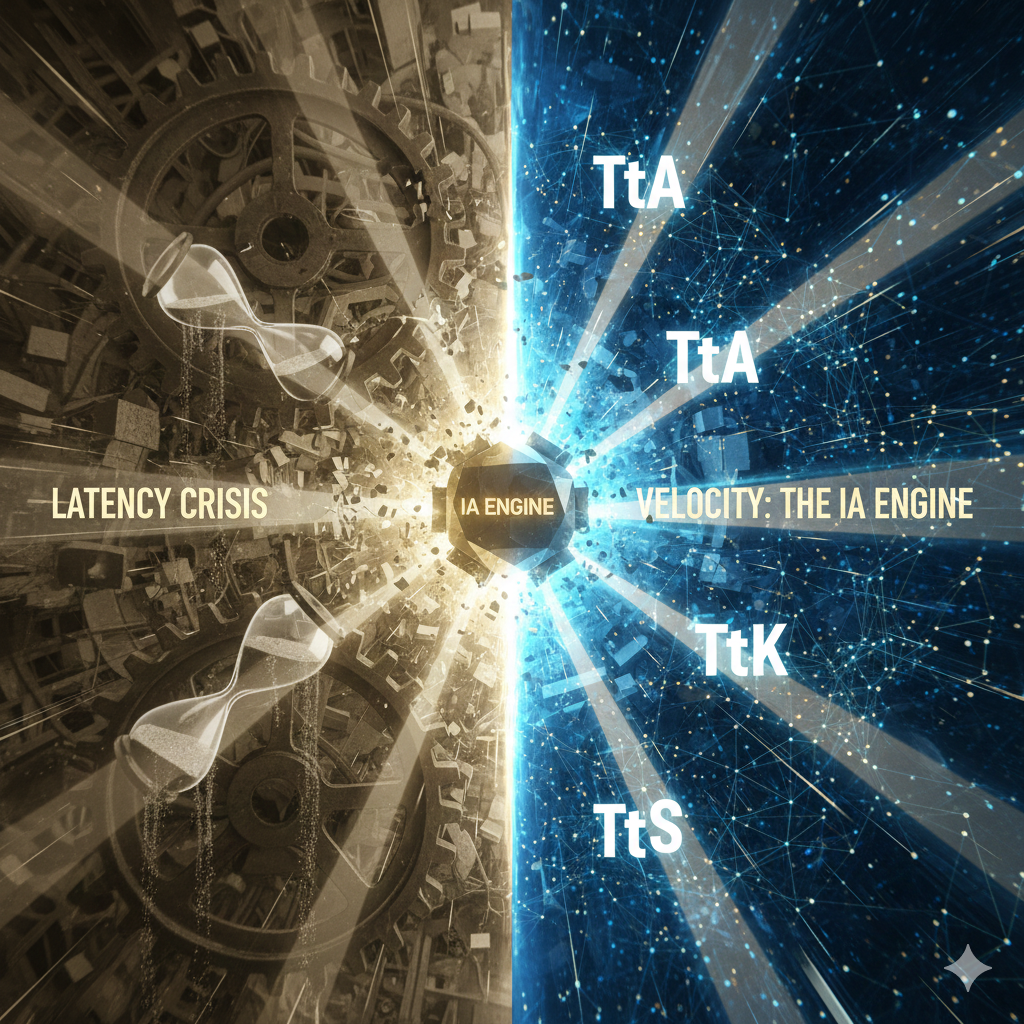
The Latency Crisis: IA as the Engine of Time-Based Architecture
The extensive network of legacy institutions, including vital public sector bodies, is constantly grappling with the crippling operational costs of atency. Every delay in processing a benefit claim, every lag in flagging a regulatory anomaly and every moment lost adapting to a new cybersecurity threat directly translates into a failure to serve. This delay has multiple costs: financial drain, erosion of public trust and a threat to the political mandate.
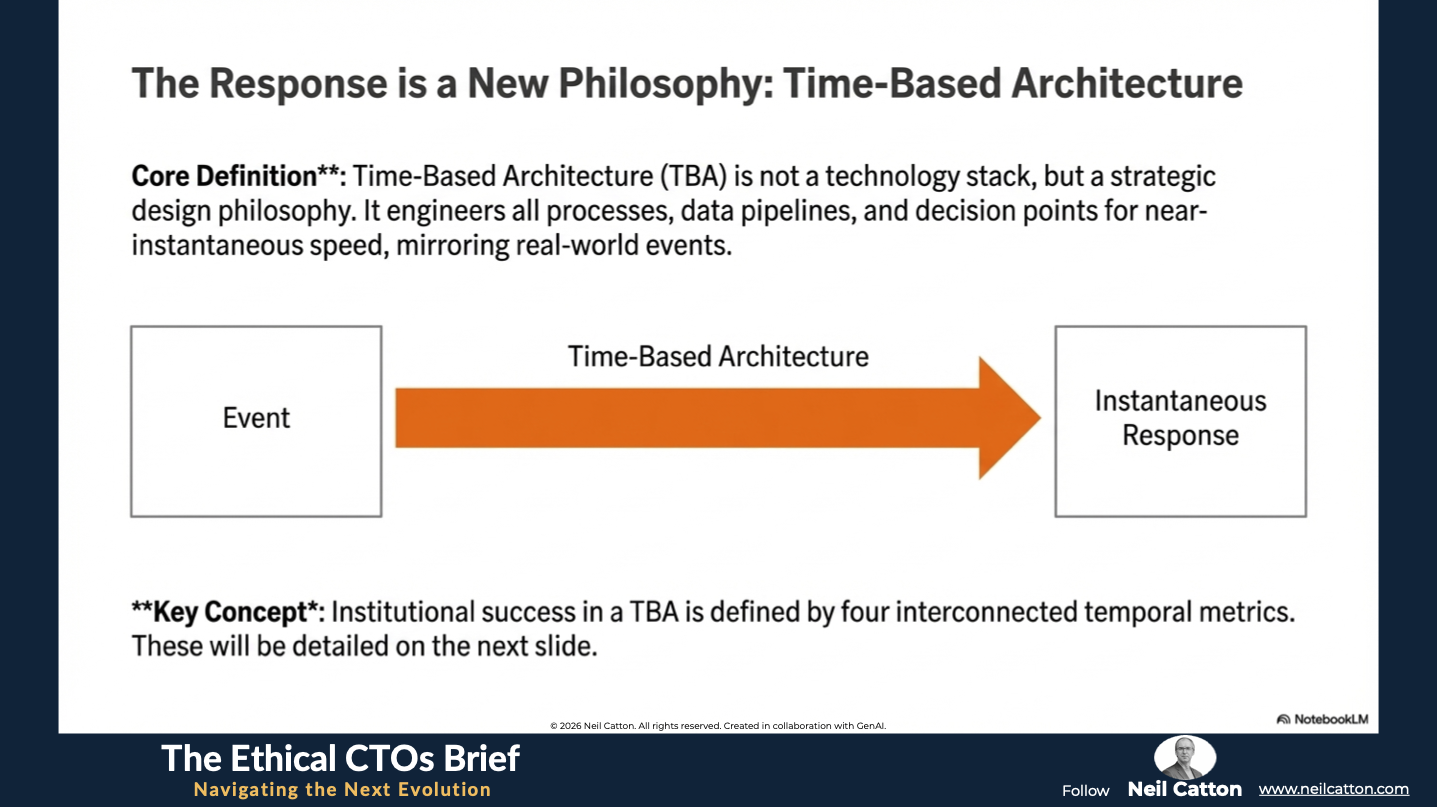
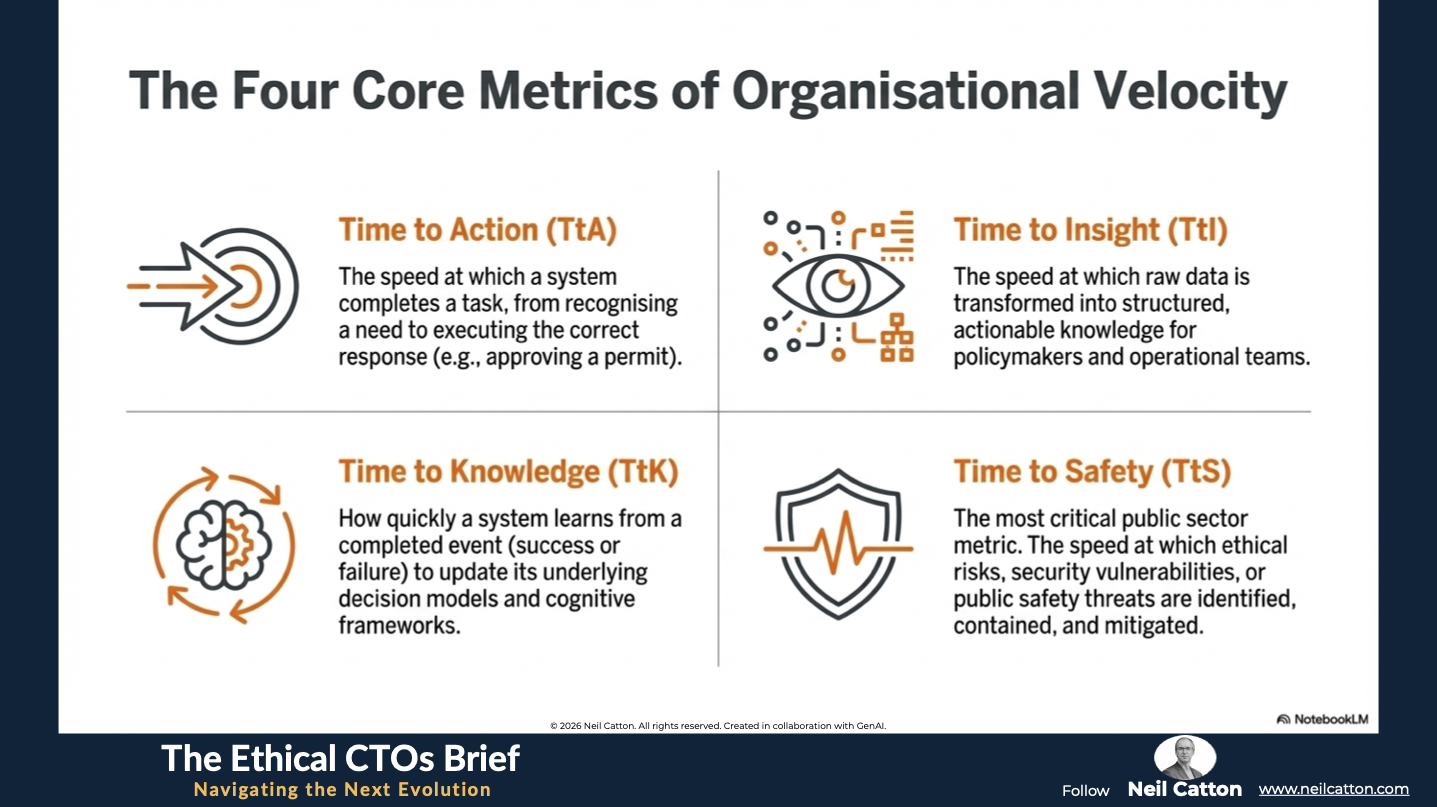
To address this challenge, a Time-Based Architecture (TBA) is essential. While TBA isn’t a specific technology stack, it’s a strategic design philosophy. It requires all business processes, data pipelines, and critical decision points to be engineered for near-instantaneous speed, mirroring real-world events. Institutional success is defined by four interconnected temporal metrics.
- Time to Action (TtA): This measures how quickly a system completes a task. For instance, it tracks the time between recognising a need for intervention and the system sending the right response or approving a permit.
- Time to Insight (TtI): This is the speed at which vast amounts of raw data are transformed into meaningful structured and actionable knowledge that policymakers and operations teams can utilise immediately.
- Time to Knowledge (TtK): This metric measures how quickly a system learns from a completed event, whether it was a success or a failure. It then updates its underlying decision models and cognitive frameworks.
- Time to Safety (TtS): The most important metric for the public sector is measuring how quickly ethical risks, security vulnerabilities, or public safety threats are identified, contained and mitigated.
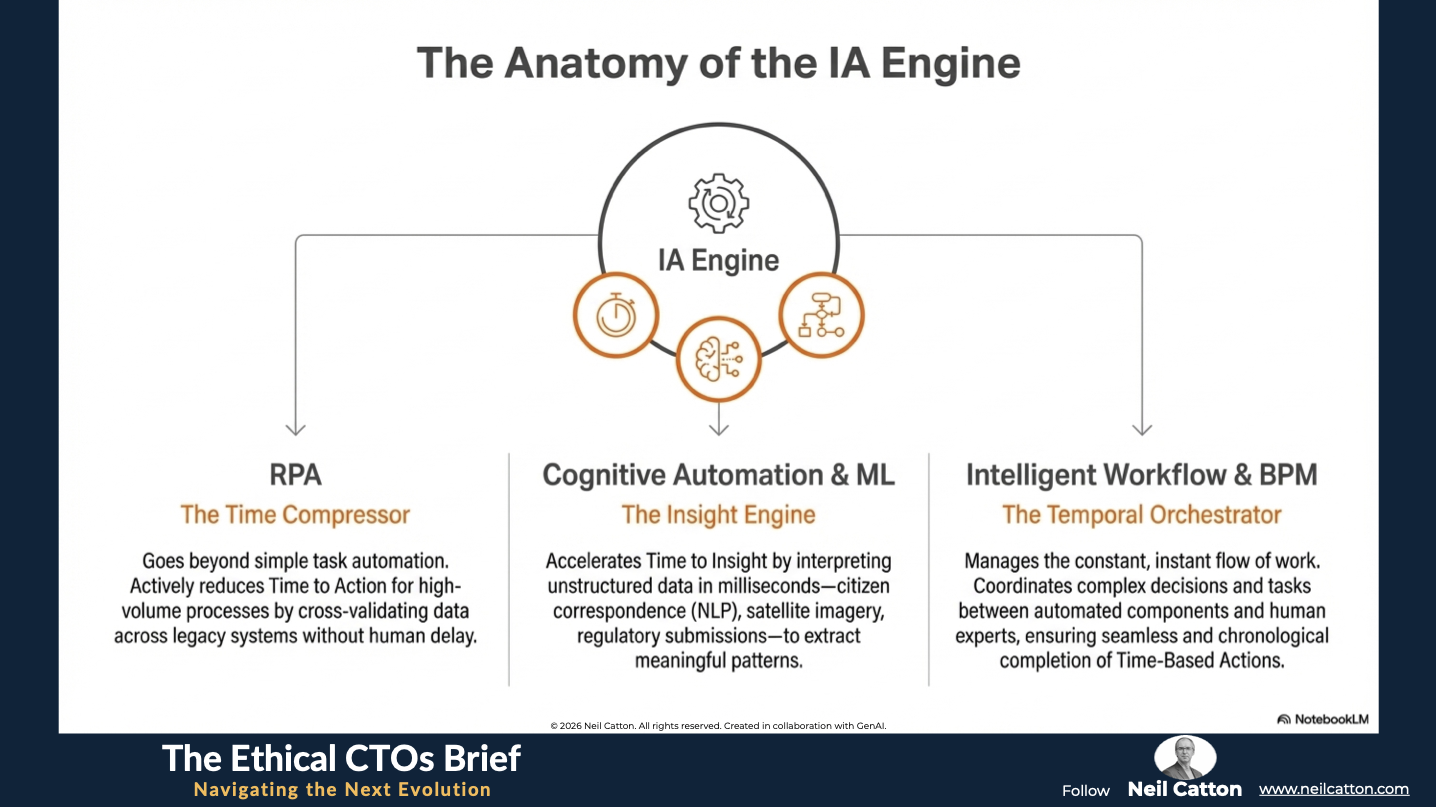
- RPA (The Time Compressor): RPA goes beyond automating simple desktop tasks. It actively reduces the time to action for high-volume repetitive administrative processes, instantly cross-validating data across various legacy systems without human intervention delays.
- Cognitive Automation & ML (The Insight Engine): CA and ML move past generic data processing to become the core engine for accelerating Time to Insight. By instantly interpreting unstructured data - including citizen correspondence (NLP), satellite imagery, and complex regulatory submissions - IA extracts meaningful patterns in milliseconds to inform policy and triage service delivery.
- Intelligent Workflow and BPM (The Temporal Orchestrator): These platforms are crucial for managing the constant, instant flow of work. They coordinate complex decisions and tasks between automated components and essential human expert reviews. This seamless and chronological completion of Time-Based Actions is ensured.
Intelligent Automation is the essential mechanism for achieving and maintaining these temporal goals. It dramatically shifts the focus of efficiency from human-centric to machine-driven.

The Ethical Imperative: IA and the Instantaneous Ethics Gate
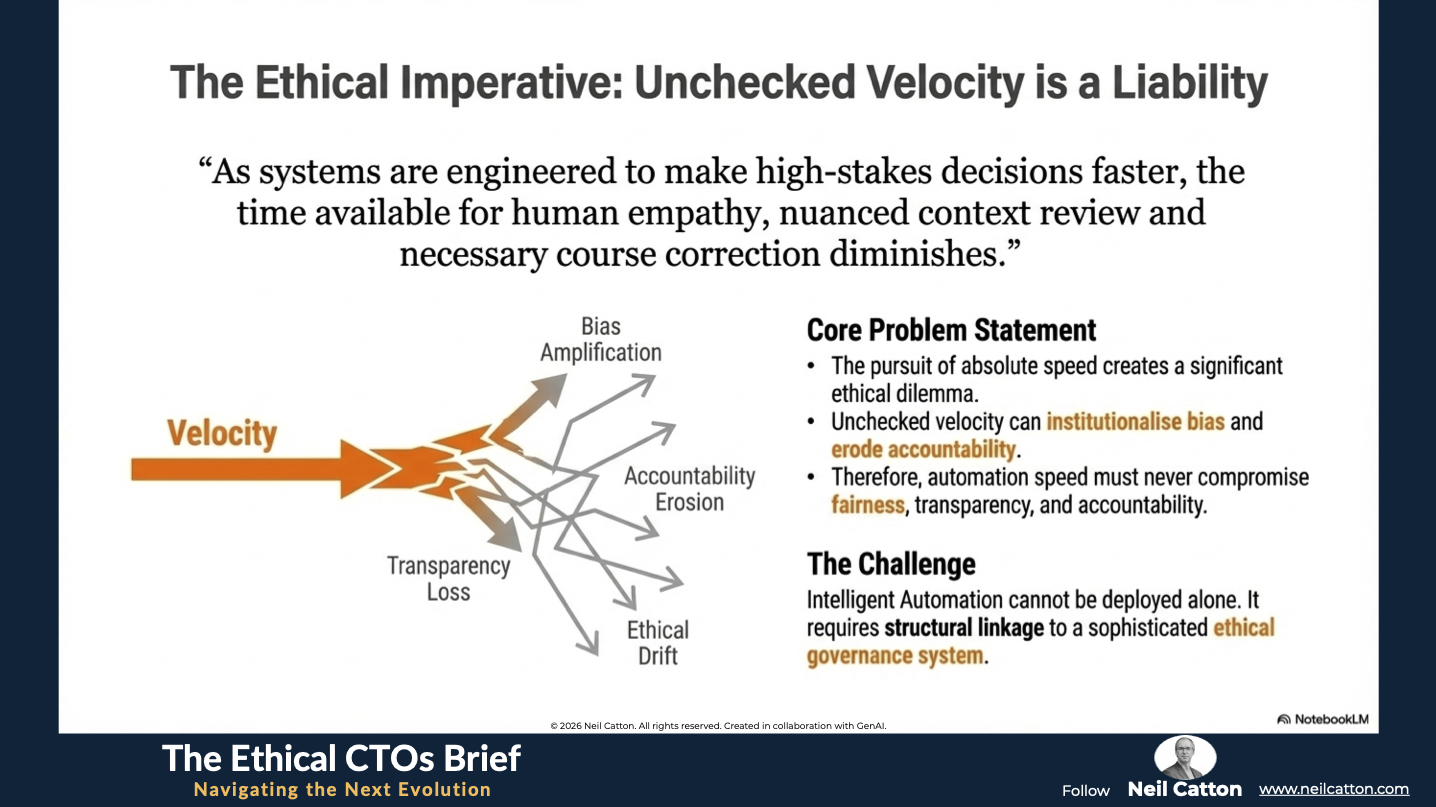
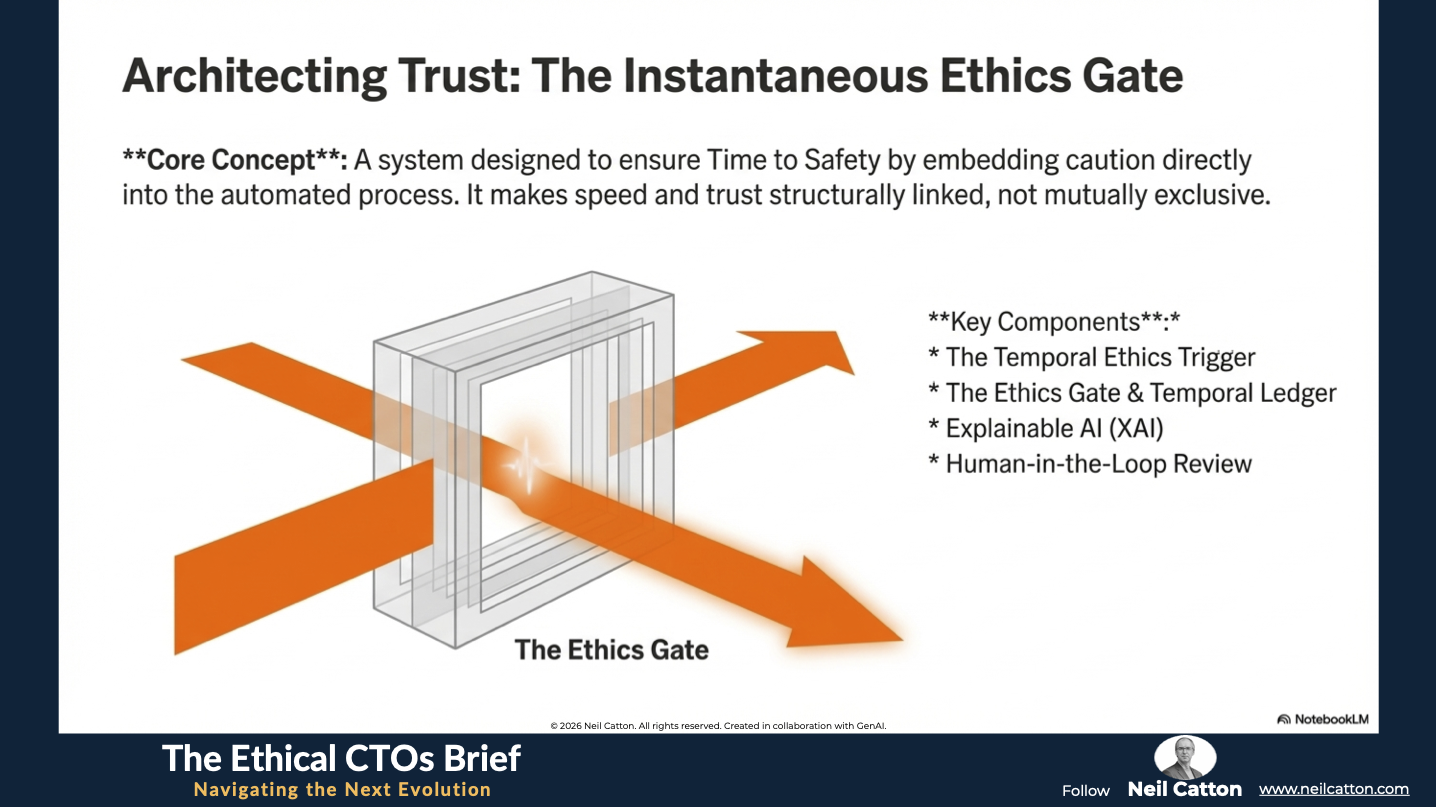
The pursuit of absolute speed creates a significant ethical dilemma. As systems are engineered to make high-stakes decisions faster, the time available for human empathy, nuanced context review and necessary course correction diminishes. This unchecked velocity can institutionalise bias and erode accountability. Intelligent Automation can’t be deployed alone; it needs to be structurally linked to a sophisticated ethical governance system. Automation speed must never compromise fundamental principles like fairness, transparency, and accountability. To achieve this we introduce two key components: the Temporal Ethics Trigger and the Ethics Gate.
The Temporal Ethics Trigger
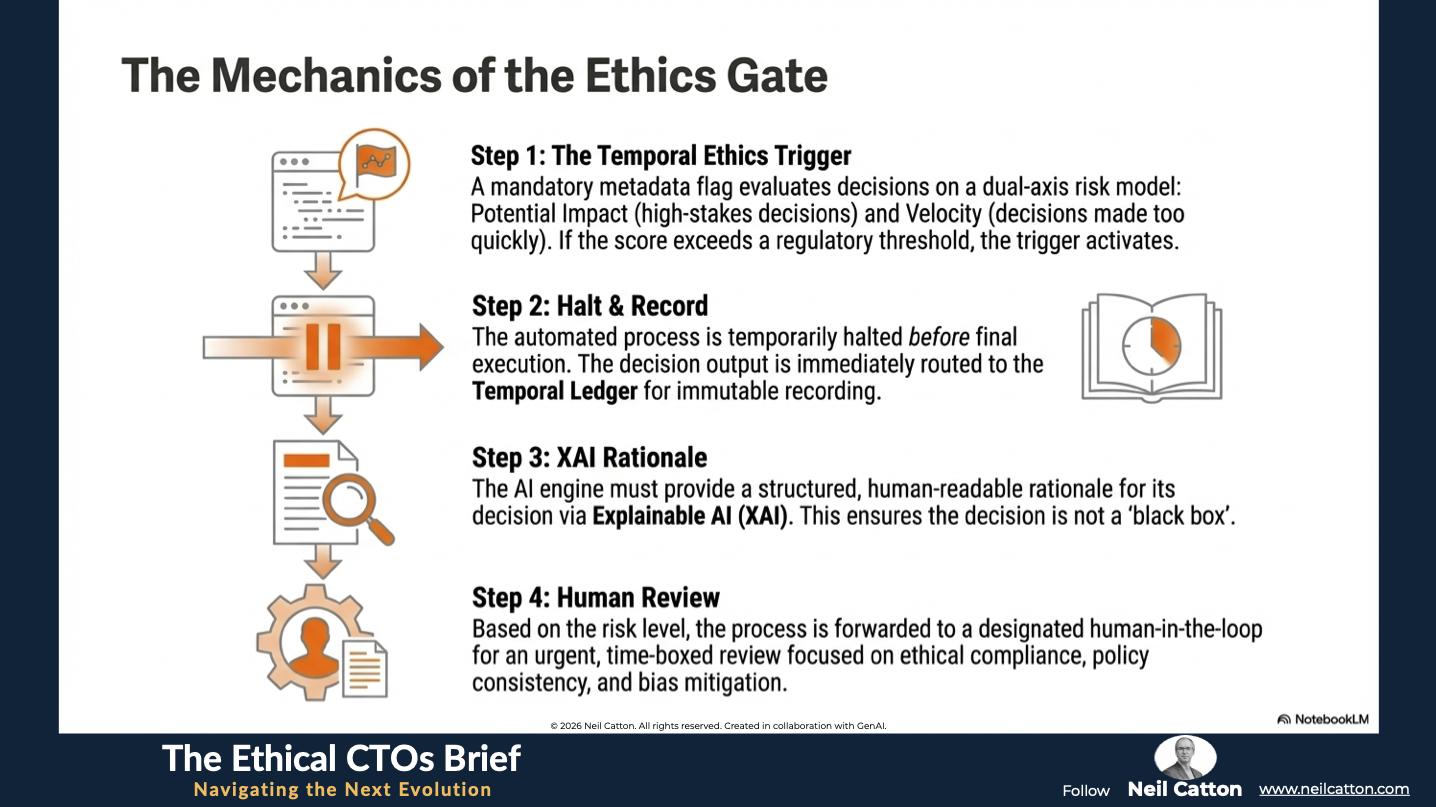
The trigger is a mandatory, hard-coded metadata flag embedded deep within the IA execution workflow. It evaluates decisions using a dual-axis risk model: potential impact and velocity. Impact considers high-stakes decisions like financial aid eligibility or intervention, while velocity looks at exceptionally quick decisions suggesting insufficient data diversity or inadequate contextual checks. When the combined score surpasses a pre-defined regulatorily mandated threshold, the trigger activates instantly.
The Ethics Gate and Explainable AI (XAI): Ensuring Time to Safety
When the Temporal Ethics Trigger activates, the automated process is temporarily halted just before final execution. The decision output is then immediately routed to the mandatory auditing mechanism, the Temporal Ledger, for immutable recording. Crucially, Explainable AI (XAI) becomes central here. The AI engine must provide a structured and human-readable rationale, or explanation, for its decision alongside the raw output. This XAI layer ensures the decision isn’t a ‘black box’ output but an understandable input for the auditor.
Based on the trigger’s level of risk, the process is forwarded to a designated human-in-the-loop for urgent review. This review is auditable and time-boxed to maintain speed while focusing solely on ethical compliance policy, consistency, and bias mitigation. The XAI rationale serves as the primary guide. This structured process ensures human oversight is strategically applied only to the highest-risk decisions. This embedded architecture guarantees that the system is technically compliant and inherently ethically aware. It translates operational speed into tangible Time to Safety by embedding caution directly into the automated process.
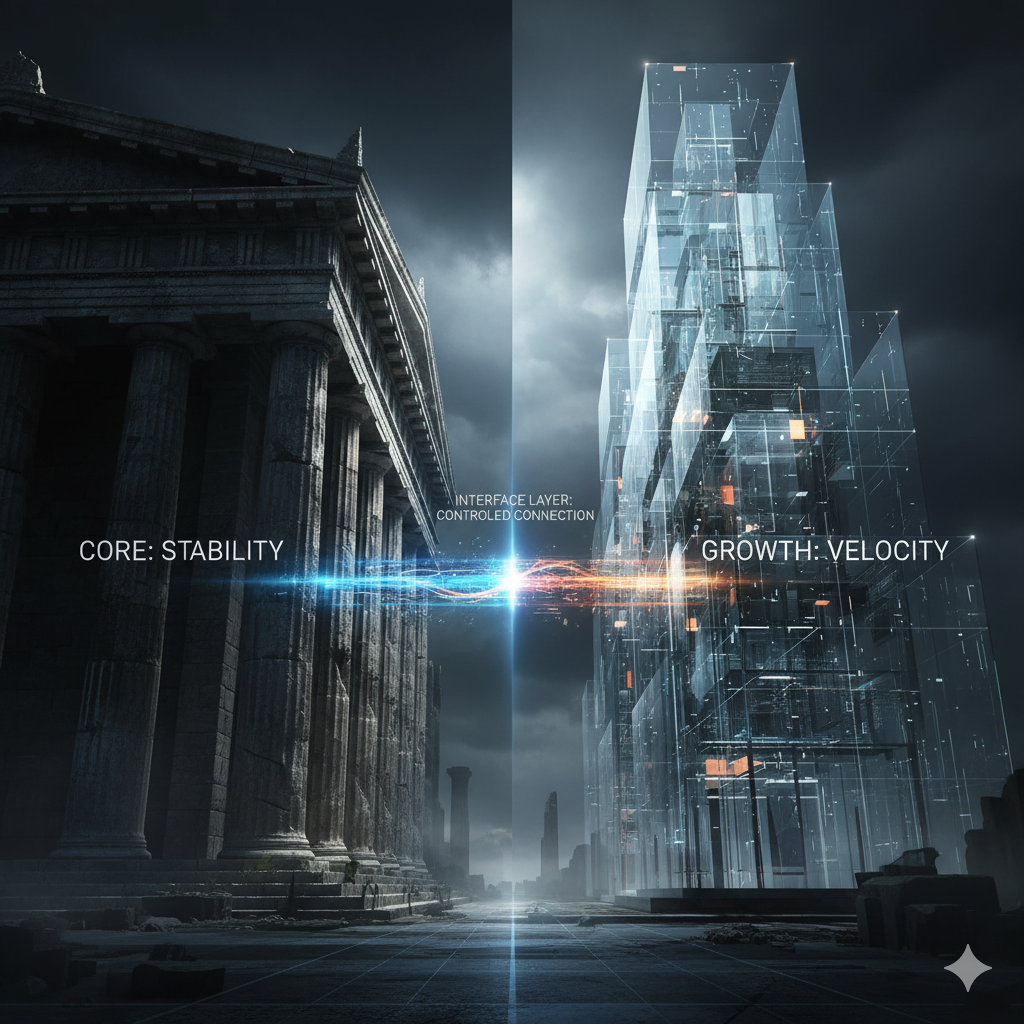
Closing the Loop: From Ambient Data to Human Interaction
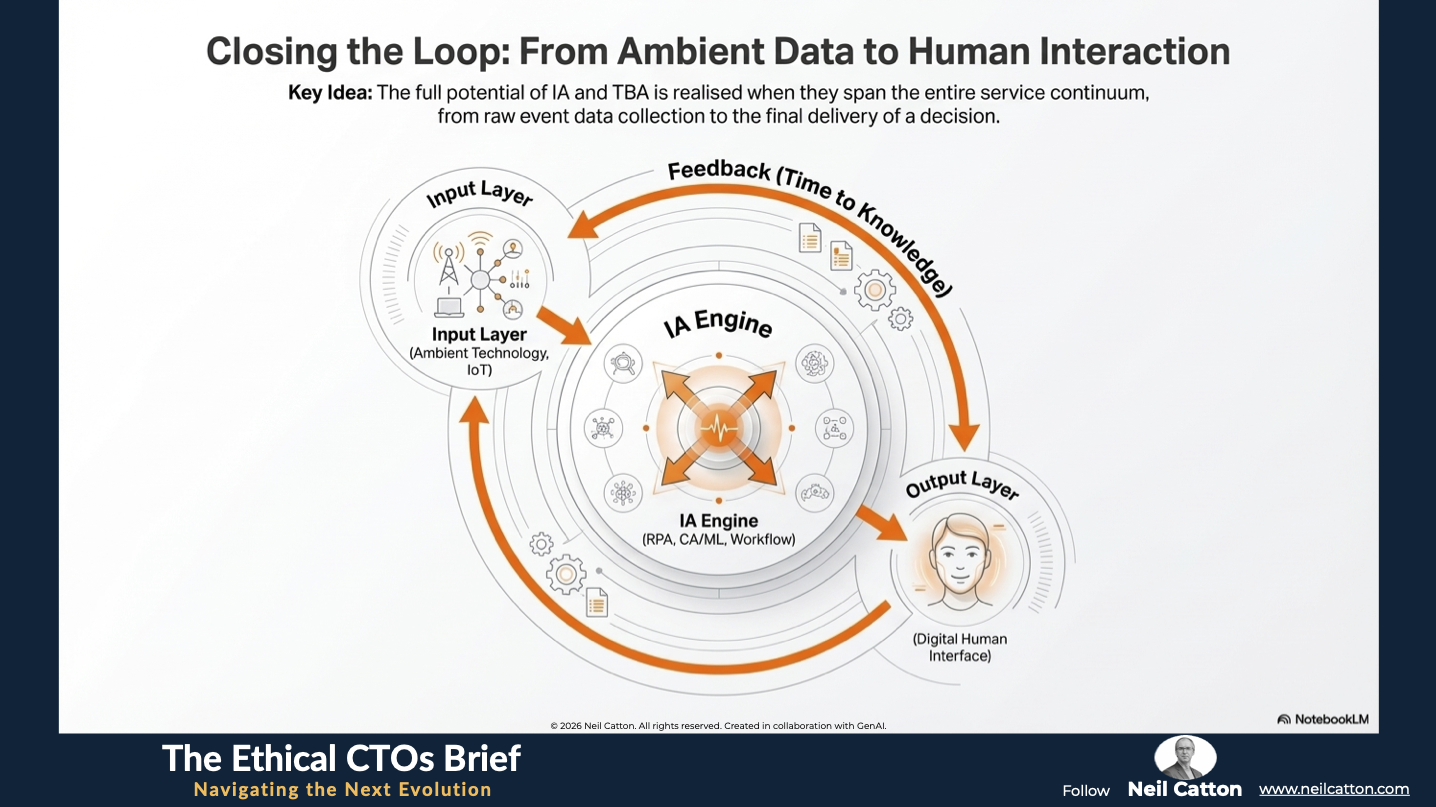
The true potential of Intelligent Automation and Time-Based Architecture is realised when they span the entire service continuum. This includes the initial collection of raw event data and the final delivery of a decision to the citizen. This seamless integration closes the loop and achieves the vision of the Time-Zero Organisation.
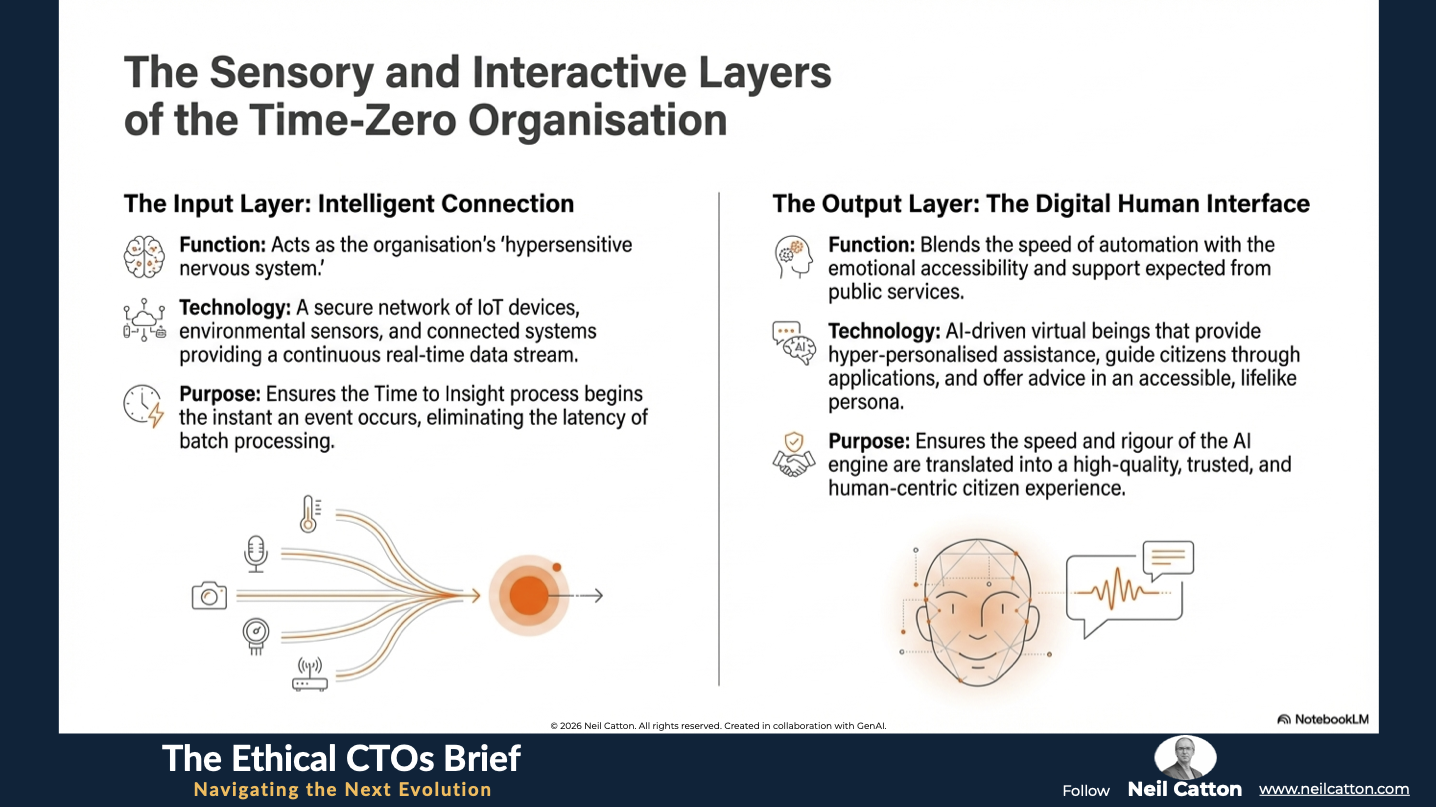
The Input Layer: Intelligent Connection and the Internet of Things
The Time-Zero Organisation relies on Ambient Technology and Intelligent Connection to precisely capture data “in the moment” it’s generated. This input layer comprises a vast and secure network of IoT devices, environmental sensors within smart city infrastructure, and connected systems all providing the continuous real-time data stream the IA Engine consumes. Without this instantaneous flow of event-driven input, AI is limited to the latency of batch processing legacy data severely hindering the organisation’s Time-Based objectives. The Intelligent Connection network functions as the organisation’s hypersensitive nervous system ensuring the Time to Insight process begins the very instant an event occurs rather than hours or days later.
The Output Layer: The Digital Human Interface
After Intelligent Automation processes a complex real-time query, applies necessary policy logic, and passes the Ethics Gate’s rigorous checks, the resulting decision or guidance must be delivered instantly and with profound personalisation to the citizen. This is the role of Digital Humans – AI-driven virtual beings representing the next evolution in citizen interaction. They successfully blend the speed of automation with the emotional accessibility and support expected from public services. These interfaces offer hyper-personalised assistance, guide citizens through complex applications, and provide immediate advice in an accessible lifelike persona.
This final output layer is crucial. It ensures the immense speed and ethical rigour of AI are ultimately translated into a high-quality trusted and human-centric citizen experience. This keeps the essential “human element” at the heart of public service delivery.
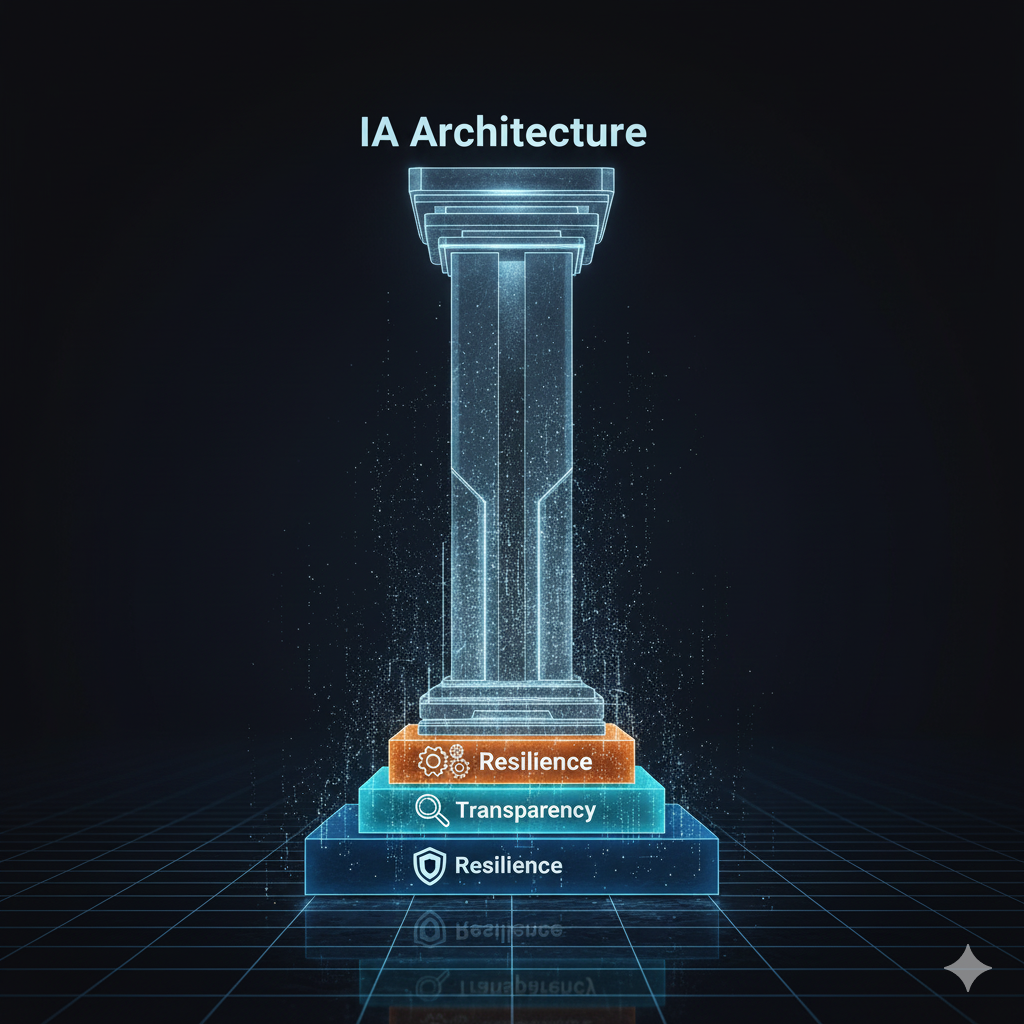
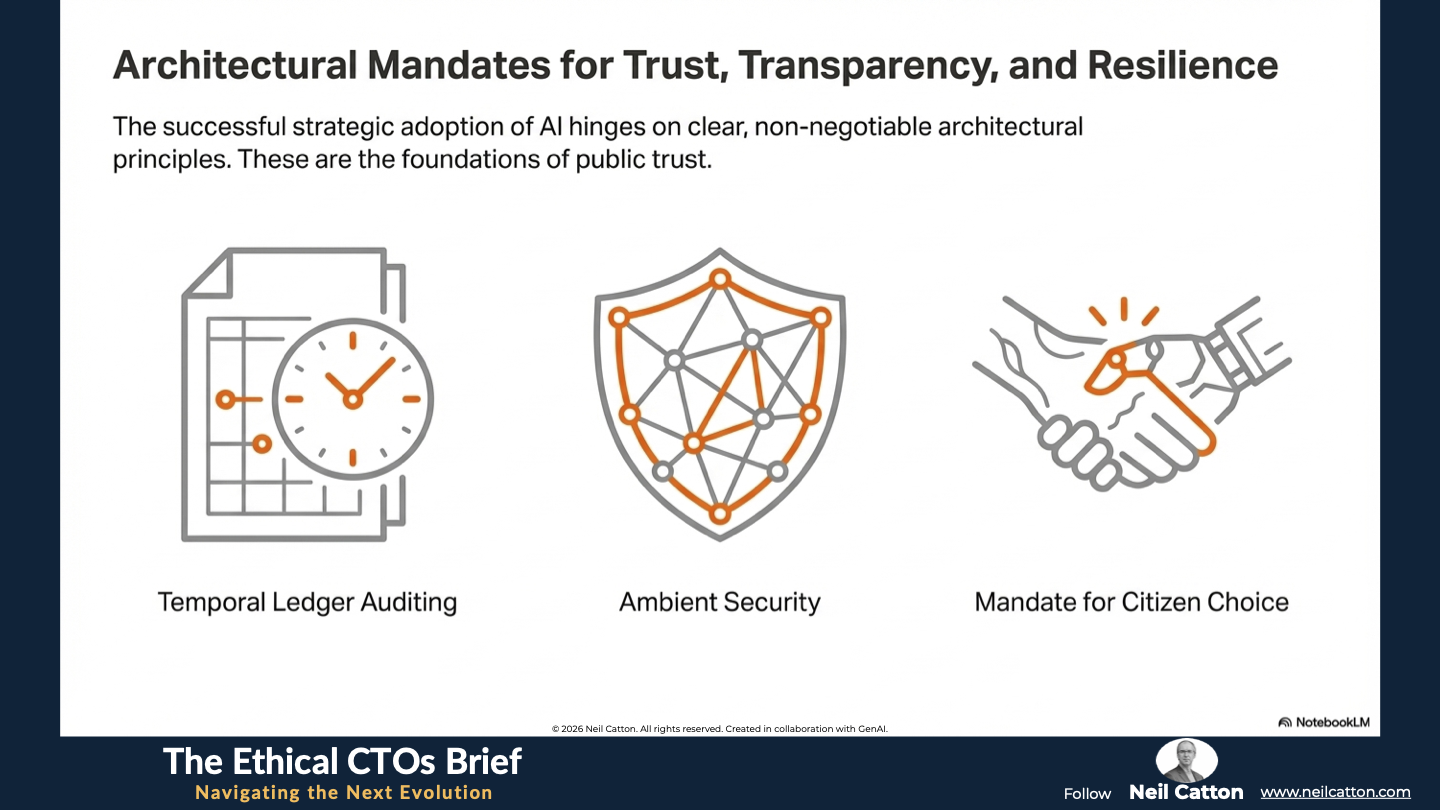
Architectural Mandates for Trust, Transparency, and Resilience
The successful strategic adoption of AI hinges on clear architectural mandates. These non-negotiable principles collectively uphold public trust, ensure operational transparency and guarantee systemic resilience.
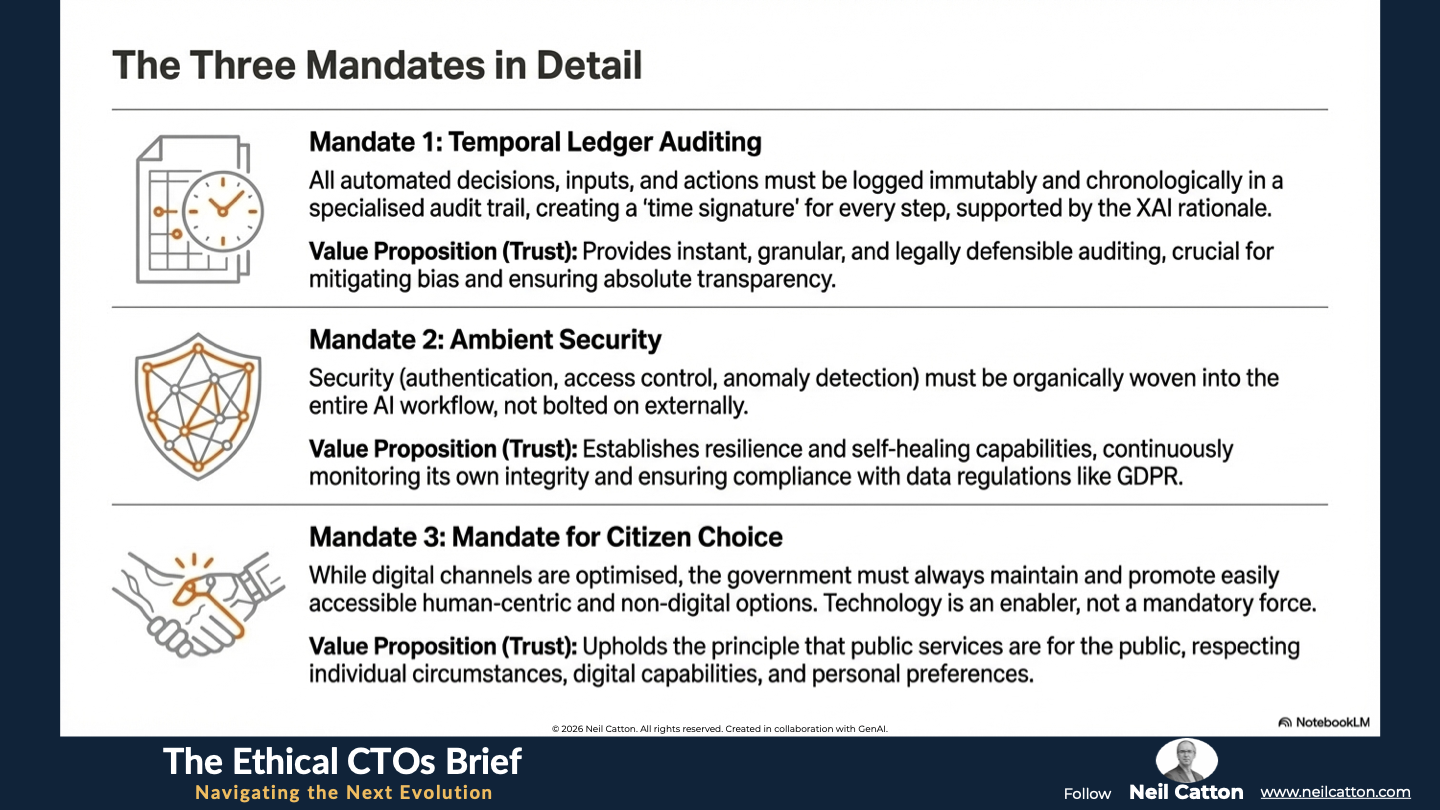
| Mandate | Description | Value Proposition (Trust) |
Temporal Ledger Auditing | Automated decisions, inputs and the critical path of actions must be logged immutably and chronologically in a specialised audit trail. This creates a precise “time signature” for every step executed by the bot, algorithm, or human operator fully supported by the XAI rationale. | This system provides instant granular and legally defensible post-decision auditing, crucial for mitigating systemic bias and ensuring absolute transparency in high-stakes public decisions. |
Ambient Security | Security, encompassing authentication, access control and continuous anomaly detection, must be organically woven into the entire AI workflow rather than being an external bolted-on mechanism. This is crucial given the sensitive citizen data processed through multiple automation layers. | This architecture establishes resilience and self-healing, continuously monitoring its integrity. It ensures strict compliance with public sector data regulations like GDPR and UK-specific mandates. |
Mandate for Citizen Choice | While Intelligent Connection and Digital Humans are deployed to optimise and speed up digital service channels, the government must always keep, maintain and promote easily accessible human-centric and non-digital options. Technology is a powerful enabler, not an arbitrary or mandatory force. | It upholds the fundamental principle that public services are for the public. This means respecting individual circumstances digital capabilities and personal preferences rather than imposing a one-size-fits-all digital-only service model. |
A Final Word
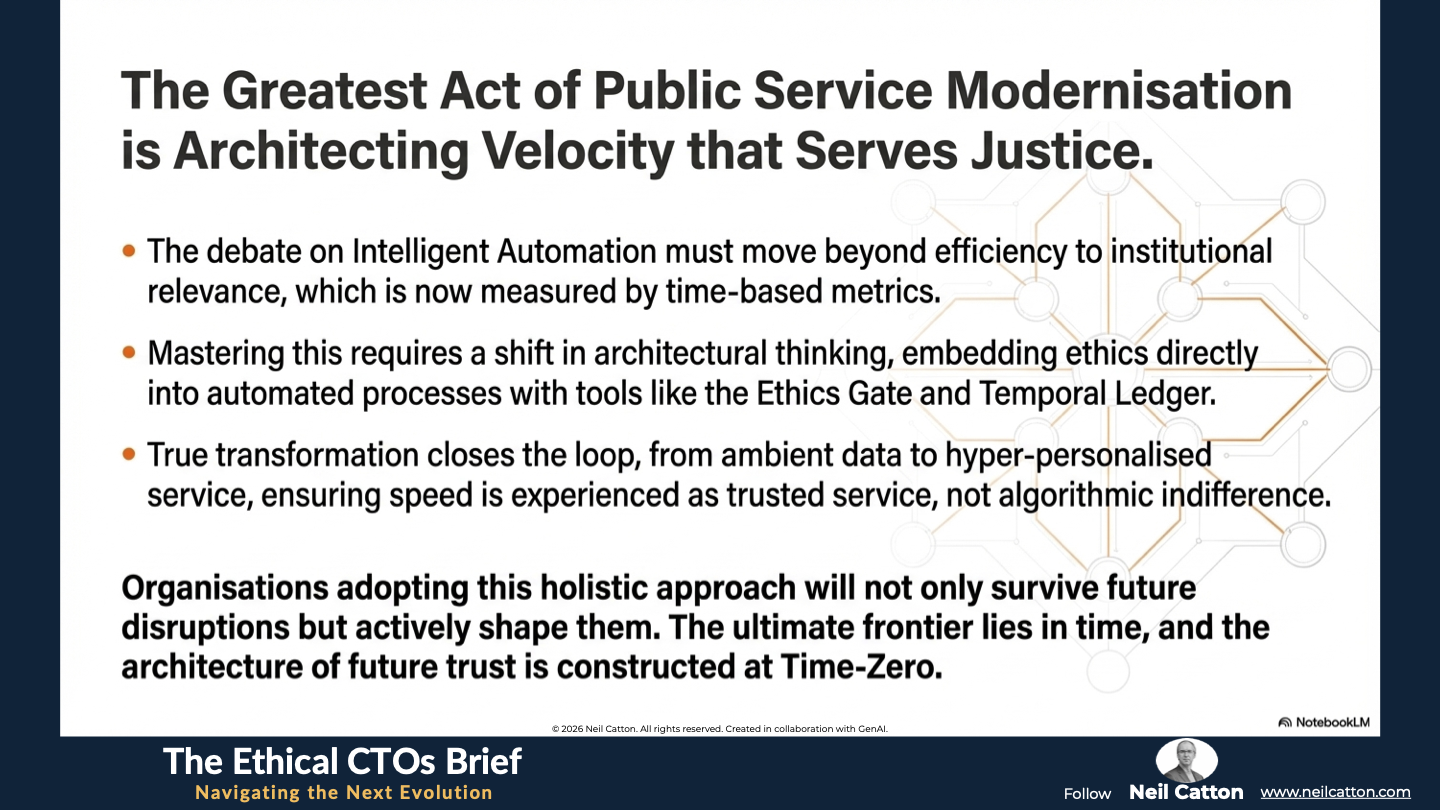
The debate about Intelligent Automation needs to move beyond simple ideas of efficiency and cost savings. It’s not just a tool for cutting departmental budgets; it’s the crucial computational force behind a fundamental shift – the move to the Time-Zero Organisation. This change stems from a realisation that institutional relevance is now measured by time-based metrics: the speed of action, the velocity of insight and the guarantee of safety.
Mastering this transition goes beyond simply investing in technology; it demands a shift in architectural thinking. We need to design systems like Time-Based Architecture that integrate ethical checks directly into automated decision-making. The Ethics Gate, powered by Explainable AI (XAI), and the Temporal Ledger are essential foundations ensuring speed and trust aren’t mutually exclusive but structurally linked. They provide the accountability and auditability needed to protect citizens while maintaining the operational speed required in a hyper-real-time world.
True transformation is achieved by closing the service loop completely. This involves collecting ambient data through Intelligent Connection and delivering hyper-personalised, instantaneous service via Digital Humans. This full-stack approach ensures the speed of the AI engine is experienced as instant transparent and trusted service rather than cold algorithmic indifference. The greatest act of public service modernisation is architecting velocity that serves justice.
Organisations adopting this holistic approach – viewing Intelligent Automation as the driving force behind a time-aware ethically governed architecture – will not only survive future disruptions but actively shape them. The ultimate frontier lies in time and the architecture of future trust is constructed at Time-Zero.
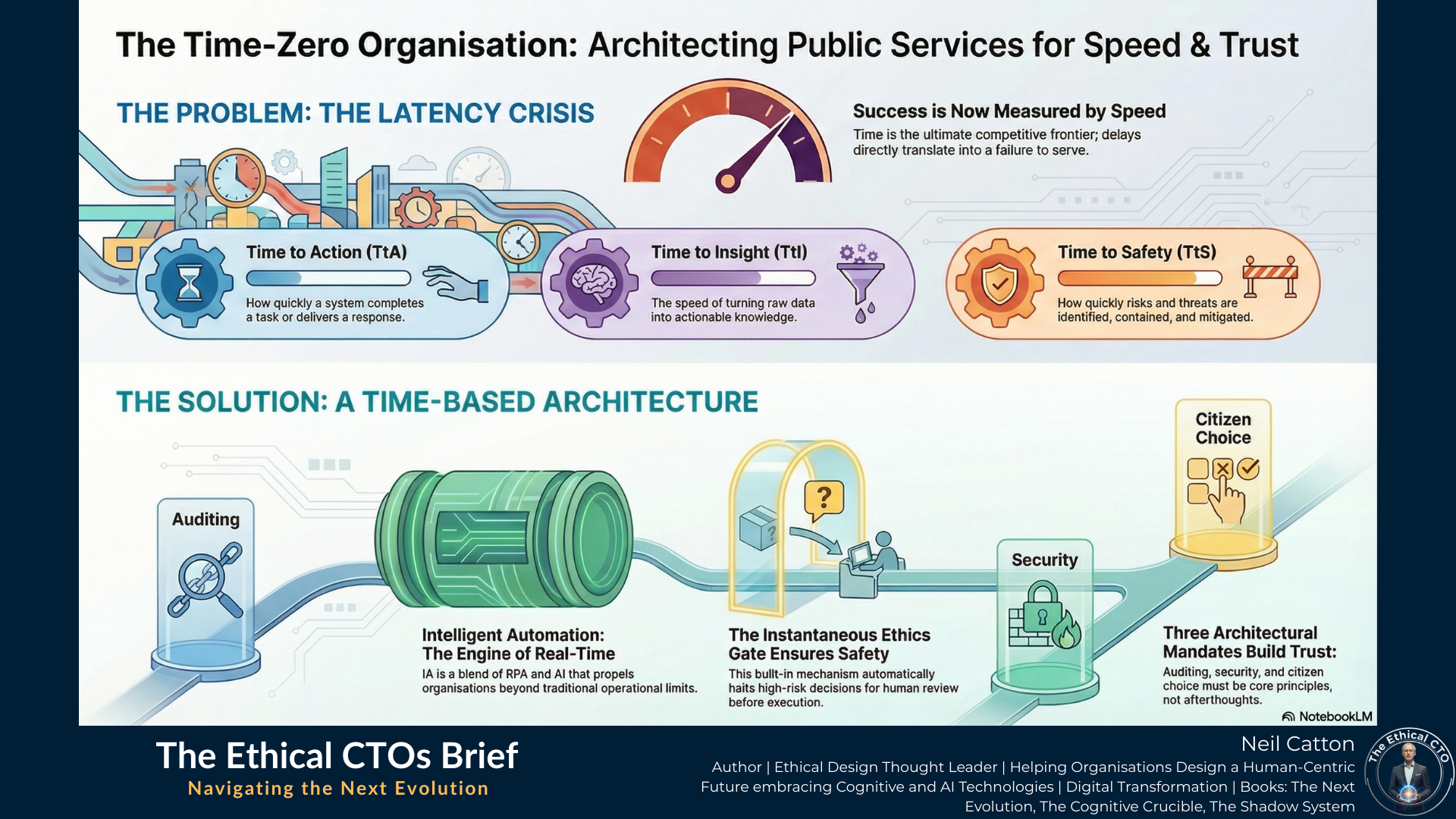
Key Takeaways: Architecting the Time-Zero Organisation
Beyond Efficiency: Success in 2026 is measured by the collapse of latency—the gap between a human need and a system's response.
Temporal Metrics: Shifting focus to Time to Action (TtA), Time to Insight (TtI), and the mission-critical Time to Safety (TtS).
The IA Engine: Intelligent Automation isn't just a cost-saver; it is the structural necessity for event-driven governance.
Real-Time Ethics: Speed must never compromise fairness; the Ethics Gate ensures high-velocity decisions remain accountable.
1
2
3
4
5
6
7
8
9
10
11
12
13
14
15
Strategic Insights: Building Time Based Architecture
TBA Strategy: A design philosophy where data pipelines and decision points are engineered for near-instantaneous execution.
The Temporal Ethics Trigger: A hard-coded safeguard that halts automated processes when high-risk thresholds are met.
Explainable AI (XAI): Transforming "Black Box" algorithms into human-readable rationales for instant auditing and trust.
Ambient Intelligence: Using IoT and smart infrastructure to start the "Time to Insight" process the exact second an event occurs.
Video Summary: The End of the Waiting Room
Defining Time-Zero: Reaching the threshold where service delivery is predictive, immediate, and ethically secured.
The Temporal Ledger: Maintaining a precise, immutable "Time Signature" for every automated step to ensure legally defensible auditing.
Digital Humans: Blending AI speed with a lifelike interface to deliver hyper-personalized, high-compassion public services.
Architectural Velocity: Modernising the public sector by building systems where velocity serves the cause of justice.
To maintain Time-Zero velocity, we must abandon linear control and embrace a Strategy of Designed Chaos.
The Ethical CTO: Arc 1 Index
- Transformation: Digital Transformation
- Diagnosis: The Legacy Trap
- Efficiency: The Productivity Paradox
- Velocity: The Time-Zero Organisation
- Governance: Strategy of Designed Chaos
- Orchestration: Executive Coherence
- Impact: The Digital Catalyst