Beyond the Checklist:
Addressing the Systemic Illness of Digital Transformation
We’ve been told for a decade that the UK public sector is held back by "legacy systems" and "budget constraints". I don't buy it.
These aren't the root causes of our stagnation; they are the convenient symptoms of a much deeper failure. After years of watching Digital Transformation projects turn into expensive box-ticking exercises, it’s clear that our real "Legacy Debt" isn't sitting in a server room, it’s embedded in our governance and how we value human impact.
In this briefing, I’m moving past the usual transformation jargon to look at why we keep failing the "Citizenship Experience". We’ll explore why the move toward AI-driven symbiosis is no longer optional, and why the "Ethical CTO" must prioritise human agency over mere transactional efficiency.
It is time to stop patching a broken system and start architecting a value-driven one.
From Symptoms to Systemic Illness
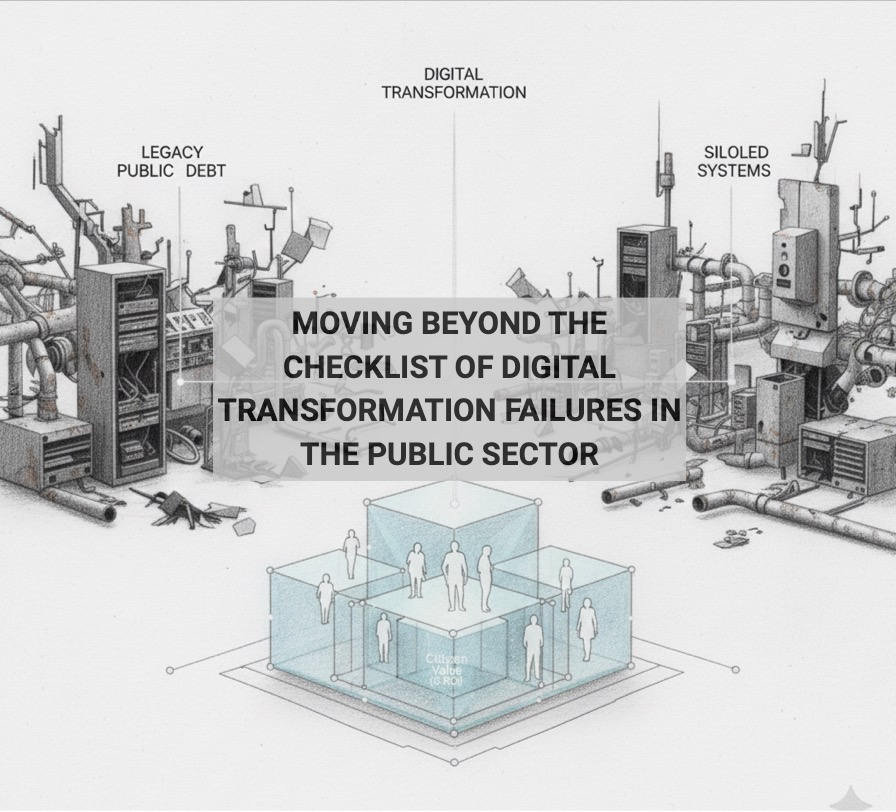
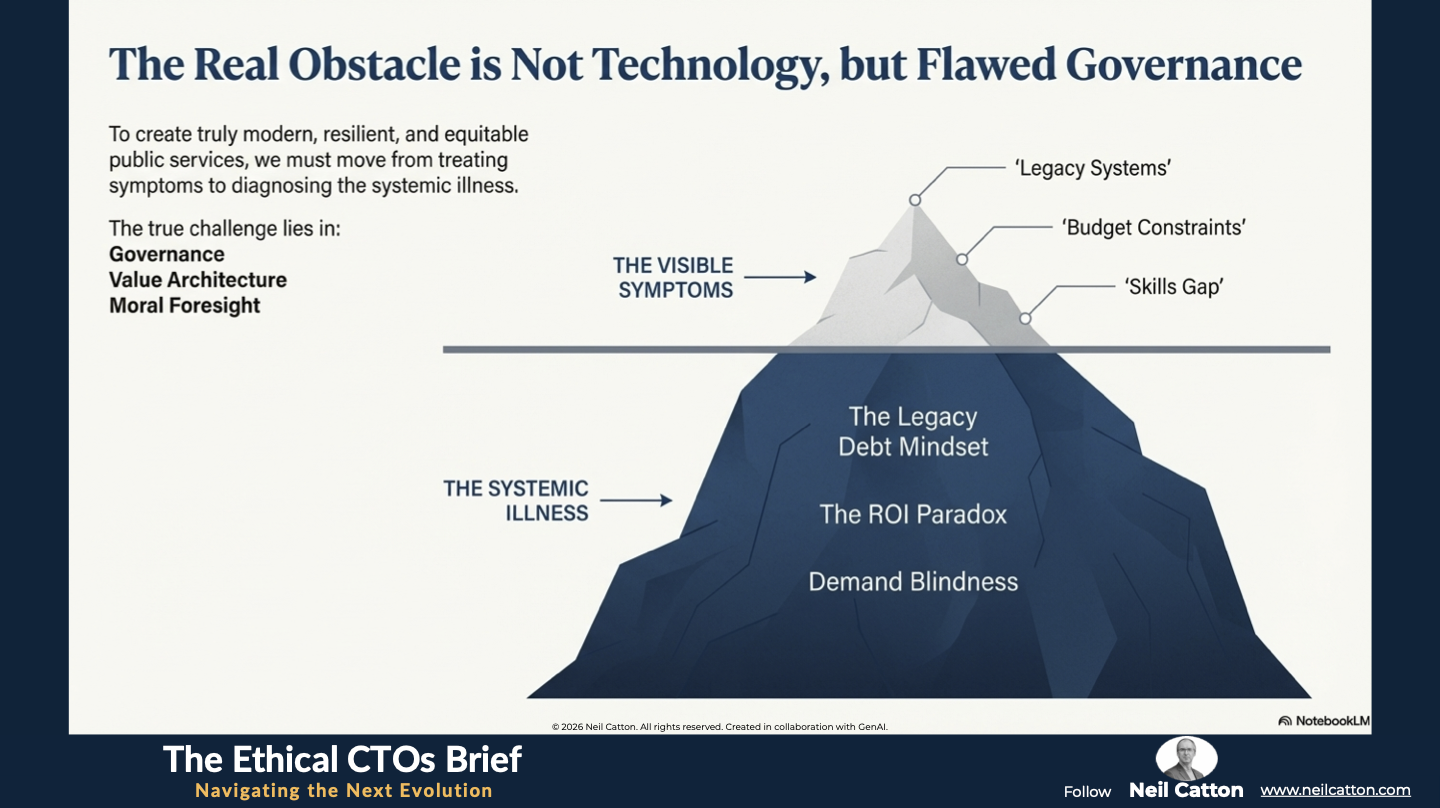
Digital Transformation (DT) is no longer a strategic goal for the UK public sector; it’s a fundamental requirement. It aims to boost efficiency, ensure seamless accessibility and deliver genuinely responsive services in our increasingly digital world. Despite substantial financial investment and numerous government-led reforms over the past decade, the sector remains constrained. The recurring excuses – “legacy systems”, “budget constraints” and the “skills gap” – aren’t the core problems but rather symptoms of a deeper systemic failure in how change is governed funded and valued.
The real obstacle to digital progress isn’t technology itself but a pervasive challenge in governance, value architecture, and moral foresight. To create truly modern resilient and above all equitable public services we must move beyond simply treating symptoms. This article, grounded in systems thinking and moral foresight, diagnoses three strategic failures that perpetuate stagnation and introduces the Next Evolution Mandate. This mandate will guide us in architecting a future where public service is defined by structural integrity and profound citizen value.
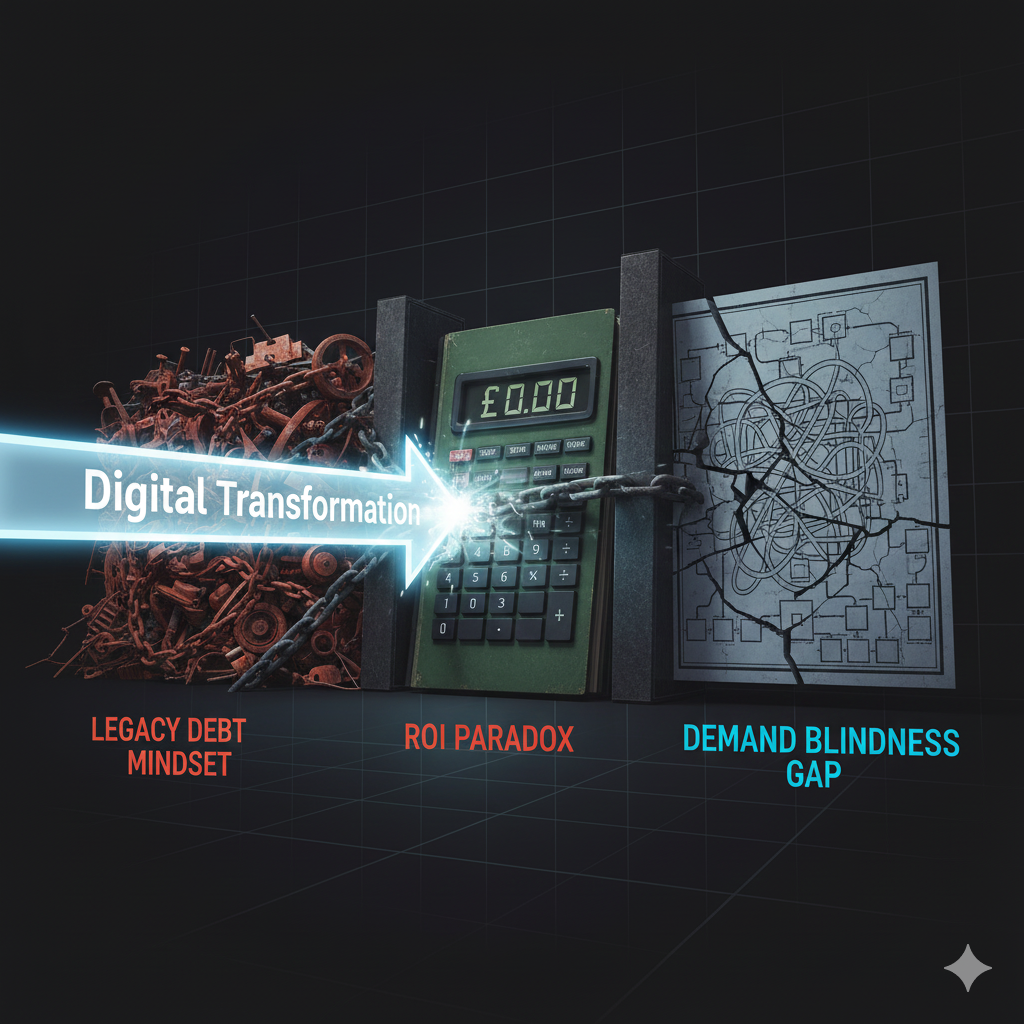
To escape the cycle of incremental change and ongoing stagnation, public sector leadership must shift its focus from operations to critically analysing the deeper flaws within its planning and financial models. The problem isn’t with the tools available but with the outdated governance systems hindering their effective use.
Failure 1: The Legacy Debt Mindset
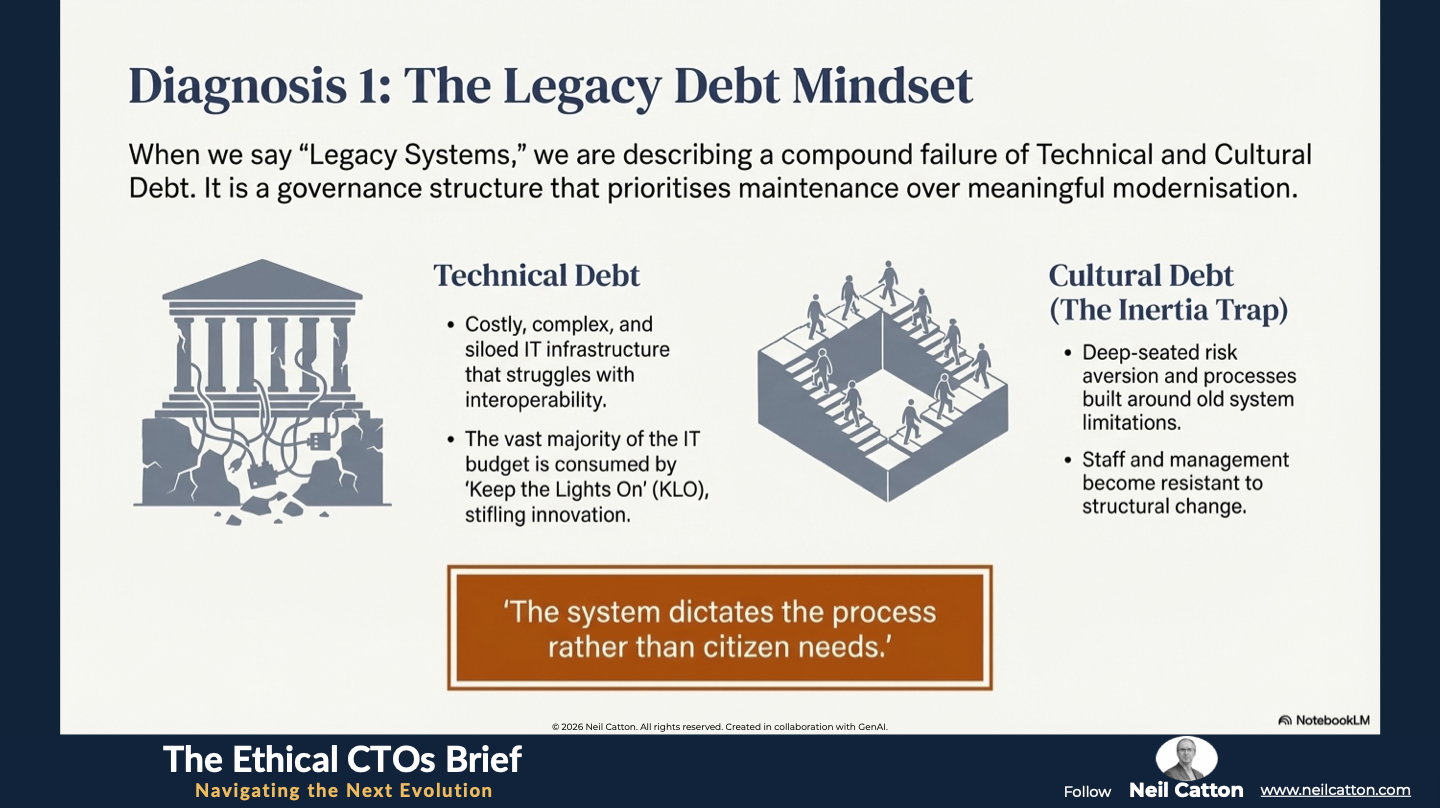
When organisations cite “Legacy Systems” as their main hurdle, they’re describing a complex issue called Technical Debt, compounded by Cultural Debt. This problem goes far beyond outdated COBOL code and clunky interfaces; it’s fundamentally about a governance structure that constantly prioritises maintenance over meaningful modernisation.
The Compound Effect of Debt:
- Technical Debt: The most pressing issue is the costly, complex and deeply siloed IT infrastructure that struggles with basic interoperability. Crucially, this infrastructure consumes the vast majority of the IT budget under the “Keep the Lights On” (KLO) banner. This stifles innovation and leaves little capital or appetite for transformative investment.
- Cultural Debt (The Inertia Trap): This is the invisible and more damaging layer. It’s the deep-seated risk aversion and entrenched departmental processes built around the old system’s limitations. These processes become the ‘standard operating procedure’ making staff and management resistant to structural change even when the technology is clearly inadequate. The system dictates the process rather than citizen needs.
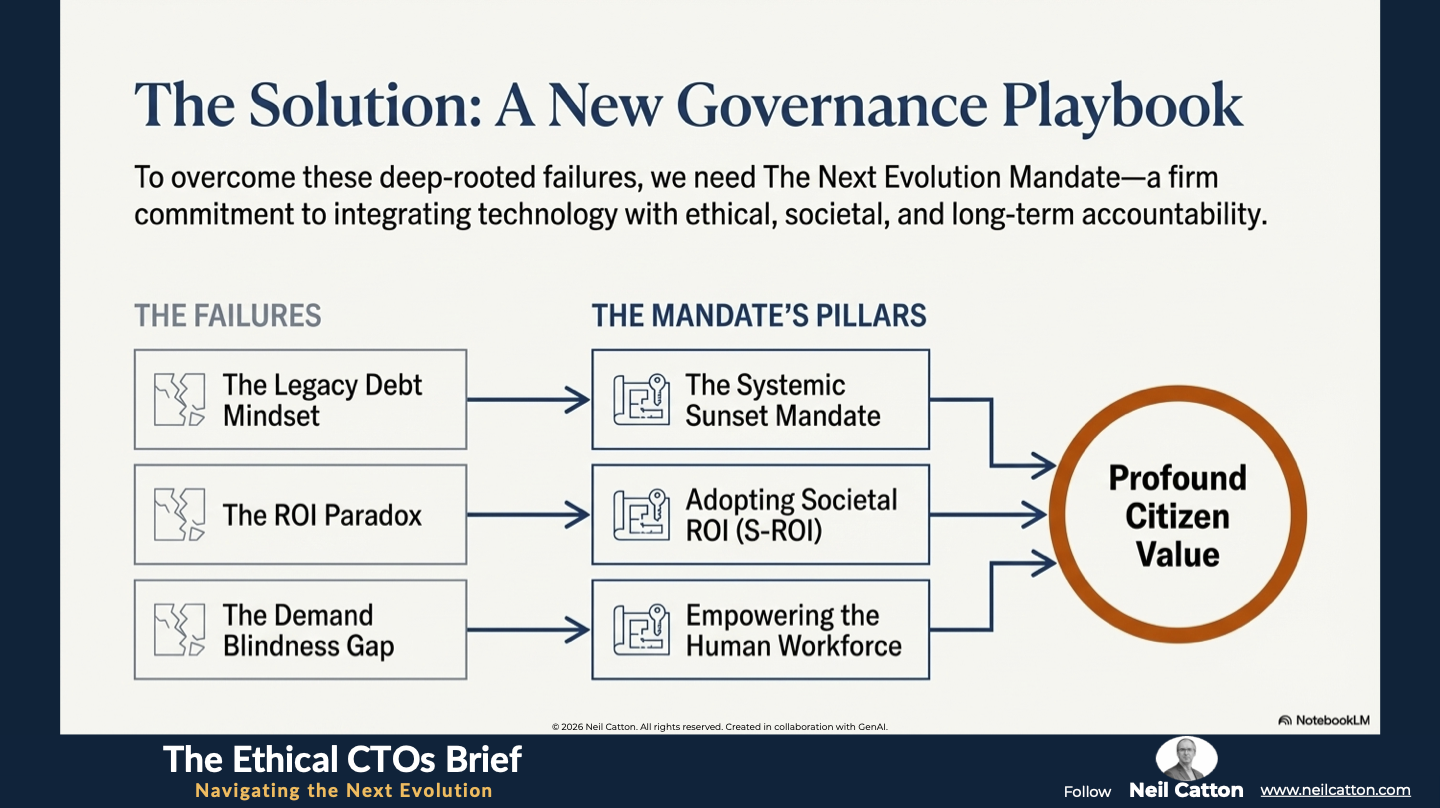
The Systemic Sunset Mandate: The Legacy Debt Mindset flourishes because there’s no systemic or moral impetus to dismantle an ageing system simply because its value to citizens is declining. It only faces scrutiny when technically unstable. A stable system consistently delivering poor, complicated, or inequitable experiences demonstrates a profound failure of foresight. To address this, governance must mandate a Systemic Sunset Mandate. This policy should directly link the end of any service component to measurable degradation in citizen experience, high costs of ownership, and an ethical inability to incorporate modern inclusive capabilities. This crucial shift compels planning teams to accurately assess the true systemic cost of inertia.
Failure 2: The ROI Paradox
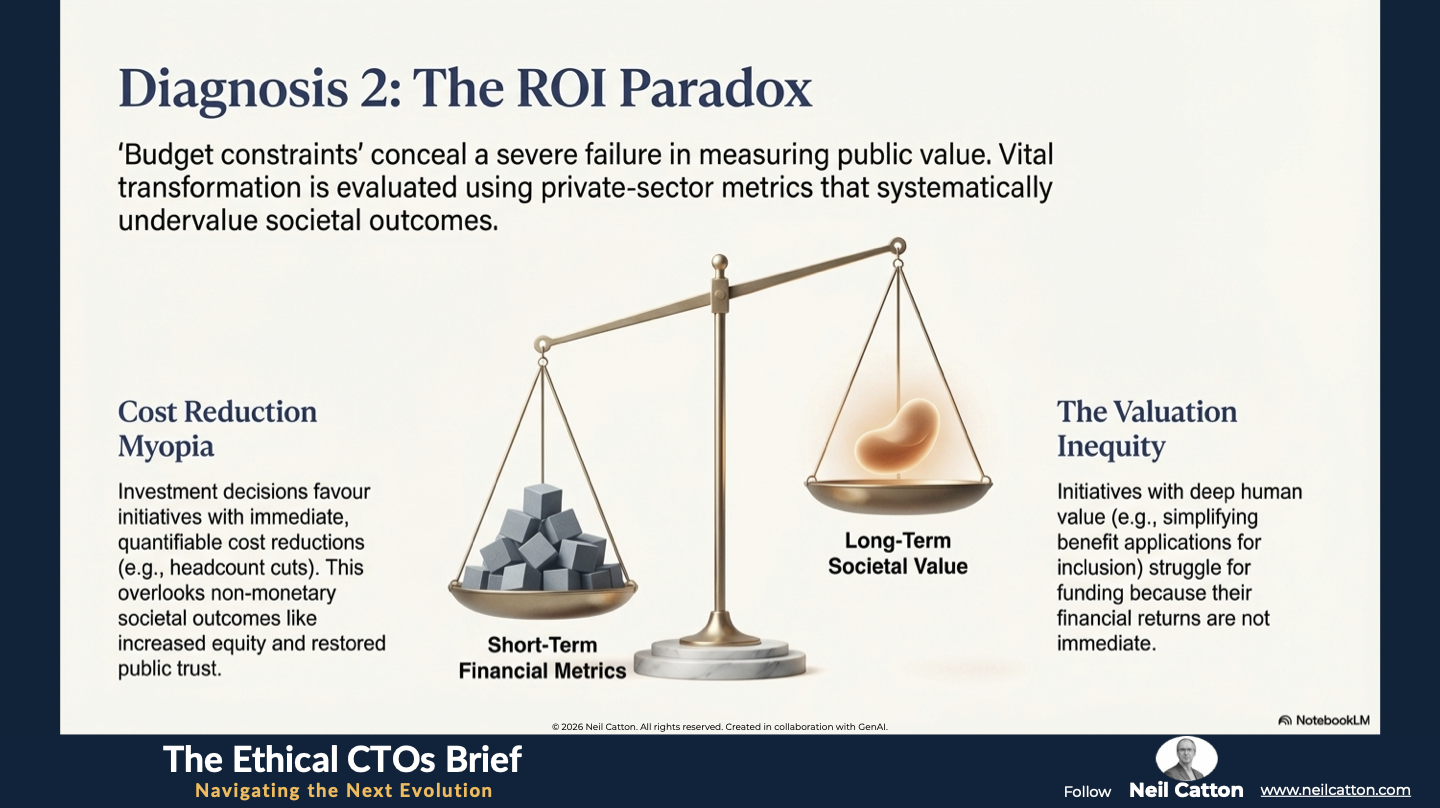
The widespread complaint of “budget constraints” often conceals a deeper problem: a severe failure in measuring public value. The public sector is fundamentally constrained by the ROI Paradox. Vital structural transformation is almost exclusively evaluated using traditional private-sector financial metrics.
The Constraint of Short-Term Financial Metrics:
- Cost Reduction Myopia: Investment decisions, especially those swayed by short-term political cycles, overwhelmingly favour initiatives promising immediate quantifiable cost reductions like headcount cuts through basic automation and compliance assurance. This approach systematically overlooks the non-monetary societal outcomes that truly define public service success such as increased social equity and restored public trust.
- The Valuation Inequity: Initiatives that prioritise deep human and societal value, such as a multi-agency project simplifying complex benefit applications to boost inclusion, or a trauma-informed digital pathway, face fierce competition for funding. Their immediate or financial returns aren’t evident, leading to systemic under-investment in human-first design.
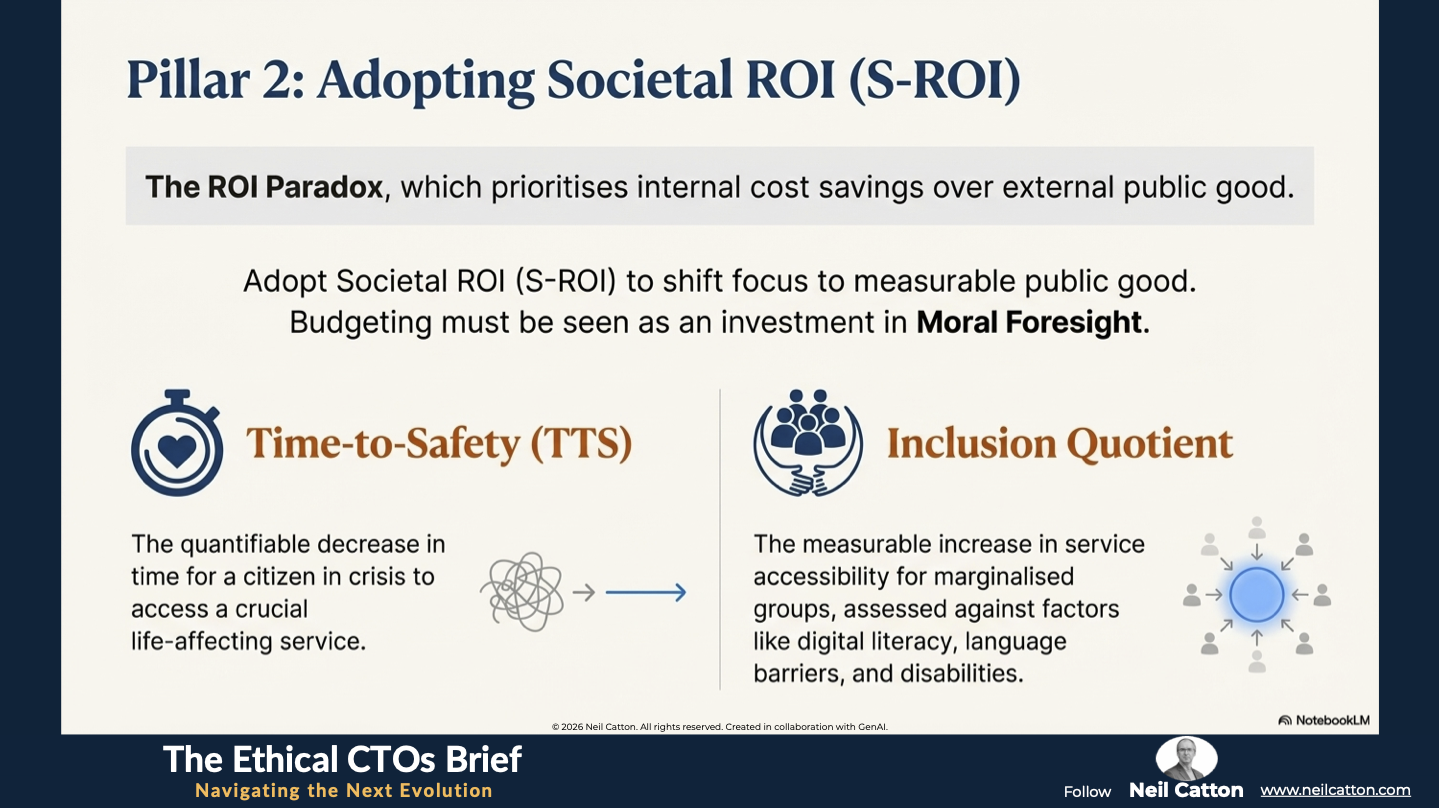
- Time-to-Safety (TTS): The quantifiable decrease in time for a citizen ,especially vulnerable or facing a crisis, to access a crucial life-affecting public service like housing support or mental health referrals.
- Inclusion Quotient: The measurable increase in service accessibility for marginalised and vulnerable groups is assessed effectively against factors like digital literacy, language barriers and physical or cognitive disabilities.
- Time-to-Safety (TTS): The quantifiable decrease in time for a citizen ,especially vulnerable or facing a crisis, to access a crucial life-affecting public service like housing support or mental health referrals.
- Inclusion Quotient: The measurable increase in service accessibility for marginalised and vulnerable groups is assessed effectively against factors like digital literacy, language barriers and physical or cognitive disabilities.
Introducing Societal ROI (S-ROI): To resolve this paradox, the sector urgently needs to adopt Societal ROI (S-ROI) as its primary measure for transformation success. This shift of focus from internal cost savings to external, measurable public good is crucial. Budgeting should be seen as an investment in Moral Foresight. If digital design leads to exclusion or delays citizen access, the budget was wasted regardless of any apparent efficiency gains. Key S-ROI metrics include:
Failure 3: The Demand Blindness Gap
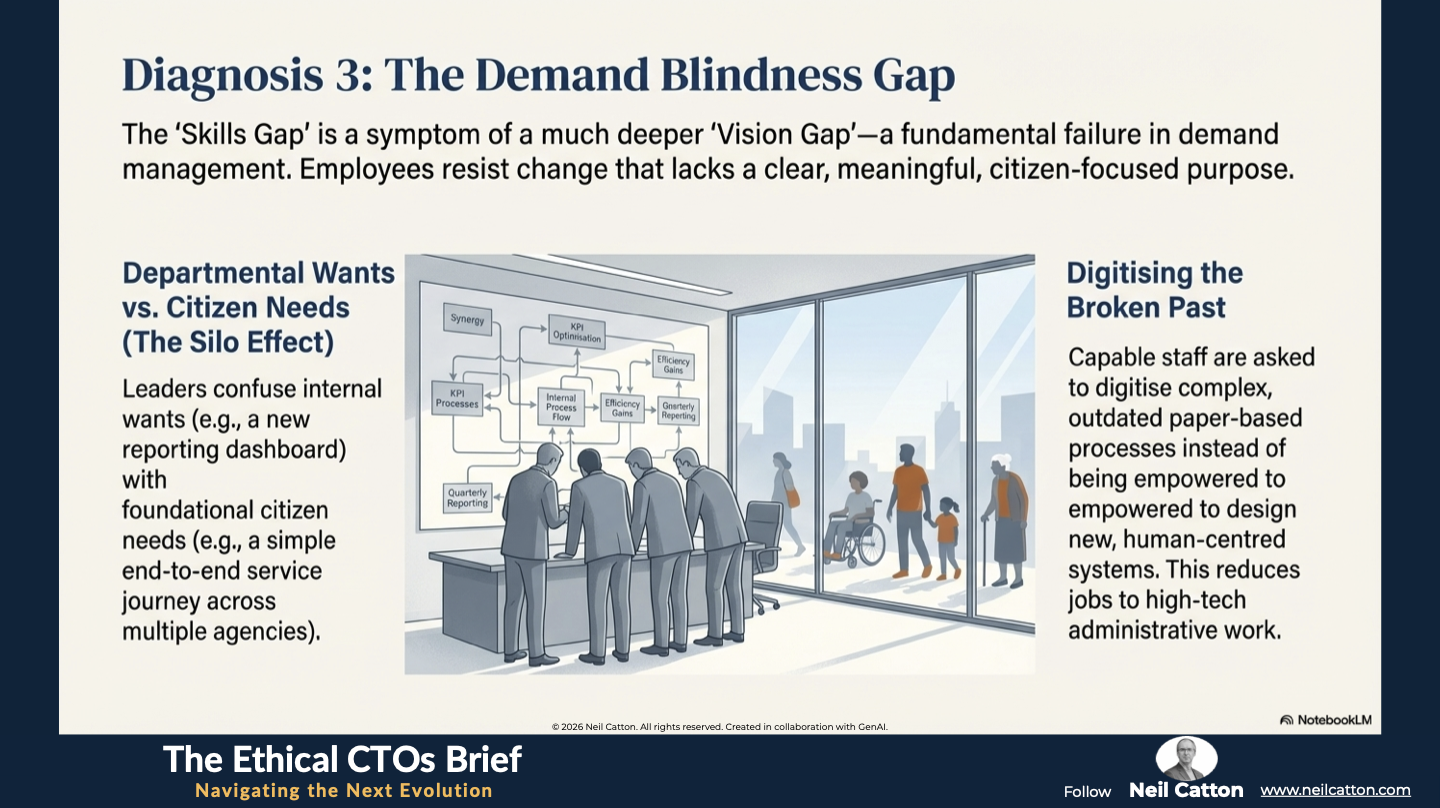
The widely lamented “Skills Gap” is often a symptom of a much deeper Vision Gap – a fundamental failure in Demand Management. This leads to strategic drift, low morale, and high attrition. Public sector employees don’t resist learning; they resist structural change lacking a clear meaningful and citizen-focused purpose.
The Mismatch of Demand:
- Departmental Wants vs. Citizen Needs (The Silo Effect): Leaders often confuse departmental wants, like a new internal reporting dashboard to satisfy executive governance in a silo, with foundational citizen needs, such as a simple single end-to-end service journey across multiple agencies. This demand blindness is further compounded by internal silo structures resulting in poor prioritisation. Staff feel overwhelmed by new tools that simply digitise complex internal bureaucracy rather than addressing real external human-scale problems.
- Digitising the Broken Past: The workforce is already dedicated and capable. However, they’re being asked to digitise existing, often complex, paper-based processes rather than being empowered to design new human-centred systems. This operational focus stifles innovation and reduces jobs to high-tech administrative work failing to deliver on the promise of improved public service.
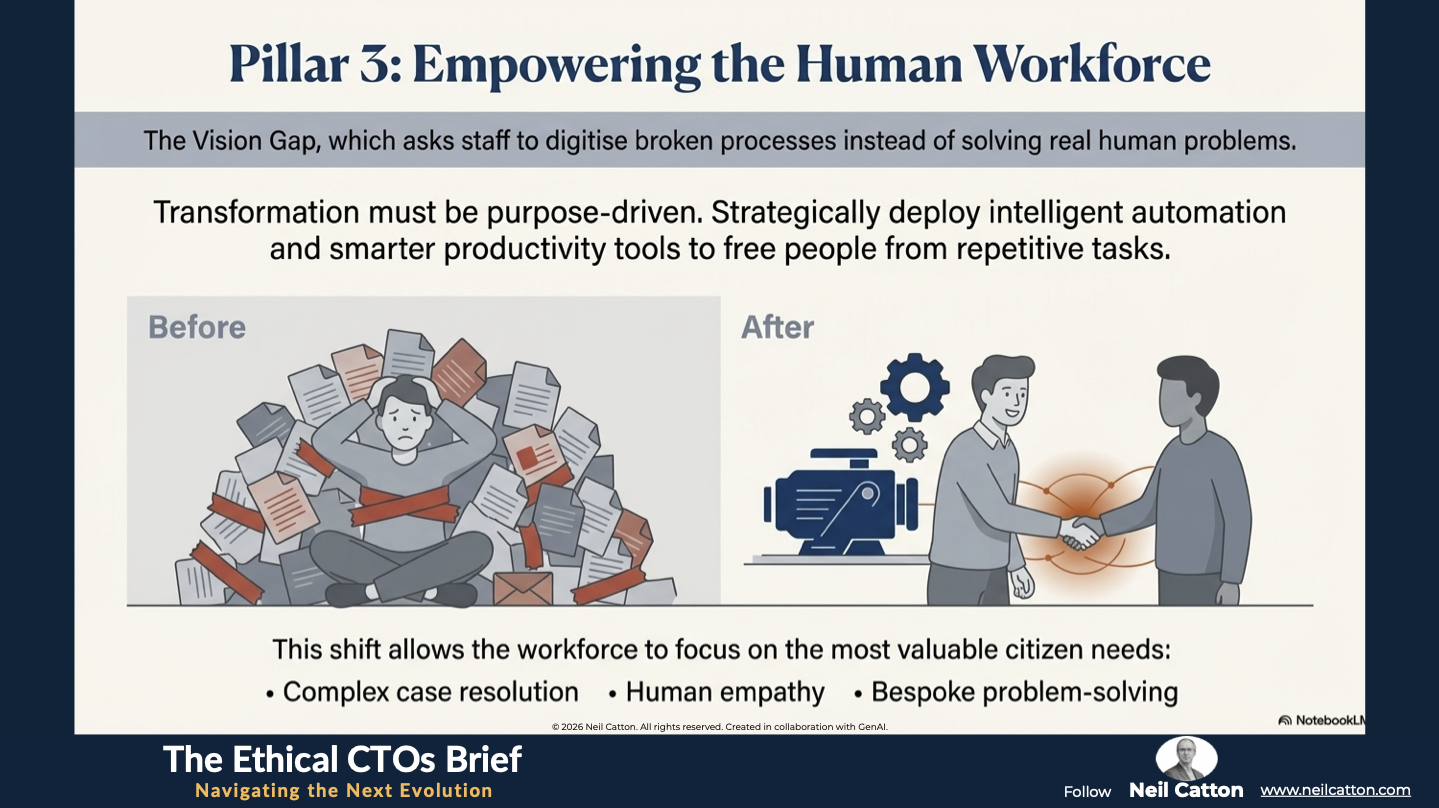
The Solution: Empowering the Human: Transformation must be purpose-driven and empower the human workforce. Strategic deployment of intelligent automation and smarter productivity tools will deliver high-quality services by freeing people from repetitive transactional tasks. This shift allows them to focus on the most valuable citizen needs: complex case resolution, human empathy and bespoke problem-solving. This requires building capability beyond basic tool adoption, focusing on the ethical and strategic use of technology to meet these highest-value needs.
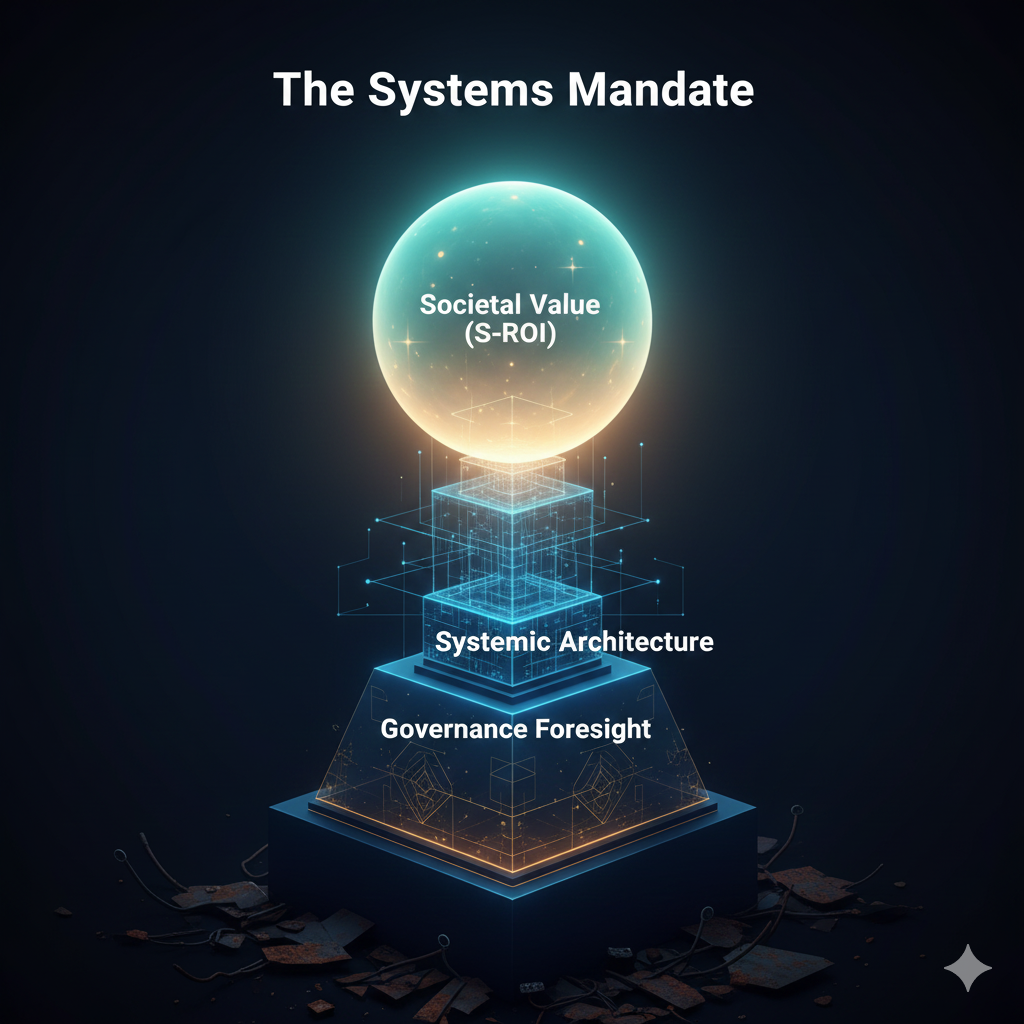
The Systems Mandate: Architecture, Value, and Foresight
To overcome these three strategic failures – Legacy Debt, the ROI Paradox and Demand Blindness – a new governance playbook is needed. The Next Evolution Mandate is a firm commitment to a structural approach that seamlessly integrates technology with ethical societal and long-term accountability.
Digital Ethics as the Core Architecture
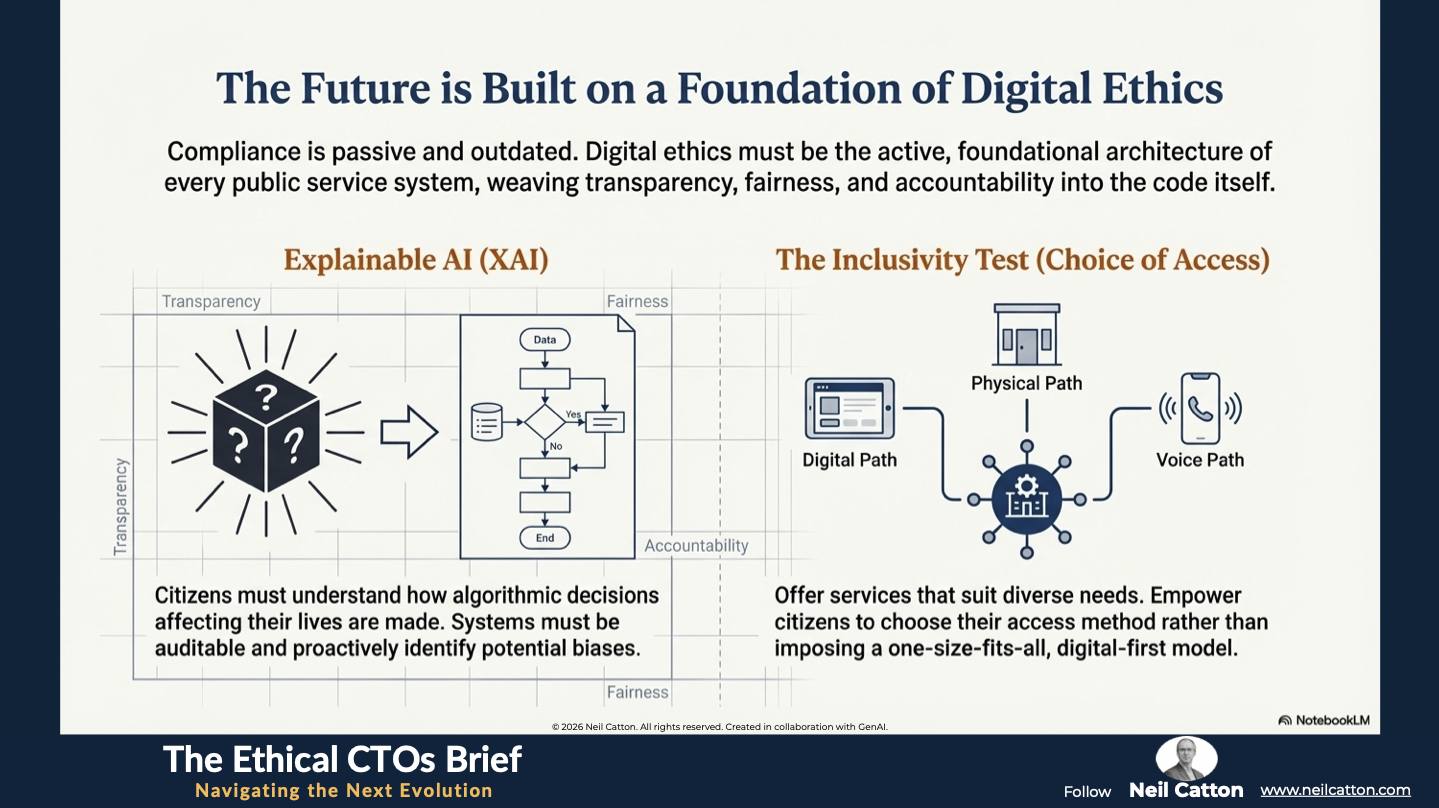
Compliance is important but it’s passive and outdated. Digital ethics should be the active, foundational architecture of every public service system. Services, especially those using AI and ML, must be designed from the outset with transparency, fairness, and accountability woven into their code, data governance, and policy structure.
- The Imperative of Explainable AI (XAI): Citizens need to understand how a crucial life decision like benefits allocation, tax assessment or resource prioritisation is made when an algorithm is involved. This requires auditable XAI systems that clearly explain their output and proactively identify potential biases in the training data. These systems should ensure fairness, not discrimination.
- The Inclusivity Test (Choice of Access): Ultimately, every service revolves around people. Any transformation must offer services that suit diverse needs and circumstances. Assuming technology is the sole solution risks alienating citizens and fostering negativity. We must empower citizens to access services according to their preferences rather than imposing a one-size-fits-all digital-first model. The architecture must be resilient and adaptable to all users, providing a variety of access points.
Valuing the Next Evolution of Technology
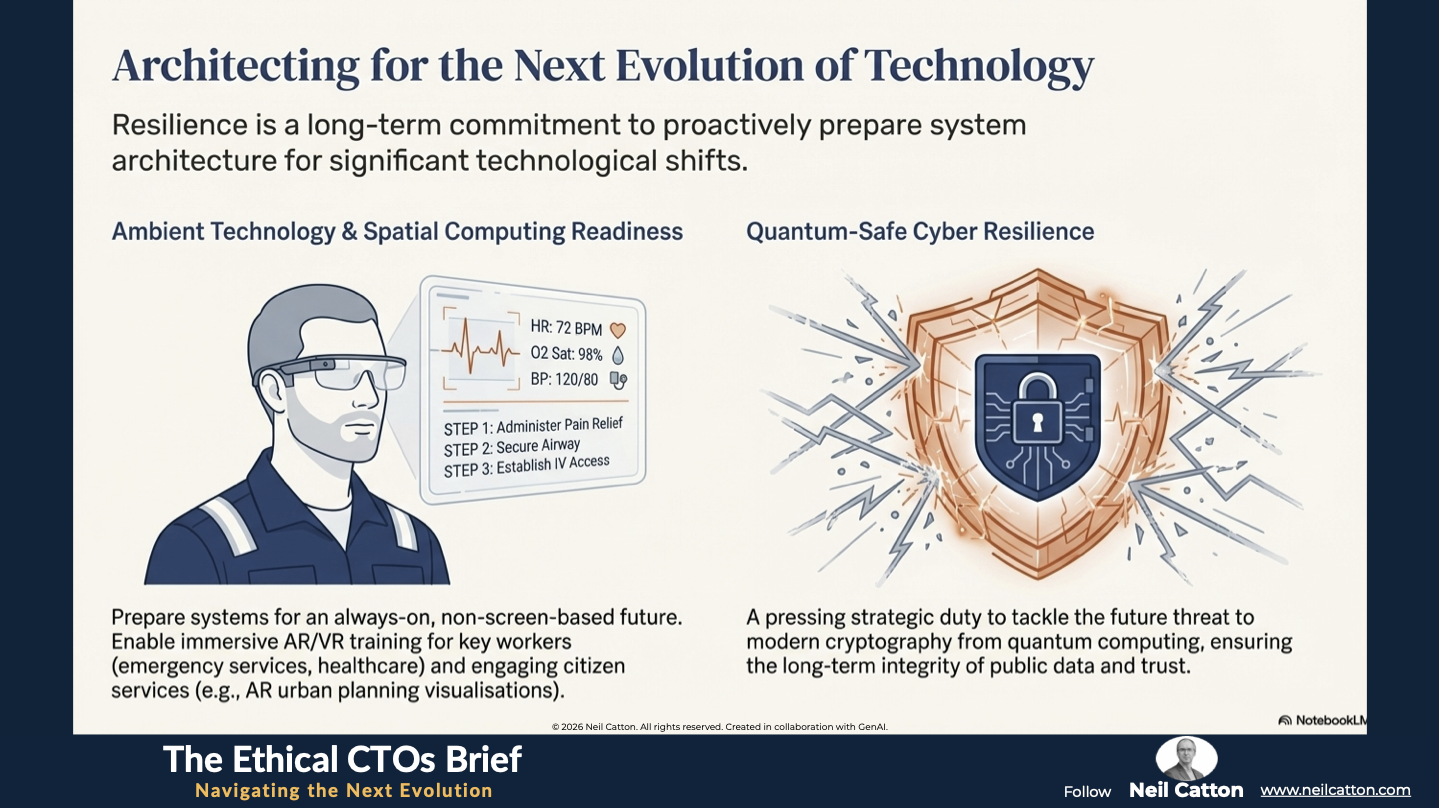
Resilience and Sustainability is a long-term commitment, not just about backing up current data. It involves proactively preparing system architecture for the significant technological shifts ahead. This preparedness is fundamental to the moral obligation of delivering long-term responsible public service.
- Ambient Technology and Spatial Computing Readiness: Public service governance must future-proof its structures to meet the evolving demands of service delivery. This shift will be towards increasingly ambient services – ubiquitous, always-on and non-screen-based. Proactively preparing systems for spatial computing, including enhanced reality (AR) and virtual reality (VR), is crucial. This will enable highly immersive and effective training for key workers like emergency services and healthcare staff. Interactive and engaging citizen services will be possible, such as complex urban planning visualisations via AR. Today’s systems must be designed to safely and ethically integrate with the spatial web of tomorrow.
- Quantum-Safe Cyber Resilience: The long-term security and integrity of public data are a crucial moral and strategic priority. Proactively tackling the future threat to modern cryptography posed by emerging quantum systems – known as Quantum-Safe Cyber Resilience – isn’t a distant dream. It’s a pressing strategic duty to maintain public trust in their personal data security over the coming decades.
Implementing the Human-First Velocity
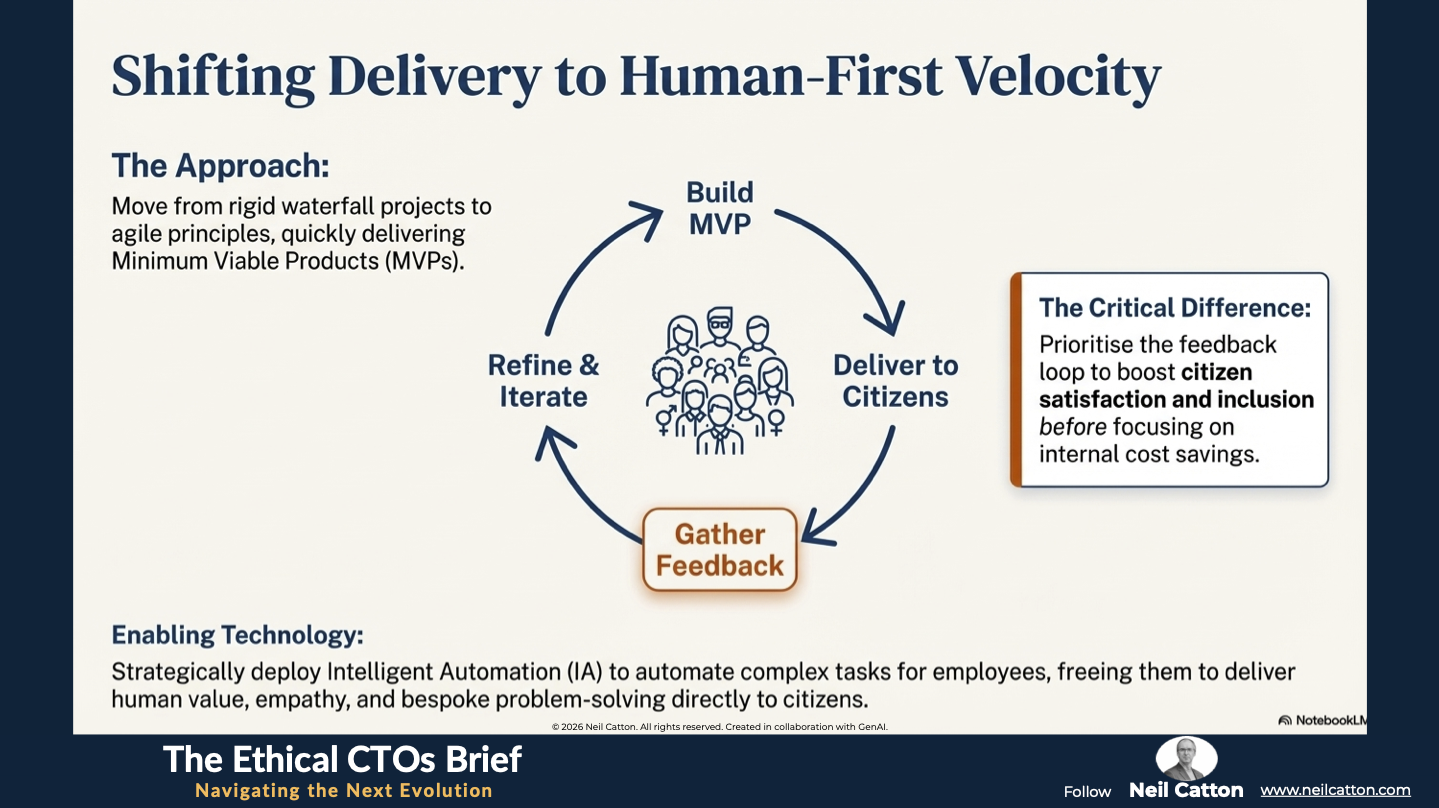
The final step is shifting delivery from rigid, slow waterfall projects to Human-First Velocity. This involves adopting agile principles to quickly and iteratively deliver Minimum Viable Products (MVPs). However, a key difference lies in prioritising the feedback loop to boost citizen satisfaction and inclusion before focusing on internal cost savings.
By strategically deploying Intelligent Automation (IA), UK public sector organisations can achieve unprecedented productivity, significantly enhance citizen satisfaction and build a more resilient and adaptable public service. This involves automating complex tasks for employees, freeing them to deliver human value empathy and bespoke problem-solving to citizens.
A Final Word
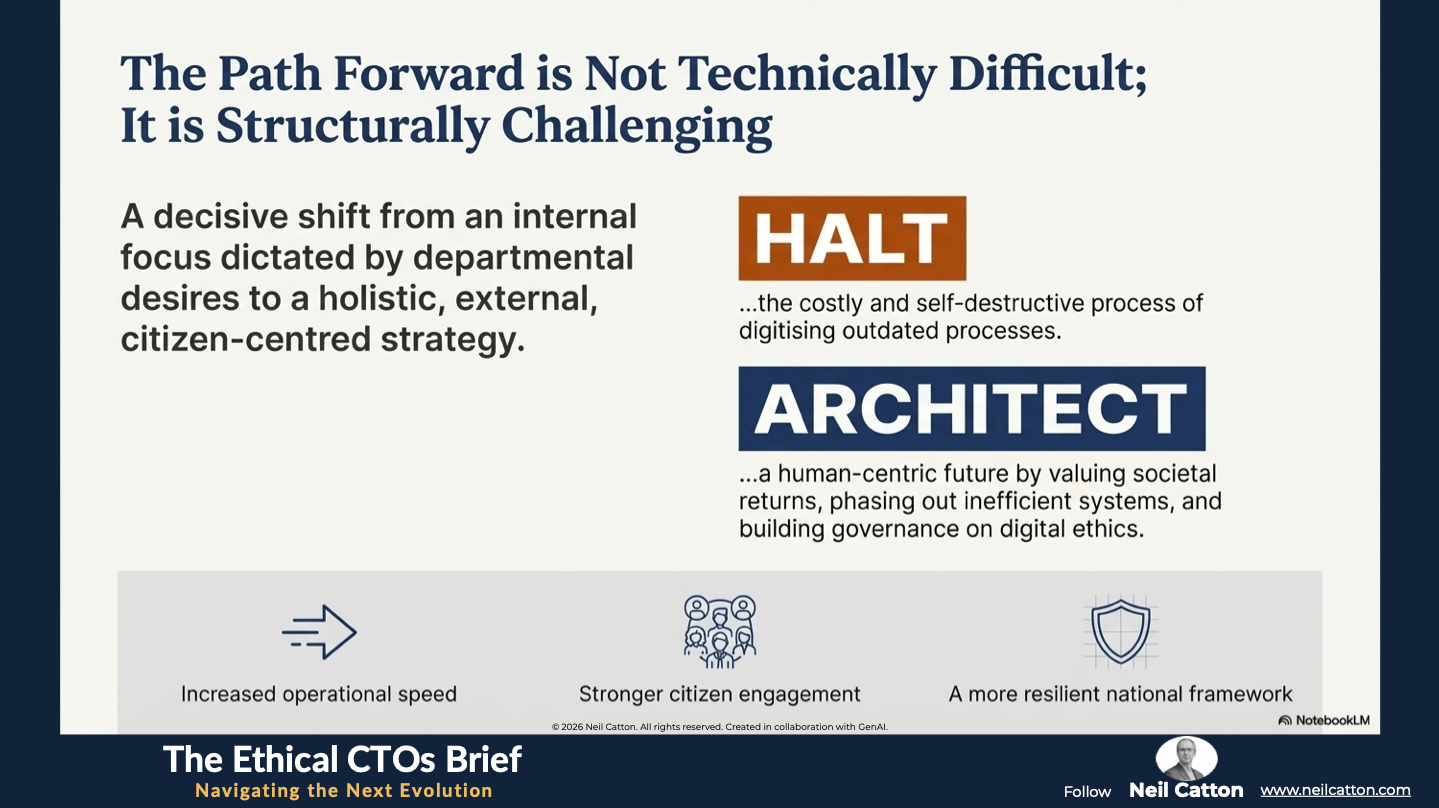
The path to genuine digital transformation in the UK public sector isn’t technically difficult; it’s structurally challenging. Success depends on a courageous, fundamental commitment: decisively shifting from an internal focus dictated by departmental desires to wholeheartedly embrace a holistic, external, citizen-centred strategy solely centred on human needs.
We must halt the costly and self-destructive process of digitising outdated processes. This only reinforces the Legacy Debt Mindset and hinders progress. Instead, we need to architect a human-centric future. This involves valuing societal returns, phasing out inefficient systems and ensuring governance is based on digital ethics. The long-term benefits – increased operational speed, improved decision-making, stronger citizen engagement and a more resilient national framework – are substantial and urgently required.
Navigating this essential structural shift requires a fresh approach – a playbook that combines systems thinking, moral foresight and practical governance insights, to deliver responsible innovation, Societal ROI and genuine public value.
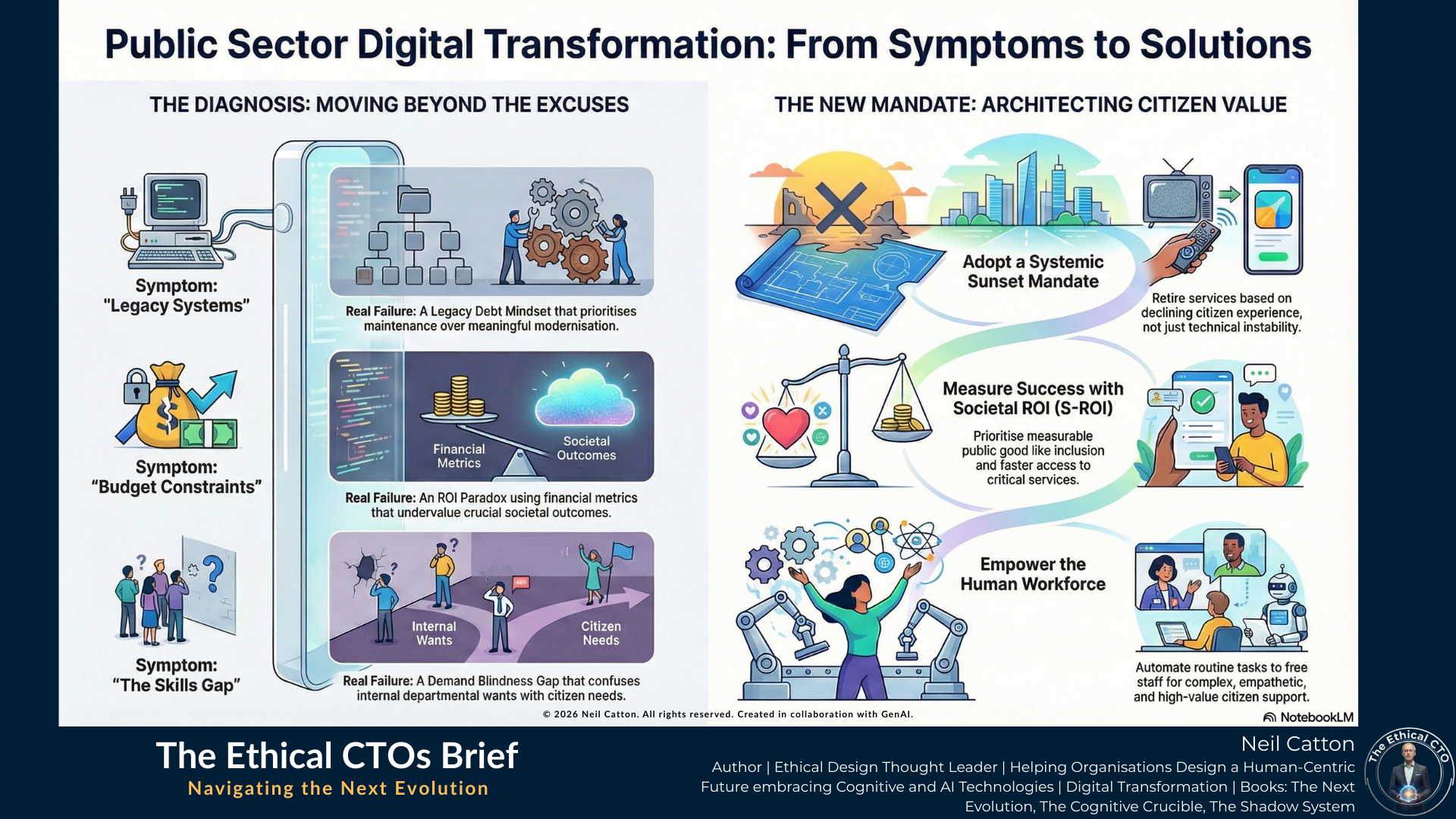
Key Takeaways: Diagnosing the Stagnation
The Legacy Debt Mindset: Technical debt is only the surface; "Cultural Debt" (entrenched risk aversion) is what prevents meaningful modernisation.
The ROI Paradox: Public sector success is often strangled by private-sector financial metrics that ignore the most important outcome: Public Trust.
Demand Blindness: We are often guilty of digitising "broken pasts" rather than architecting a "human-first" future.
The Systemic Sunset: Governance must mandate the dismantling of systems that fail the "Citizenship Experience," regardless of their technical stability.


1
2
3
4
5
6
7
8
9
10
11
12
13
14
15
Strategic Insights: Architecting Society 5.0
Societal ROI (S-ROI): A new primary metric for success that values Time-to-Safety (TTS) and Inclusion Quotients over simple headcount reduction.
Active Digital Ethics: Ethics shouldn't be a checklist; it must be the foundational architecture of every AI and data system.
Explainable AI (XAI): Auditable systems are mandatory for life-affecting decisions like benefits, tax, and public resource allocation.
Human-First Velocity: Shifting from slow "waterfall" projects to agile delivery that prioritises citizen feedback loops above all else.
Briefing Summary: Scaling Human Inten
The CIO Shift: Moving the role from "Operational Manager" to "System Shaper" and "Ethical Architect."
Quantum-Safe Resilience: Why proactive data security is a moral obligation to maintain long-term public trust.
Ambient Services: Preparing architecture for the move toward "Spatial Computing" and non-screen-based citizen interactions.
Conclusion: Technology is not the driver of reform; it is the engine that scales human strategy and morality.
Understanding Transformation and what it means for your organisation is only the first step on the transformation journey, next it's vital to look at, and understand, your "Legacy" landscape to avoid the Legacy Trap.
The Ethical CTO: Arc 1 Index
- Transformation: Digital Transformation
- Diagnosis: The Legacy Trap
- Efficiency: The Productivity Paradox
- Velocity: The Time-Zero Organisation
- Governance: Strategy of Designed Chaos
- Orchestration: Executive Coherence
- Impact: The Digital Catalyst