The Way we work: Reinvention, Evolution or revolution
is a constant process driven by technological advancements and cultural shifts.
Work has always been a defining feature of human existence, shaping cultures, economies, and individual identities. But today, the very nature of work is undergoing a profound transformation, driven by rapid advancements in technology, automation, artificial intelligence, and shifting societal expectations. We are not just witnessing an evolution of job roles, we are standing on the edge of a fundamental reinvention of work and society itself.
This reinvention is not about minor adjustments or incremental efficiencies; it is about rethinking the relationship between work, purpose, and human progress. How will people find meaning in a world where machines handle much of the labour? What happens to economies built on traditional employment structures? And are businesses and governments prepared for the level of adaptability this shift demands? If we allow technology to handle our daily lives how do we avoid becoming a lazy society?
The answers are neither simple nor uniform. But one thing is clear: the way we work, live, and organise society is changing faster than we ever anticipated.
What is the Reinvention of Work and Society?
In The Next Evolution, the Reinvention of Work and Society describes a world where technology moves from being a tool to being the foundation of a new social contract. This shift is characterized by three core pillars:
The End of Presence-Based Value: Shifting from "hours at a desk" to a focus on autonomous, purpose-driven output facilitated by remote and hybrid collaboration.
Skill-Based Economies: The transition from rigid degree-based hierarchies to a system of lifelong learning and interdisciplinary knowledge, where adaptability is the primary currency.
Human-Centric Contribution: As AI automates routine cognitive and manual tasks, human value is recalibrated around uniquely human traits: emotional intelligence, strategic thinking, and ethical innovation.
This reinvention is not merely about efficiency; it is an imperative for societal survival in an age of total digital connectivity.
 The Way We Work: Reinvention, Evolution or Revolution?
The way we work and interact within society is undergoing a fundamental transformation, driven by automation, artificial intelligence, spatial computing, digital connectivity, and shifting human expectations. The traditional structures of employment, where people work fixed hours in centralised locations performing repetitive tasks, are rapidly dissolving, giving way to a new era of flexible, skill-based, and AI-augmented work environments.
At the heart of this reinvention is the realisation that work is no longer solely defined by physical presence, rigid hierarchies, or even human labour alone. Digital and AI-driven tools are automating routine tasks, allowing people to focus on creativity, problem-solving, and uniquely human skills such as emotional intelligence and strategic thinking. The rise of remote and hybrid work models has demonstrated that location is becoming increasingly irrelevant, while the gig economy and decentralised organisations challenge traditional employment structures, shifting towards more autonomous and purpose-driven ways of working.
Meanwhile, the concept of society itself is evolving alongside work. As automation and AI take over repetitive and manual labour, people are being pushed towards roles that require constant learning, adaptability, and digital literacy. Work is no longer just about earning a living, it is about engaging in continuous upskilling and reskilling to stay relevant in a world where knowledge and technology evolve at an unprecedented pace. Lifelong education and personal development will become fundamental pillars of modern work, requiring individuals, businesses, and governments to rethink their approach to career progression.
Additionally, the emergence of AI co-workers, digital twins, and spatial collaboration tools is redefining how teams function. Meetings are shifting into mixed-reality spaces, project management is handled by AI assistants, and productivity is increasingly measured by output rather than hours spent working. The reinvention of work is not just about replacing old jobs with new ones, it is about fundamentally redefining how value is created in a world where human potential is augmented by intelligent systems.
Society itself must adjust to this transformation. If AI and automation are expected to take on a larger share of the workload, then what does that mean for employment, income distribution, and economic structures? Will we see the rise of universal basic income (UBI) to compensate for job displacement, or will entirely new sectors emerge to redefine the role of human contribution? The reinvention of work is not just a technological evolution, it is a societal shift that challenges our deepest assumptions about purpose, productivity, and progress.
This new model of work offers tremendous opportunities, but it also brings challenges that require rethinking policies, education systems, and economic frameworks. The reinvention of work is not something happening in the distant future, it is already unfolding today, and how we navigate it will determine whether society flourishes in an era of unprecedented digital and AI-driven transformation.
- From Routine to Creativity: AI and automation will handle repetitive, predictable tasks, allowing human workers to focus on roles requiring creativity, emotional intelligence, and complex problem-solving.
- From Rigid Employment to Fluid Work: The traditional concept of lifelong careers in a single organisation is giving way to a more flexible, project-based, and skill-oriented economy.
- From Work as Survival to Work as Fulfilment : As automation reduces the need for basic labour, there is a growing opportunity to redefine work as a pursuit of meaning, innovation, and societal contribution rather than mere economic necessity.
This reinvention is not a theoretical future, it is happening now. But why is it so critical?
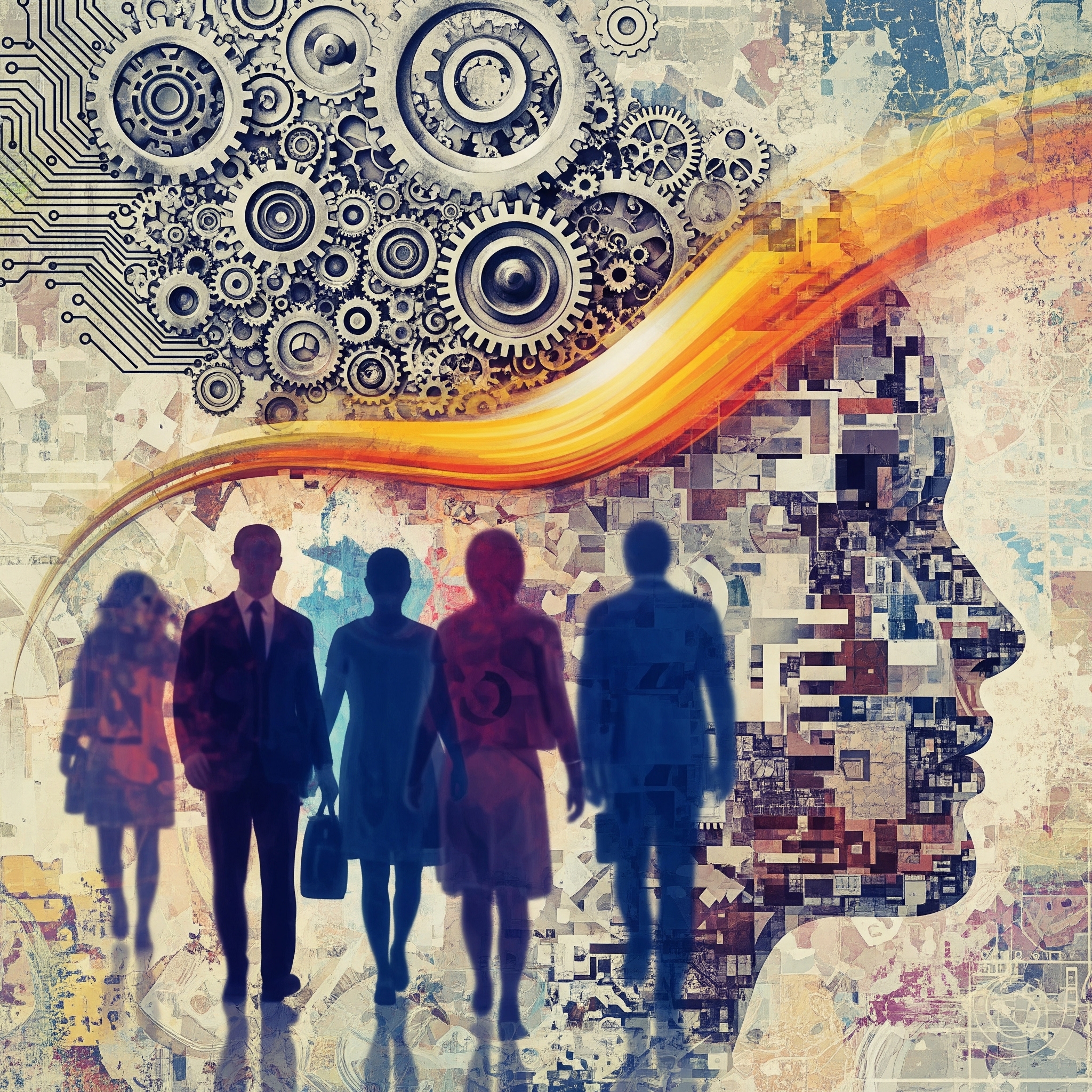 Why? Survival and Advancement in today’s society
The reinvention of work is not just about efficiency or technological progress, it is about the fundamental survival and advancement of society in a rapidly evolving world. As automation, artificial intelligence, and digital transformation continue to reshape industries, the very concept of work must evolve to keep pace with these changes. If we fail to redefine how people contribute to the economy and society, we risk creating mass unemployment, economic disparity, and social unrest.
Technological disruption.
Machines and algorithms are increasingly capable of performing repetitive, manual, and even cognitive tasks faster and more accurately than humans. Jobs that once provided stability, such as administrative roles, data processing, and even certain forms of creative work, are being automated at an accelerating rate. Without proactive adaptation, large portions of the workforce could find themselves displaced and without viable alternatives. The only way forward is to redefine work itself, ensuring that people develop the skills and adaptability needed to thrive in an AI-augmented world.
Demographic shifts and changing worker expectations.
Younger generations entering the workforce are demanding greater flexibility, purpose-driven careers, and work-life balance. The rigid 9-to-5 structure is becoming obsolete as people seek autonomy and personalised career paths. If organisations fail to adapt, they risk losing talent to those that embrace remote work, project-based employment, and digital collaboration.
Broader economic and societal implications.
If AI and automation dramatically reduce traditional employment opportunities, governments and businesses will need to explore new economic models, potentially including Universal Basic Income (UBI) or alternative forms of wealth distribution. Skills-based economies will replace degree-based hierarchies, meaning education systems must evolve to focus on lifelong learning, adaptability, and interdisciplinary knowledge.
Human identity and purpose.
People have defined themselves by what they do, but what happens when traditional work disappears? The reinvention of work is not just about surviving the technological revolution; it is about reshaping our relationship with productivity, contribution, and self-worth. It is about ensuring that human potential is enhanced rather than diminished in an era of rapid change.
If managed well, this transformation could lead to a more equitable, efficient, and fulfilling society, where AI and automation free people from mundane tasks, allowing them to focus on innovation, creativity, and problem-solving. If ignored or mismanaged, it could lead to unprecedented job displacement, economic collapse, and social division. That is why the reinvention of work is not just important, it is imperative for the future of humanity.
 Happening Around Us: Change is already underway
The reinvention of work is already underway, driven by advancements in automation, artificial intelligence, remote collaboration, and changing workforce expectations. Organisations, governments, and individuals are navigating an era where traditional career paths are dissolving, digital-first work environments are becoming the norm, and lifelong learning is essential to remain relevant.
- AI and automation is rapidly reshaping industries by taking over repetitive, data-driven, and even creative tasks. From AI-powered customer service chatbots and robotic process automation (RPA) in finance to self-driving trucks disrupting logistics, businesses are integrating intelligent systems to enhance productivity and reduce costs. AI can now generate reports, design graphics, write content, analyse legal documents, and even assist in medical diagnostics—raising fundamental questions about the future role of human workers.
- Remote and hybrid work models have become widespread, accelerated by the COVID-19 pandemic. Organisations worldwide have realised that location-independent work is not only possible but beneficial. This shift has led to a surge in digital collaboration tools, virtual offices, and decentralised workforces, where employees can operate across borders without being tied to physical offices. Platforms like Slack, Zoom, and Microsoft Teams have become digital headquarters, and companies are experimenting with virtual and augmented reality (VR/AR) workspaces that create immersive environments for global teams.
- Gig economy and project-based work is another significant shift. Traditional full-time employment is giving way to on-demand, flexible roles where workers take on freelance, contract, or short-term assignments. Platforms like Upwork, Fiverr, and Toptal enable professionals to find work outside the constraints of long-term employment. While this model offers greater freedom and autonomy, it also raises concerns about job security, benefits, and workers’ rights, forcing governments and businesses to rethink labour laws, taxation, and employment protections.
- Education and re-skilling initiatives are expanding to address the growing skills gap. With automation displacing certain jobs, continuous learning is becoming a necessity. Companies are investing in corporate training programs, AI-driven personalised learning, and micro-credentialing platforms that allow workers to adapt to changing demands. Institutions such as Coursera, Udacity, and LinkedIn Learning provide access to digital courses in high-demand fields like data science, cybersecurity, AI development, and cloud computing. Meanwhile, universities and governments are reconsidering traditional degree-based education models in favour of skills-based hiring and practical training programs.
- Alternative economic models such as Universal Basic Income (UBI) are gaining attention. As automation replaces jobs, some governments and policymakers are exploring UBI as a potential safety net to ensure people have financial stability despite workforce disruptions. Pilot programs in countries like Finland, Canada, and the United States have tested how unconditional financial support can help people transition to new career paths, start businesses, or engage in lifelong learning.
- Emerging work environments are also integrating the metaverse and extended reality (XR). Companies like Meta (formerly Facebook), Microsoft and Apple are investing heavily in virtual workspaces, AI-driven personal assistants, and holographic communication. Imagine a future where professionals attend meetings in fully immersive VR offices or where AI-powered avatars represent human employees in digital workspaces. This shift could eliminate geographical barriers, enhance collaboration, and redefine the traditional office environment.
Despite these advancements, challenges remain. Governments and businesses must address legal, ethical, and social concerns surrounding automation-driven job losses, workers’ rights, AI bias, and the economic divide. As the nature of work continues to evolve, organisations must ensure that the transition is inclusive, fair, and beneficial to society as a whole.
The reinvention of work is no longer a distant concept, it is happening now. The way people earn a living, develop skills, and contribute to the economy is being rewritten in real-time. The key question is whether businesses, governments, and individuals can adapt quickly enough to ensure that this transformation leads to a better future for all. Click to edit text. Focus on how you can benefit your customers.
 Future Potential: Science Fact or Science Fiction?
The future of work and society is on the cusp of a profound transformation, with technology-driven innovation opening possibilities that were once the realm of science fiction. As AI, automation, extended reality (XR), and decentralised work models continue to evolve, the way humans engage in economic activity, collaborate, and structure their daily lives will shift in unprecedented ways. If managed effectively, this transformation has the potential to create a more inclusive, flexible, and productive workforce, one that moves beyond outdated notions of rigid employment structures and embraces dynamic, skills-based opportunities.
- Emergence of human-AI collaboration as a fundamental work model. Rather than replacing human jobs outright, AI and automation will become powerful co-pilots, enhancing human capabilities and handling repetitive or complex computational tasks. AI-powered personal assistants, predictive analytics, and machine-learning-driven decision support systems will allow workers to focus on creativity, problem-solving, and strategic thinking. In this future, AI could act as a real-time knowledge partner, suggesting solutions, optimising workflows, and even anticipating challenges before they arise.
- Erosion of traditional (physical) workplaces will continue to erode, making way for hyper-flexible, location-independent employment. The rise of decentralised autonomous organisations (DAOs), blockchain-based work contracts, and digital identities will empower individuals to work from anywhere, for anyone, and be compensated fairly without intermediaries. Smart contracts on the blockchain will automate payments, ensure transparency, and enable global workforces to collaborate without relying on traditional corporate structures. This shift could foster a borderless economy, where talent is no longer limited by geography but instead flows freely based on skill and expertise.
- Extended reality (XR) will redefine how people interact in professional settings. Virtual offices, augmented collaboration tools, and holographic telepresence will create environments that feel as immersive and interactive as physical spaces, allowing for seamless cooperation between remote teams. Imagine stepping into a virtual design lab where architects, engineers, and clients from different parts of the world manipulate a 3D-rendered prototype in real time, or a digital twin of an entire factory where managers can predict and prevent machine failures before they occur. The future of work could become a fusion of the physical and digital realms, enabling deeper engagement and new forms of creative expression.
- Education and skills development will also undergo a radical reinvention. The traditional four-year degree model will likely become obsolete, replaced by continuous, AI-driven learning tailored to individual career trajectories. AI tutors and adaptive learning platforms will personalise education in real time, identifying knowledge gaps and suggesting the most effective learning pathways. Micro-credentials, stackable certifications, and industry-specific training modules will ensure that individuals can reskill and upskill on demand, staying relevant in an ever-changing job market.
- From Work-Life to Life-Work balance, the potential benefits of this transformation extend beyond productivity and economic efficiency. If properly implemented, the future of work could lead to greater balance, improved mental well-being, and more fulfilling careers. With automated tasks reducing burnout and digital tools streamlining workflows, workers will have more time to focus on meaningful pursuits, whether that be creative passions, entrepreneurship, or social impact initiatives. The rise of four-day work weeks, universal basic income experiments, and alternative economic models could allow society to shift away from the traditional work-for-survival mentality, enabling people to pursue work that aligns with personal fulfilment rather than necessity.
However, the transition will not be without challenges. Governments, businesses, and individuals must address issues of inequality, digital exclusion, and workforce displacement. The risk of an AI-dominated economy concentrating power in the hands of a few is a legitimate concern. Ensuring equitable access to digital tools, reskilling opportunities, and economic support mechanisms will be critical in preventing large-scale unemployment and societal instability.
If humanity navigates these shifts effectively, the reinvention of work and society could unlock a future where individuals are more empowered, industries are more innovative, and economic opportunities are more accessible than ever before. The key will be ensuring that technology serves as an enabler of human potential rather than a force of disruption, guiding us toward a world where work is no longer a burden but a platform for boundless creativity and progress.
 Challenges: Overcoming obstacles for a smooth transition
While the reinvention of work and society presents exciting opportunities, it also comes with significant challenges that must be addressed to ensure a smooth and equitable transition. The shift towards AI-driven automation, decentralised work models, and digital economies will inevitably disrupt industries, reshape labour markets, and raise complex ethical, social, and economic concerns. If these challenges are not carefully managed, the benefits of this transformation could become concentrated among a privileged few, deepening existing inequalities rather than alleviating them.
Workforce displacement
As automation and AI take over routine and repetitive tasks, many traditional jobs, particularly in manufacturing, logistics, retail, and customer service, are at risk of obsolescence. The rise of autonomous vehicles, robotic process automation (RPA), and AI-driven analytics could see millions of workers facing challenging working environments and shrinking opportunities. To counteract this, societies must prioritise reskilling and upskilling initiatives that equip individuals with the tools to thrive in a technology-driven economy. Governments, educational institutions, and private companies must collaborate to create accessible, affordable, and adaptive learning pathways that allow workers to transition into emerging industries such as AI ethics, cybersecurity, data science, virtual world design, and renewable energy technologies.
The Digital Divide
As work becomes increasingly digital and decentralised, those without reliable internet access, digital literacy, or the necessary devices risk being left behind. This divide is not just a problem in developing nations but also affects low-income communities in advanced economies, where access to technology remains uneven.
Overcoming this issue requires a multi-pronged approach:
- Investment in digital infrastructure to ensure universal high-speed internet access
- Public-private partnerships to provide free or subsidised devices for those in need
- Widespread digital literacy programmes that teach essential skills such as online collaboration, cybersecurity awareness, and AI-assisted productivity tools
Economic security concerns
As the traditional 9-to-5 employment model gives way to gig work, freelancing, and decentralised digital employment, workers may face income instability, lack of benefits, and reduced labour protections. If unchecked, this could lead to exploitation and economic persistent insecurity for large segments of the workforce. Solutions such as universal basic income (UBI), portable benefits systems, and gig worker unions could help provide financial stability while allowing workers to enjoy the flexibility of new work models. Governments must rethink outdated labour laws and social safety nets to ensure that workers in non-traditional employment structures are protected.
Overreach in digital workplaces
With remote and hybrid work models becoming the norm, there is an increased risk of employer surveillance, data exploitation, and AI-driven decision-making bias. Many companies are already using AI-powered productivity monitoring tools, tracking employees’ keystrokes, screen time, and online behaviour. While these tools can enhance efficiency, they also raise serious privacy concerns and risk fostering an oppressive work culture. Establishing clear ethical guidelines, employee protections, and legal frameworks is essential to ensure that AI-driven workplaces remain fair, transparent, and respectful of individual autonomy.
Societal adaptation
The cultural shift towards AI-enhanced work, virtual collaboration, and metaverse-driven economies requires a fundamental rethinking of identity, purpose, and community. Many people derive meaning and self-worth from their professions, and as jobs evolve or disappear, new frameworks for fulfilment and social belonging must emerge. Societies must foster a culture of lifelong learning, creative exploration, and community-driven innovation so that work is no longer seen solely as a means of survival but as a platform for personal growth and societal contribution.
Finally, governance and regulation will play a critical role in shaping the future of work. Policymakers must navigate a delicate balance between innovation and oversight, ensuring that new technologies enhance human well-being rather than exploit or exclude. Issues such as AI bias in hiring, data protection laws, decentralised economy regulations, and fair wages in an automated world require proactive policymaking, rather than reactive crisis management. Governments must work alongside business leaders, ethicists, technologists, and civil society groups to develop policies that support sustainable and inclusive growth.
A Future of Opportunity - If We Choose to Shape It
The reinvention of work and society is not just about technological advancement, it is about human progress. The challenges ahead are formidable, but they are not insurmountable. With inclusive policies, adaptive education systems, fair economic structures, and ethical governance, the world can transition into a future where technology empowers rather than replaces, and where work becomes a more meaningful, fulfilling, and equitable experience for all. The decisions we make today will define not just the future of work but the future of humanity itself.
 Are businesses Ready? Business and Societal maturity
The reinvention of work and society demands a profound shift in how businesses operate, innovate, and engage with both their workforces, society and the wider world. While some forward-thinking organisations are actively embracing AI-driven automation, remote collaboration, and decentralised digital economies, many businesses remain unprepared for the level of maturity, adaptability, and ethical responsibility that the future of work requires.
Redefinition of leadership and organisational culture
Traditional hierarchical structures are being challenged by networked, flexible, and AI-assisted decision-making models. Businesses must cultivate leaders who are comfortable working alongside AI, who prioritise ethical technology deployment, and who can navigate the complexities of a workforce that is no longer bound by geographical constraints or traditional employment contracts. However, many corporate cultures are still deeply rooted in legacy management styles that struggle to integrate AI as a co-worker, digital labour as an asset, and remote teams as the new normal.
Technological readiness
While large corporations have the resources to invest in AI-driven analytics, automation, and blockchain-based workforce management, small and medium-sized enterprises (SMEs) often lag behind due to cost barriers, lack of expertise, or resistance to change. This creates a risk that the future of work will be dominated by a handful of powerful tech-driven enterprises, leaving smaller businesses struggling to remain competitive. Overcoming this challenge requires greater investment in digital infrastructure, training, and access to scalable AI solutions that can support businesses of all sizes in making the transition.
Rethink attraction, retention, and support
In a world where traditional career paths are evolving the workforce of the future will demand greater flexibility, hybrid or fully remote work options, and compensation models that include digital currencies, blockchain-verified gig work contracts, and AI-enhanced career development. Many businesses remain attached to rigid employment structures, expecting employees to conform to outdated standards of productivity, office presence, and hierarchical advancement. Companies that fail to adapt to this new reality will struggle to attract top talent as workers increasingly prioritise purpose-driven careers, life-work balance, and AI-augmented professional growth over traditional job security.
Ethical dimension
As businesses integrate AI into hiring, performance evaluation, and decision-making, issues of bias, fairness, and transparency become critical. Many organisations are still ill-equipped to audit and regulate their AI systems, which could result in systemic discrimination, data privacy violations, and unethical surveillance practices. To ensure that AI-driven workplaces are inclusive, fair, and trustworthy, businesses must invest in AI ethics training, bias detection tools, and transparent AI governance frameworks, something that only a handful of companies are currently doing.
Regulation and Compliance
Governments are beginning to implement new labour laws, data protection regulations, and AI governance policies that businesses must comply with. However, many organisations are reactive rather than proactive when it comes to compliance, often struggling to keep up with rapidly evolving legal frameworks. Businesses that fail to align with ethical AI deployment, fair worker treatment, and transparent data usage may face legal action, reputation damage, and loss of consumer trust. Future-proofing against these risks requires embedding ethical and legal foresight into business strategies now, rather than scrambling to adjust when new regulations take effect.
Innovation mindset shift
Many businesses still see automation and AI adoption purely as a cost-cutting measure, focusing on efficiency rather than long-term sustainability. This short-sighted approach fails to acknowledge that the reinvention of work is not just about replacing human labour with machines, it is about augmenting human capabilities, creating new forms of value, and fostering a more dynamic, diverse, and resilient economy. Businesses that view technology solely as a means to eliminate expenses rather than a tool to empower people will struggle to remain relevant in an era where creativity, adaptability, and digital fluency are the true markers of success.
The question is not whether businesses will need to adapt, it is whether they are prepared to embrace the level of maturity, foresight, and ethical responsibility required to thrive in this new era. The reinvention of work and society cannot be driven by technology alone, it requires business leaders who are willing to challenge conventional thinking, invest in human potential, and shape workplaces that prioritise collaboration between humans and intelligent systems. Those that succeed will not only future-proof their organisations but will also play a pivotal role in defining a new economic order, one where work is more meaningful, inclusive, and sustainable than ever before.
 The Choice Ahead: Transforming now to be fit for the future
The reinvention of work and society is not a distant possibility, it is unfolding around us in real time. The convergence of AI, automation, decentralised economies, and digital collaboration is rapidly reshaping how we work, interact, and define value. As individuals, businesses, and governments, we are faced with a defining choice: do we resist these changes and risk falling behind, or do we embrace them with the foresight, ethics, and adaptability needed to build a better future?
The reality is that this transformation cannot be avoided. The way we work is already evolving, automation is changing traditional job roles, AI is influencing decision-making, and digital collaboration tools are reshaping global teams. We can either passively react to these shifts or actively shape how they unfold. The organisations and societies that take a proactive approach, investing in upskilling, ethical AI governance, and inclusive work environments, will be the ones that thrive in this new landscape.
However, embracing change comes with responsibility. Technology should not be used merely as a tool for efficiency and profit but as a means to enhance human potential, create more inclusive economies, and redefine success beyond traditional metrics. We must ensure that AI and automation do not become forces of mass unemployment and inequality but instead serve as enablers of innovation, creativity, and equitable access to opportunities. This requires rethinking education, reimagining career pathways, and redesigning policies that support a workforce no longer bound by geographical or contractual limitations.
For businesses, the choice is clear: adapt or become obsolete. The companies that succeed in this new era will not necessarily be the ones with the most advanced technology, but the ones that understand how to integrate technology in a way that enhances human collaboration, ethics, and long-term value creation. For governments, the challenge is to modernise regulatory frameworks, support continuous learning, and ensure that digital economies benefit all citizens rather than a select few. And for individuals, this shift demands a new mindset, one that is flexible, digitally literate, and open to lifelong learning.
But perhaps the most profound choice ahead is a moral and philosophical one. In a world where work, identity, and society are being fundamentally redefined, we must ask ourselves:
What kind of future do we want to create?
Will we build a society where technology empowers people, reduces inequality, and fosters greater well-being? Or will we allow unchecked automation, corporate monopolisation, and social fragmentation to dictate the future?
The reinvention of work is not just about jobs, automation, or economics, it is about the kind of world we want to live in. The future is not something we are simply waiting for; it is something we are actively creating. The choice is ours.
 Conclusion
Are we moving fast enough, and smart enough, to make this new world of work better, fairer, and more human for everyone?
The future isn’t waiting for us - it’s already here, unfolding faster than many of us ever expected.
The reinvention of work and society isn’t just about adopting new technologies or upgrading systems, it’s about rethinking what it means to be human in a digital-first world. It’s about designing work and life around flexibility, creativity, well-being, and purpose.
Of course, this transformation won’t come without challenges. Automation and AI will displace some jobs even as they create new ones. Skills gaps will widen if we don’t prioritise continuous learning. And if we don’t address inequality and digital access, the future of work risks becoming a future of exclusion for many.
But this is also a rare moment of opportunity.
Leaders have the chance to reimagine organisations as adaptive, human-centred ecosystems. Individuals have the power to rethink their skills, careers, and personal contribution. And society has the responsibility to create guardrails, ethical, inclusive, and sustainable, so that technology serves humanity, not the other way around.
The next evolution of work and society won’t be defined by machines, it will be defined by how we choose to use them. The future belongs to those willing to embrace change, invest in people, and build a world that works better for everyone.
The question is no longer
“Will the world change?”
It’s
“What role will you play in shaping it?”
- Part 1: The transition from tools to cognitive partners in Human-AI Symbiosis
Part 2: How we are reinventing work and social structures for an automated age
Part 3: Transcending physical limits through the Internet of Senses
Part 4: The infinite logic potential of the Quantum Computing revolution
Part 5: Programmable biology and the reality of Bio-Digital Convergence
Part 6: Navigating the rise of Plural Identity and digital consciousness
Part 8: Exploring the stars via Intelligent Presence and autonomous systems
Part 9: A Code of Conscience for navigating future moral complexities
Part 10: The roadmap for steering our technological future responsibly