The Clock is Broken
Why Time is Your Newest Architectural Input
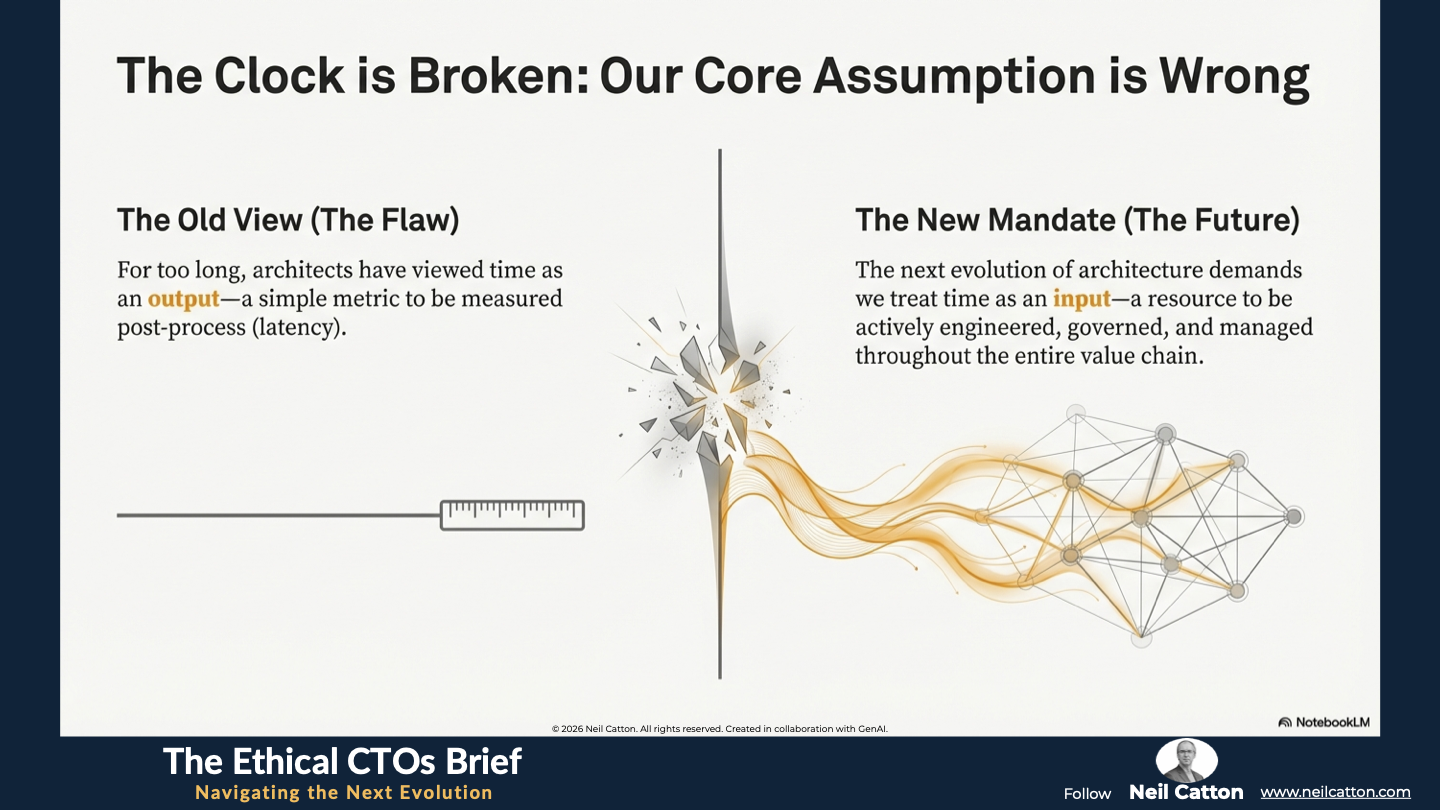
In traditional architecture, we’ve treated time as an output, a post-process metric called "latency" that we simply try to minimise. But in a world of algorithmic flash-crashes and split-second medical crises, treating time as a passive measure is a recipe for systemic failure. The reality is that our external environment is moving faster than our internal systems were ever designed to handle.
In Governing the Tempo, we explore a fundamental shift in how we build. We’re moving beyond the "Batch Processing" mindset of the past and toward a future of Event Supremacy. This article breaks down the three pillars of a high-tempo organisation:
- Event Supremacy: Why the "event" is now the primary unit of business value.
- Temporal Granularity: How to match the internal "tick" of your system to the chaotic pulse of the real world.
- Temporal Governance: Ensuring that as we accelerate, we don’t outrun our ethical guardrails or our ability to maintain human-centric control.
If you are still measuring success by how fast you did something yesterday, you’ve already lost the lead. It’s time to stop measuring the clock and start governing the tempo.
The Clock is Broken
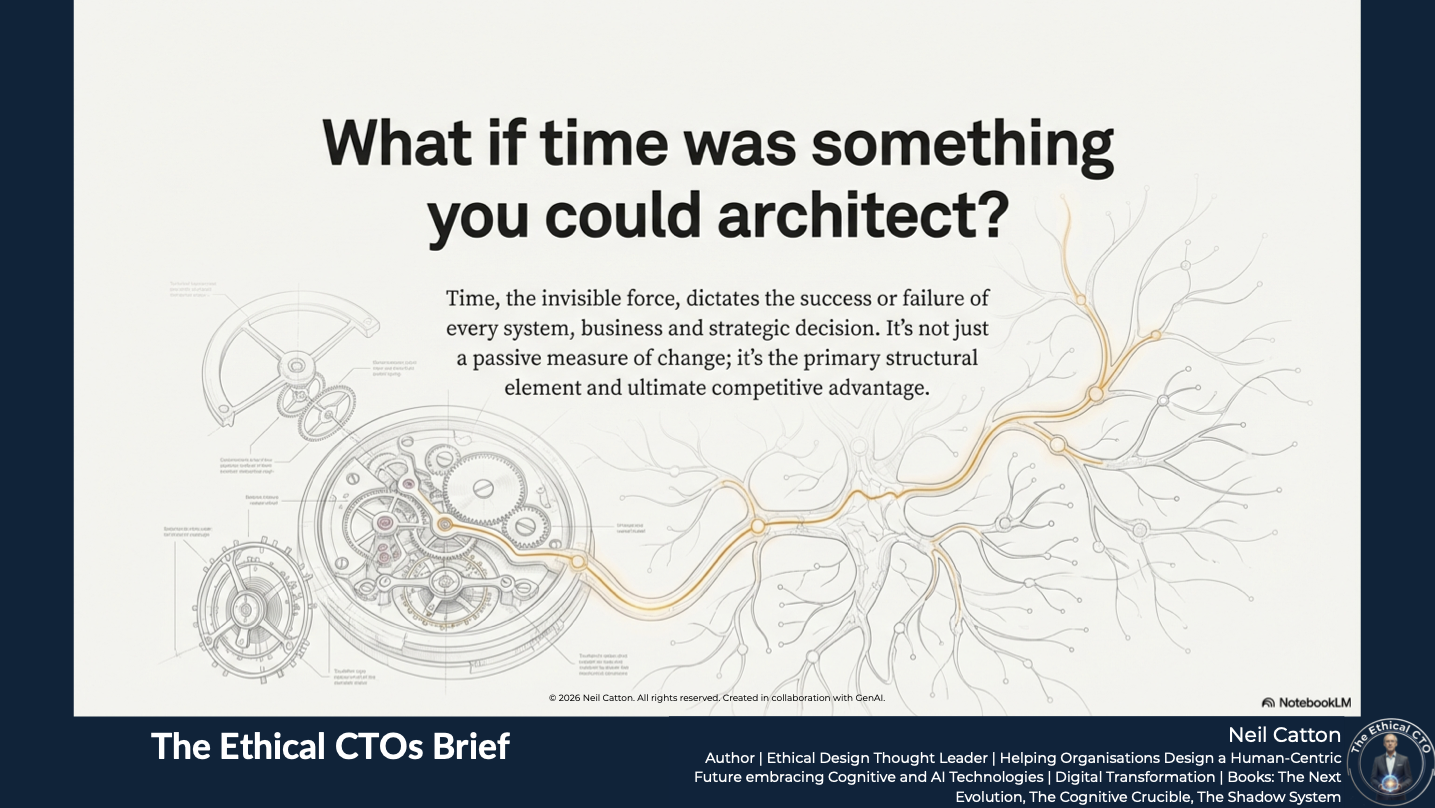
Time, the invisible force, dictates the success or failure of every system, business and strategic decision. It’s not just a passive measure of change; it’s the primary structural element and ultimate competitive advantage. For too long architects have viewed time as an output, a simple metric to be measured post-process (latency). The next evolution of architecture demands we treat time as an input, a resource actively engineered governed and managed throughout the entire value chain.
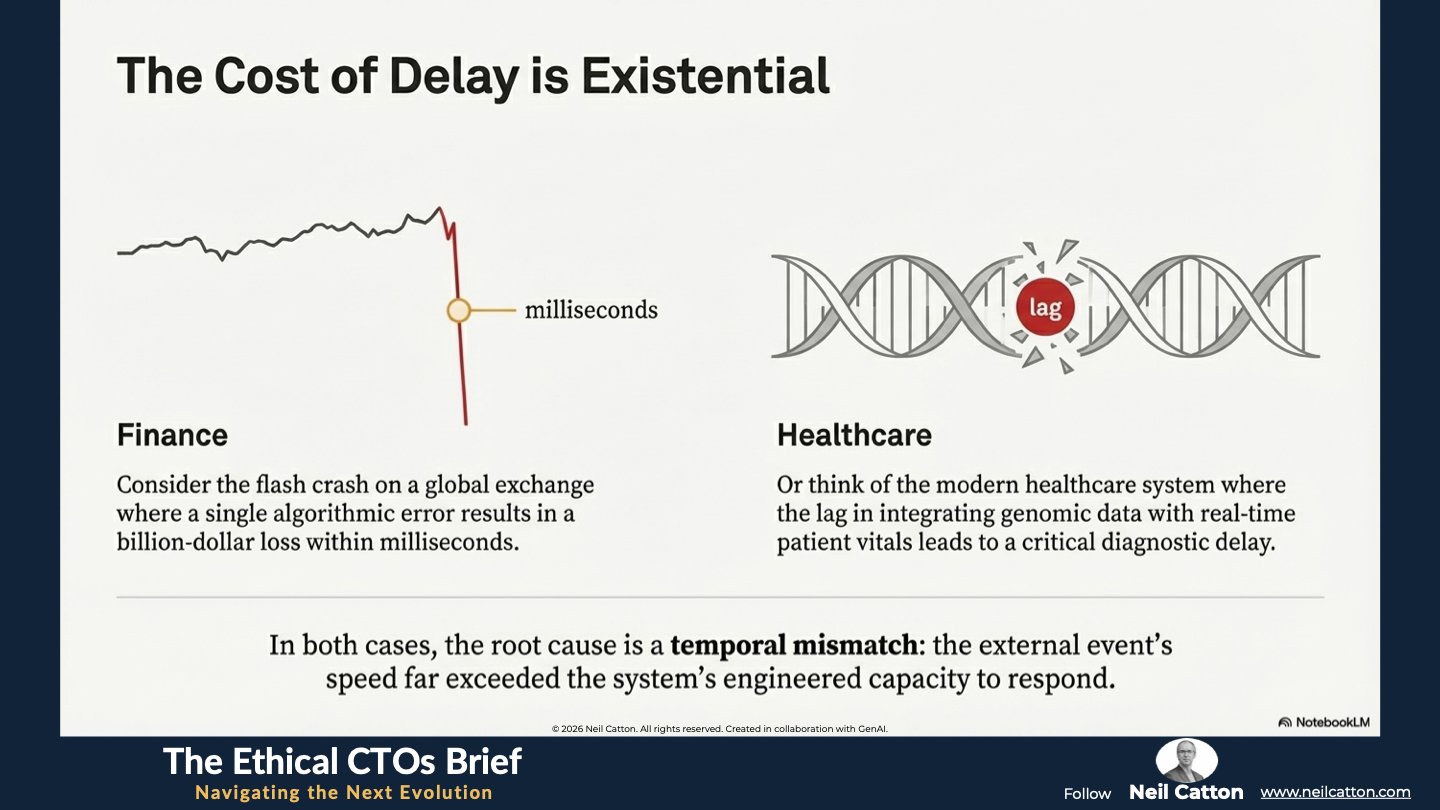
In our hyper-connected, AI-driven world, delay has become a matter of existential importance. Consider the flash crash on a global exchange where a single algorithmic error results in a billion-dollar loss within milliseconds. Or think of the modern healthcare system where the lag in integrating genomic data with real-time patient vitals leads to a critical diagnostic delay. In both cases, the root cause is a temporal mismatch: the external event’s speed far exceeded the system’s engineered capacity to respond.
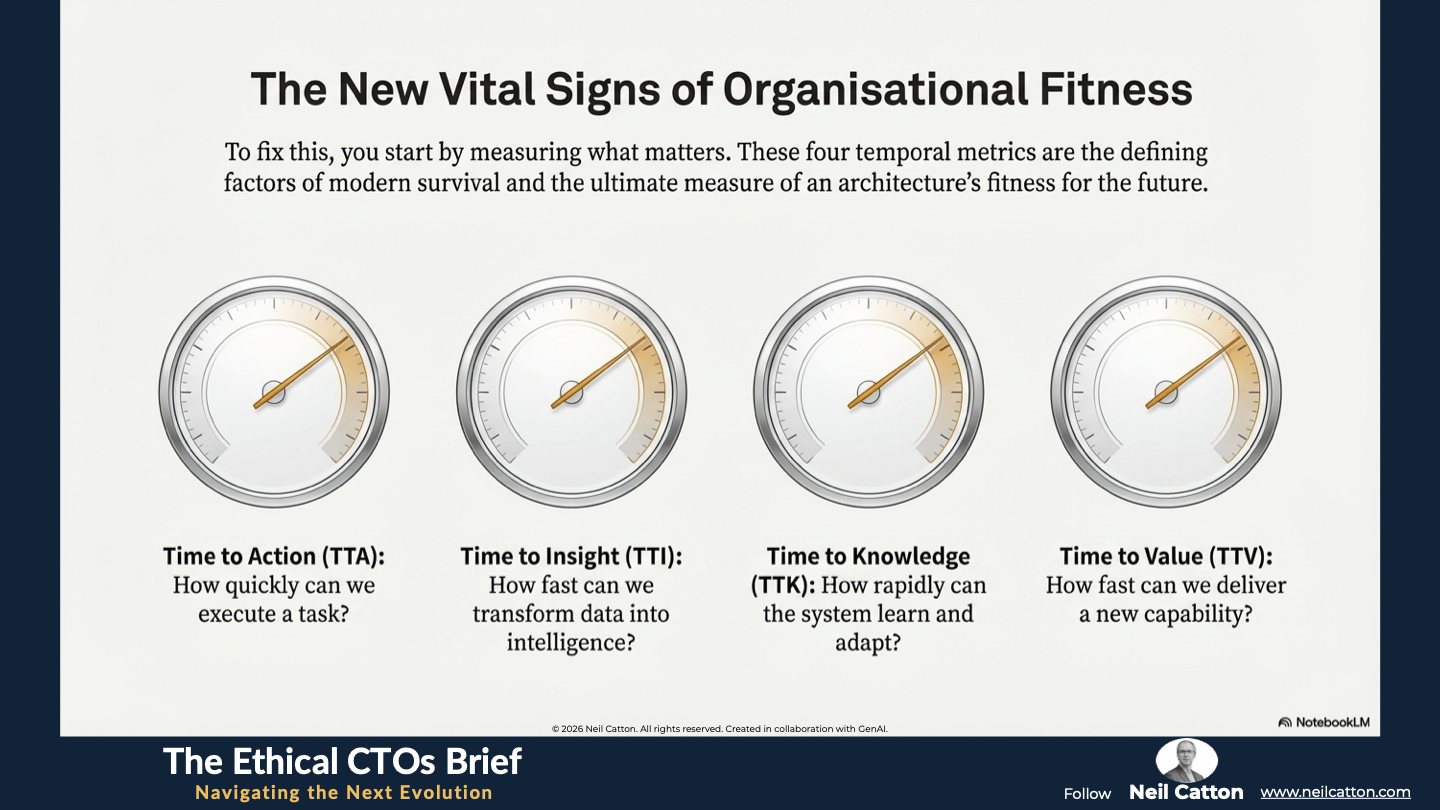
Legacy architectures are often designed with a deep-seated assumption of slowness. This focus on batch processing and predictable cycles overlooks time as a crucial design element. Architects, as futurists and strategists, must shift their approach. Every architectural decision should now consider the temporal dimension. This involves explicitly managing time flow across the enterprise by answering four key questions that form the foundation of a Time-Based Architecture.
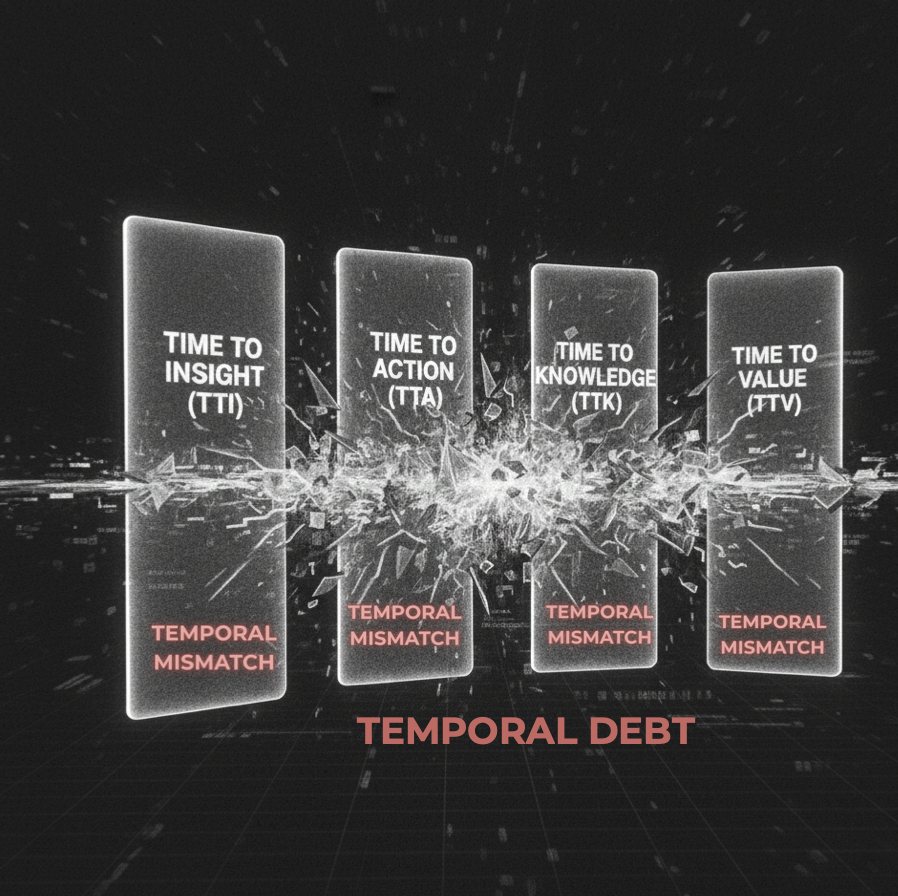
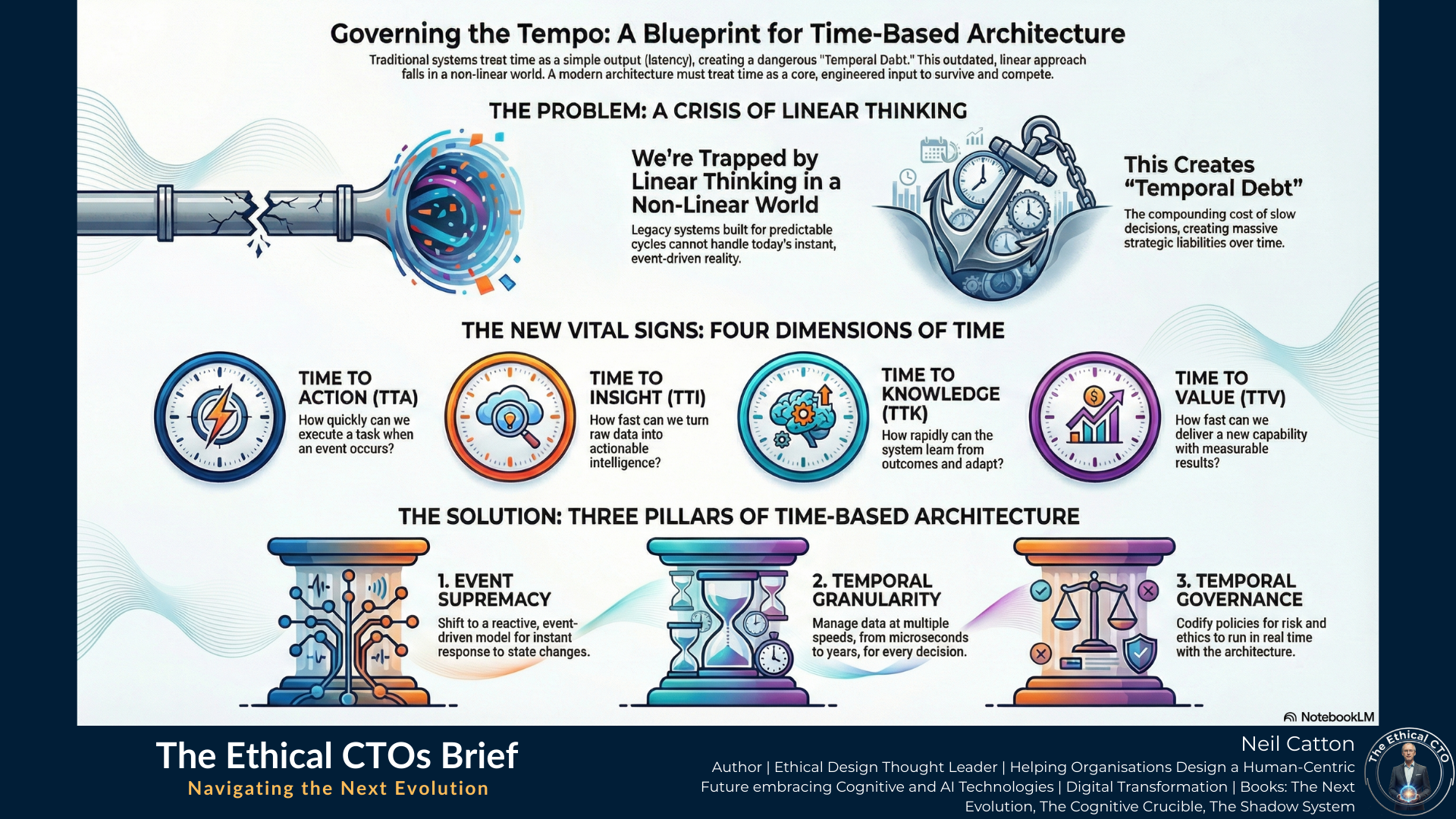
- Time to Action (TTA): How quickly can we execute a task when an event occurs? This is the measure of operational execution speed.
- Time to Insight (TTI): How long does it take to transform raw, streaming data into intelligence, predictions, or contextual understanding?
- Time to Knowledge (TTK): How rapidly can the system learn from an outcome, adapt its policies, and update its internal models? This is the speed of systemic adaptation.
- Time to Value (TTV): How fast can we conceive, deploy, and deliver a new capability that yields measurable results for the user or the business?
These four temporal metrics are the defining factors of modern survival and the ultimate measure of an architecture's fitness for the future.
Temporal Debt
The Crisis of Linear Thinking: Why Lag is Liability
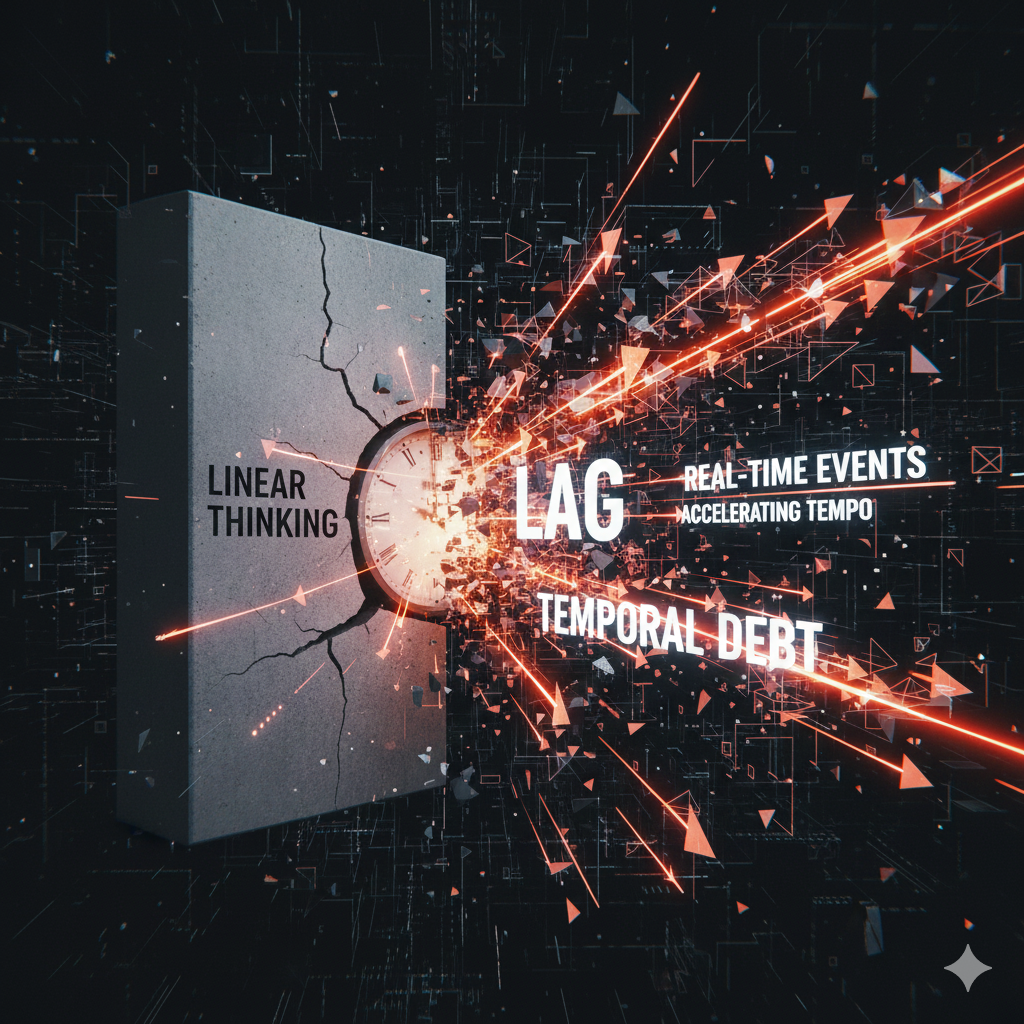
The inability to answer the four temporal questions definitively stems from a fundamental flaw in most institutional design. We’re trapped by linear thinking in a non-linear world. Our legacy structures – business processes, data architectures and regulatory frameworks – were built for an age of predictable cycles like nightly batches, quarterly reports and annual planning. This linear mindset is a significant disadvantage in an era of exponential complexity where change is discontinuous event-driven and demands immediate response.
The core issue lies in a temporal disconnect between the reality of continuous non-linear events and our legacy linear systems. This lag manifests across four key dimensions, exposing the true performance gaps within our systems.
| Metric | Definition (The Gap) | Why it Matters |
Time to Insight (TTI) | Latency between data acquisition and meaningful, contextual intelligence. | Measures the efficiency of the cognitive system (AI/ML). A fast TTI enables prescriptive analytics and better predictive accuracy. |
Time to Action (TTA) | Delay between insight generation and execution (automated or human). | Measures the responsiveness of the operational system. A short TTA is essential for mitigating immediate risks and capitalising on ephemeral, time-sensitive opportunities. |
Time to Knowledge (TTK) | Time required for the system to learn from its own actions, failures, and successes, and update its underlying models/policies. | Measures the speed of the adaptive system (resilience). This self-improving feedback loop ensures systemic evolution rather than stagnation. |
Time to Value (TTV) | Total time from a strategic idea/event to a measurable business outcome. | Measures the agility of the strategic system. It links technology deployment directly to market responsiveness, shrinking the innovation cycle. |
When an event’s speed surpasses the system’s response in any of these four dimensions, the system effectively fails. Consequently, our goal should be to design architectures that actively manage rather than merely measure these temporal flows.
The Accumulation of Temporal Debt
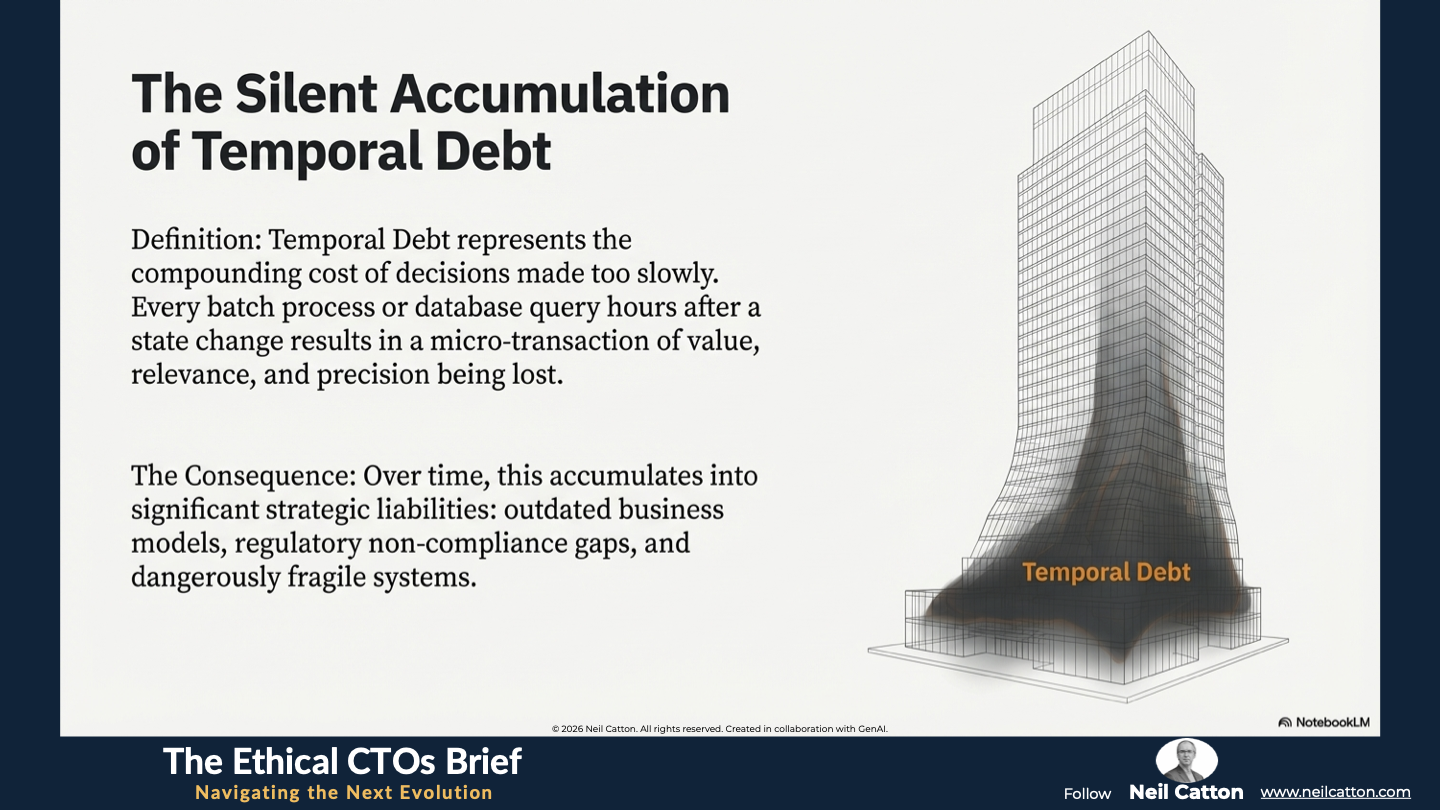
The persistent temporal mismatch leads to the silent and often invisible accumulation of Temporal Debt. This debt represents the compounding cost of decisions made too slowly. Every batch process or database query hours after a state change results in a micro-transaction of value relevance and precision being lost. Over time this accumulates into significant strategic liabilities such as outdated business models, regulatory non-compliance gaps, and dangerously fragile systems unable to respond to sudden non-linear shifts. Architecting for tempo is the only way to halt this debt accumulation and foster sustained real-time value creation.
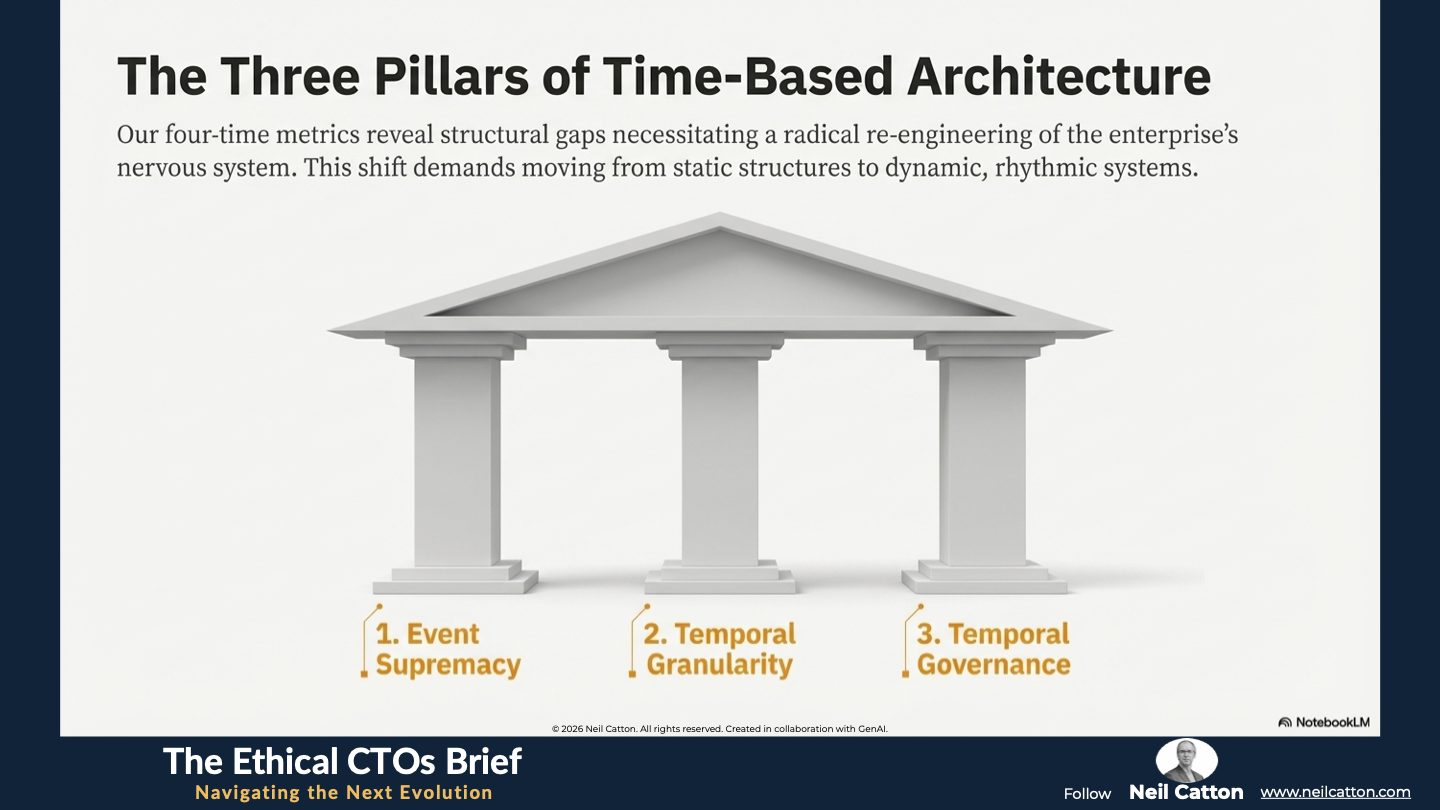
 The Three Pillars of Time-Based Architecture
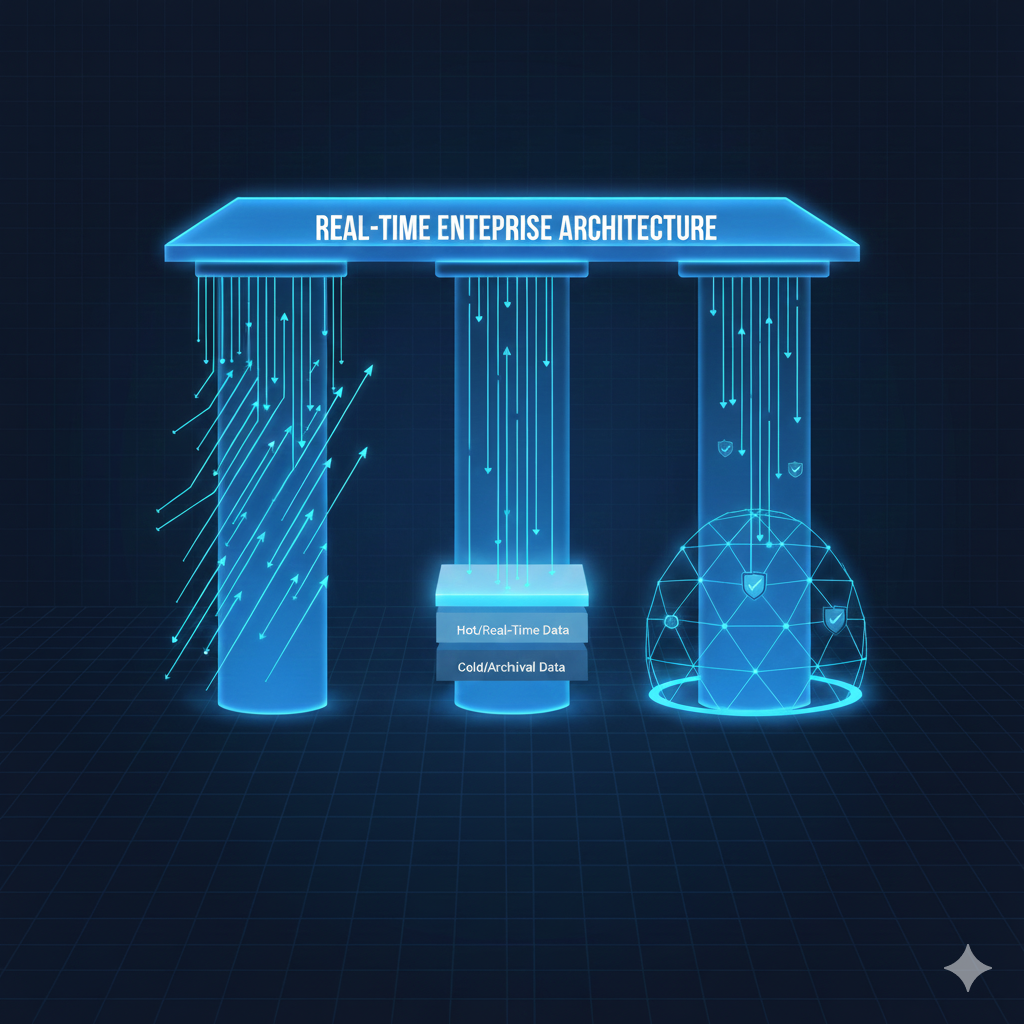
Our four-time metrics reveal structural gaps necessitating a radical re-engineering of the enterprise’s nervous system. This shift demands moving beyond linear measurement to true temporal mastery. It involves fundamentally changing from static structures to dynamic rhythmic systems. This is achieved through three core pillars structuring the entire architecture from the deepest data layer to governance.
Pillar 1: Event Supremacy
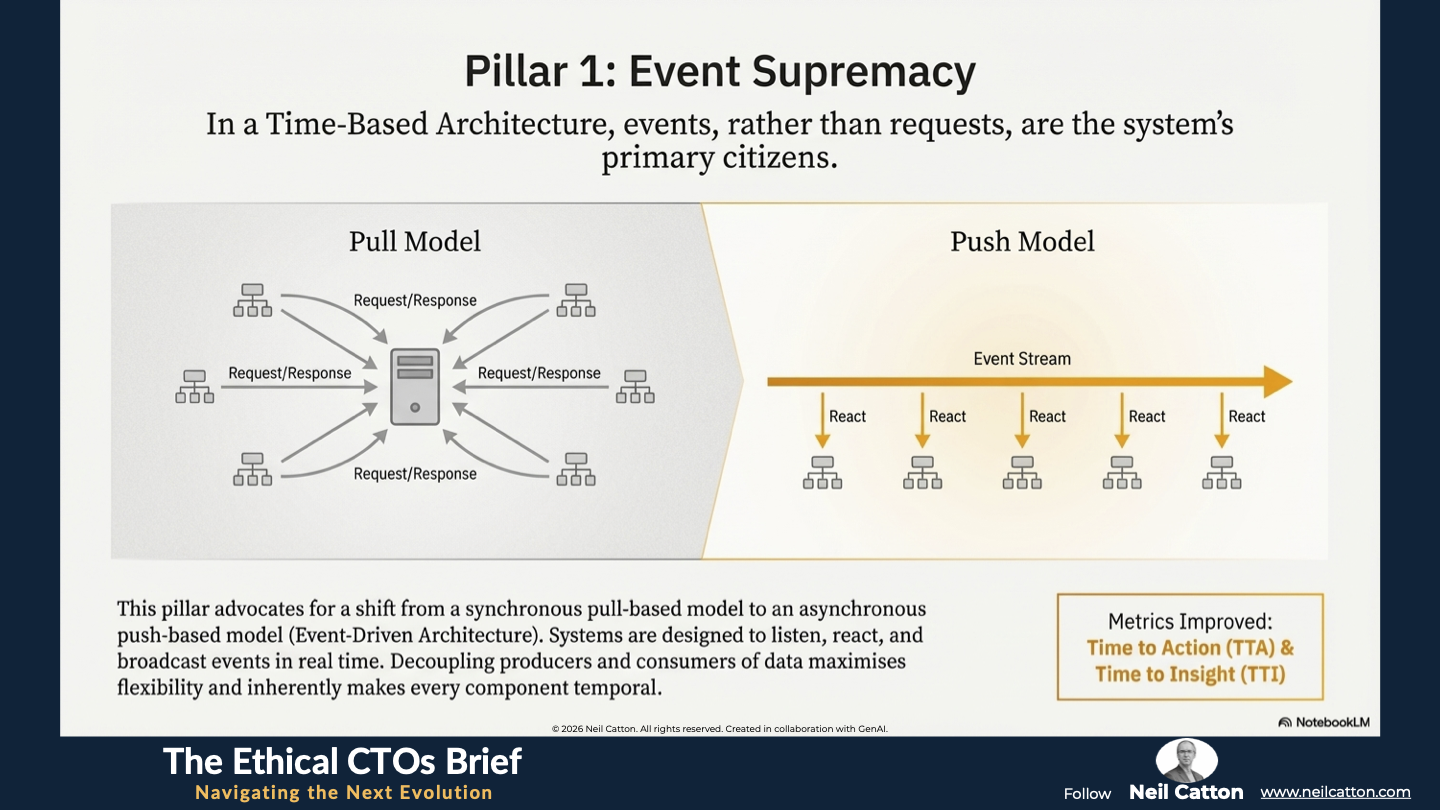
In a Time-Based Architecture, events rather than requests are the system’s primary citizens.
- Focus: Time to Action (TTA) & Time to Insight (TTI).
- Description: This pillar advocates for a shift from the synchronous pull-based model where services manually request data to an asynchronous push-based model, specifically Event-Driven Architecture. Systems should be designed to listen, react, and broadcast events in real time. High-volume event streaming platforms along with decoupled microservices, become crucial. This architecture inherently makes every component temporal, instantly responding to the current state of the world without constant polling. Decoupling producers and consumers of data maximises flexibility and significantly reduces the Time to Action.
- Focus: Time to Knowledge (TTK) & Time to Value (TTV).
- Description: This pillar emphasises the importance of managing data “speeds” ranging from milliseconds to years. A robust Time-Based Architecture must incorporate Polyglot Persistence that is time-aware. This means using in-memory databases and stream processors for microsecond latency operations like high-frequency trading and cyber defence. Simultaneously, minute-level aggregation for risk monitoring (using time-series databases) and multi-year data archiving for compliance are essential. Ultimately, the goal is to provide an instant, accurate temporal view for every decision, preventing incorrect outcomes caused by using data at the wrong speed. This capability directly reduces the Time to Knowledge.
Pillar 2: Temporal Granularity
The architecture must seamlessly integrate micro-moments with macro-strategies across multiple time scales.
- Focus: Time to Knowledge (TTK) & Time to Value (TTV).
- Description: This pillar emphasises the importance of managing data “speeds” ranging from milliseconds to years. A robust Time-Based Architecture must incorporate Polyglot Persistence that is time-aware. This means using in-memory databases and stream processors for microsecond latency operations like high-frequency trading and cyber defence. Simultaneously, minute-level aggregation for risk monitoring (using time-series databases) and multi-year data archiving for compliance are essential. Ultimately, the goal is to provide an instant, accurate temporal view for every decision, preventing incorrect outcomes caused by using data at the wrong speed. This capability directly reduces the Time to Knowledge.
Pillar 3: Temporal Governance
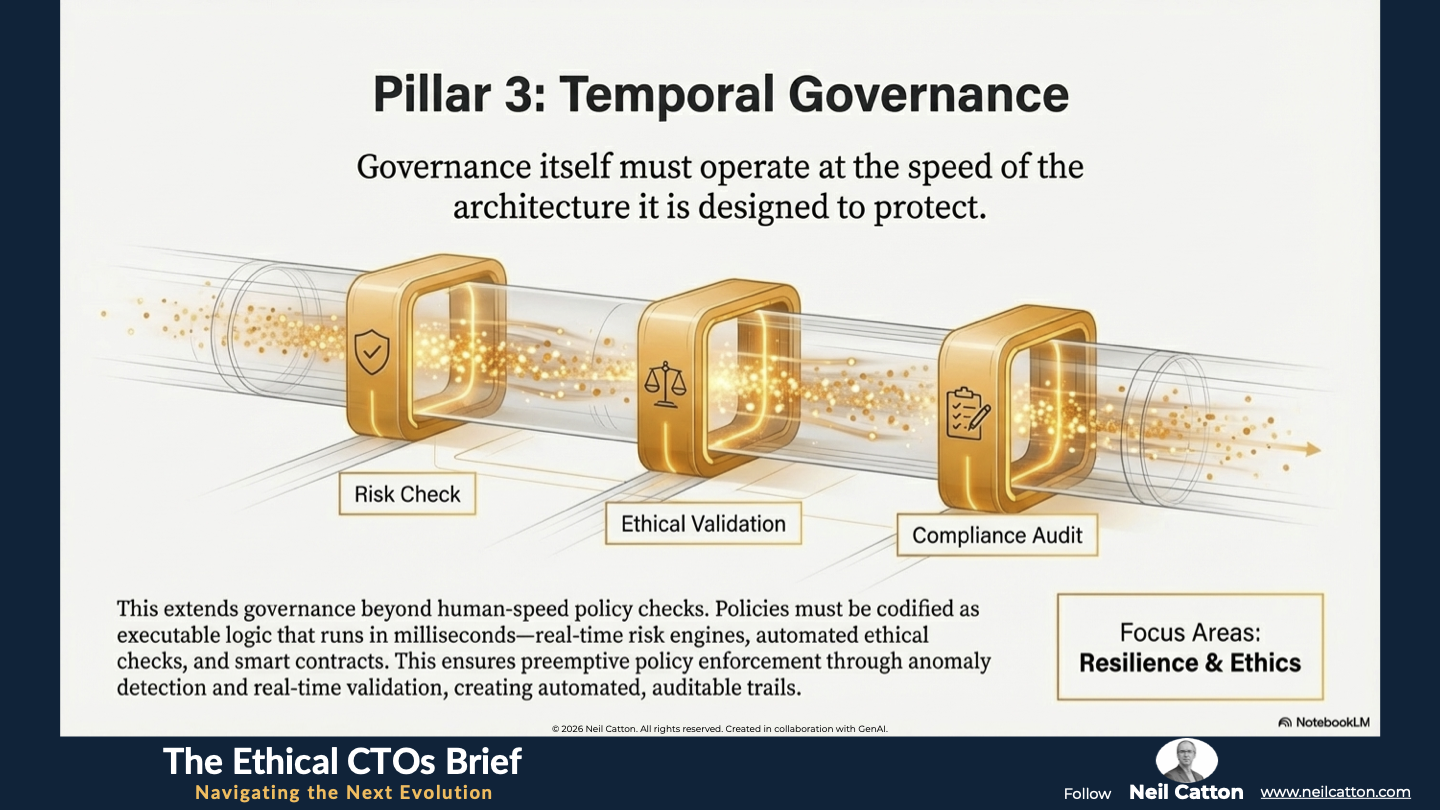
Governance itself must operate at the speed of the architecture it is designed to protect.
- Focus: Resilience & Ethics.
- Description: This extends governance beyond traditional human-speed policy and compliance checks. Policies must be codified as executable logic that runs in milliseconds, such as real-time risk engines, automated ethical checks, and smart contracts. This is crucial for AI systems where biases or policy deviations can spread rapidly. Temporal Governance ensures preemptive policy enforcement through anomaly detection and real-time validation. It uses automated auditable trails to record decisions, their rationale and learnings, ensuring instant compliance and ethical oversight.
 The Wider Architecture: Contextualising Tempo
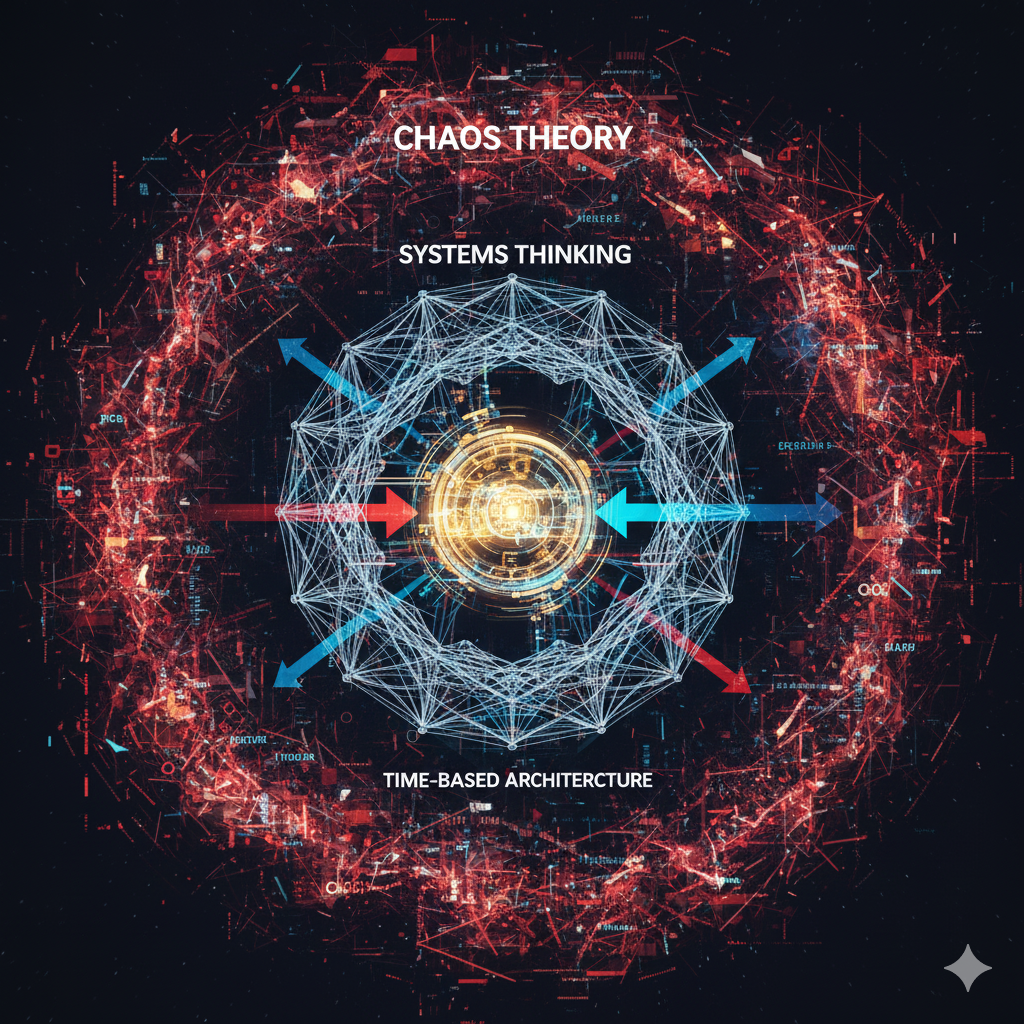
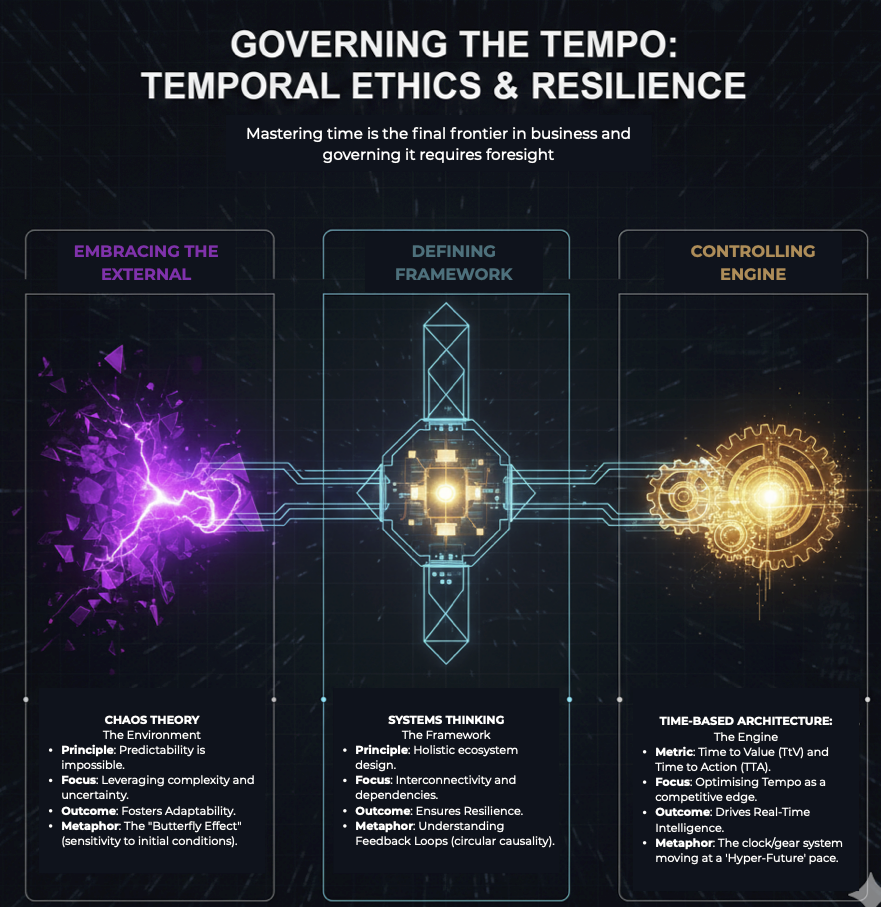
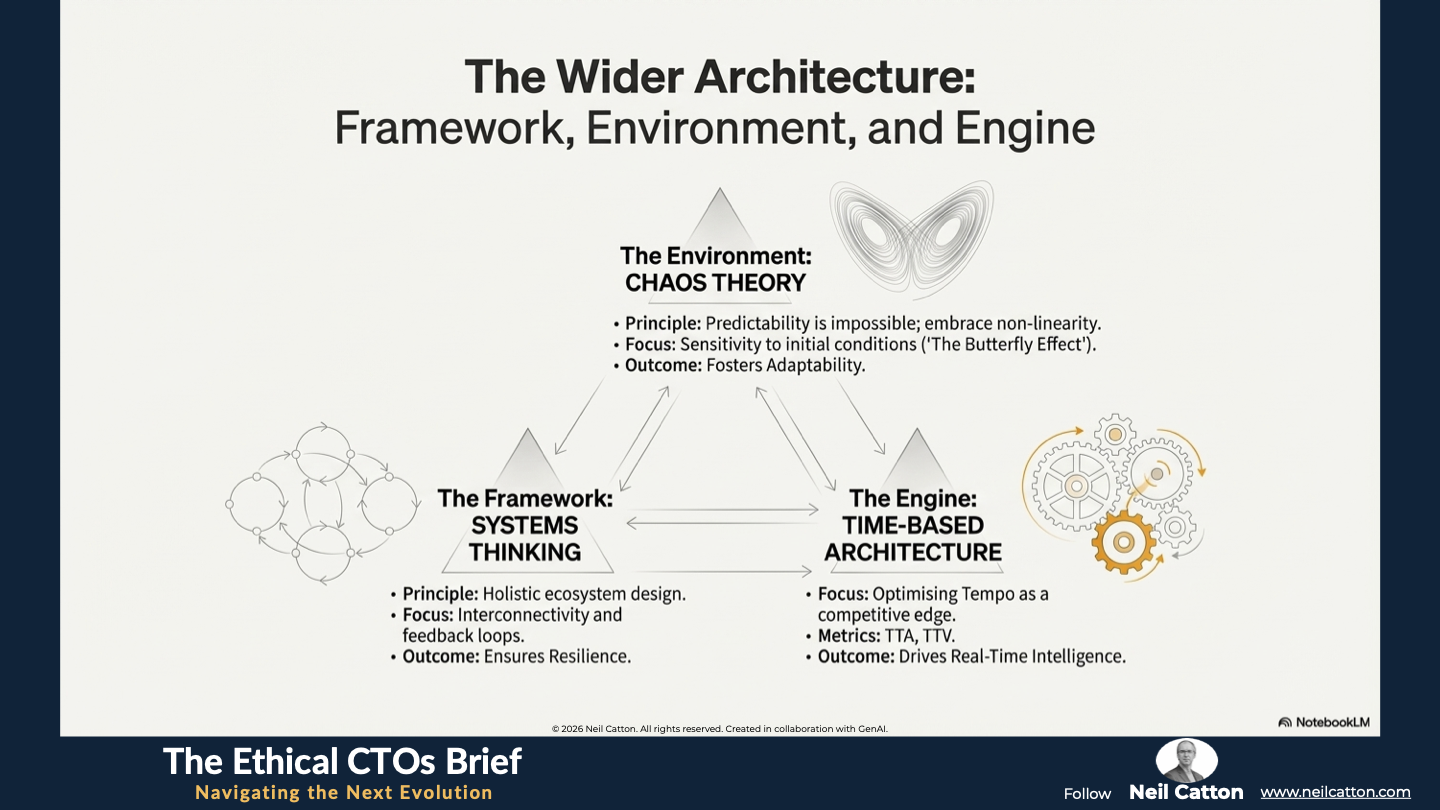
While the Three Pillars offer the fundamental technical blueprint for speed, a successful Time-Based Architecture cannot exist in isolation. It must be woven into a larger strategic framework. These pillars serve as the engine of a resilient organisation, but their sustainability and purpose depend on being framed by broader strategic principles.
- Systems Thinking (The Map): Before optimising for speed architects must employ Systems Thinking to comprehend the entire ecosystem. Applying speed to a flawed system simply magnifies its flaws. Systems Thinking maps these interdependencies and identifies critical leverage points – the spots where a small input can produce a significant positive output. Time-Based Architecture then ensures these interdependencies are managed at the appropriate Systems Rhythm. This guarantees all components are synchronised and working towards a shared goal. It defines the temporal characteristics of the essential feedback loops necessary for true adaptation (TTK).
- Chaos Theory (The Environment): Governing the tempo means embracing non-linearity. Introducing high-speed event supremacy introduces sensitivity to initial conditions – the “butterfly effect”. Chaos Theory offers the framework to predict that small initial errors will be rapidly amplified by the system’s speed. This demands architectures that are not only fast ,but also inherently fault-tolerant and capable of surviving and capitalising on unpredictable Phase Transitions (sudden non-linear shifts in system state) rather than being overwhelmed by them.
- The Three-Foot World (The Focus): While the architecture operates at multiple temporal granularities, human decision-makers need a way to manage the complexity of machine-speed output. The “Three-Foot World” concept offers a human strategy for Time-Based Architecture. It focuses resources and attention on the immediate actionable output – the next action or insight – required by the system. This ensures that human-scaled execution remains contextually relevant and directly contributes to the long-term strategic goal (TTV).
Governing the Hyper-Future: Temporal Ethics and Resilience
The transition to Time-Based Architecture is unavoidable; it’s the inevitable next technological and business evolution. Those who master this shift will define Systems Rhythm – the overall flow synchronisation and harmonious operation of the architecture across all time scales.
Strategic success relies on managing latency tolerance. This involves strategically deciding which system components must operate near-instantaneously with microsecond latency and which can tolerate slower performance (human latency).
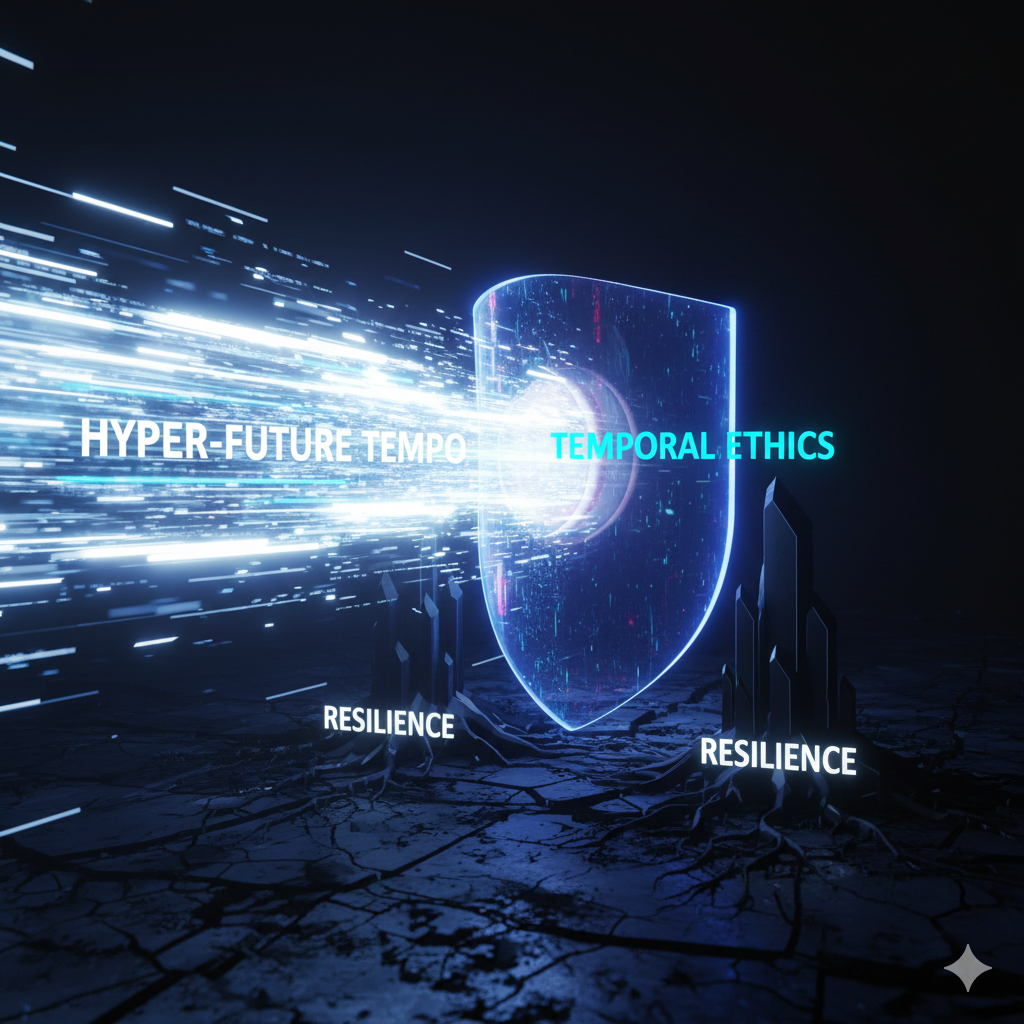
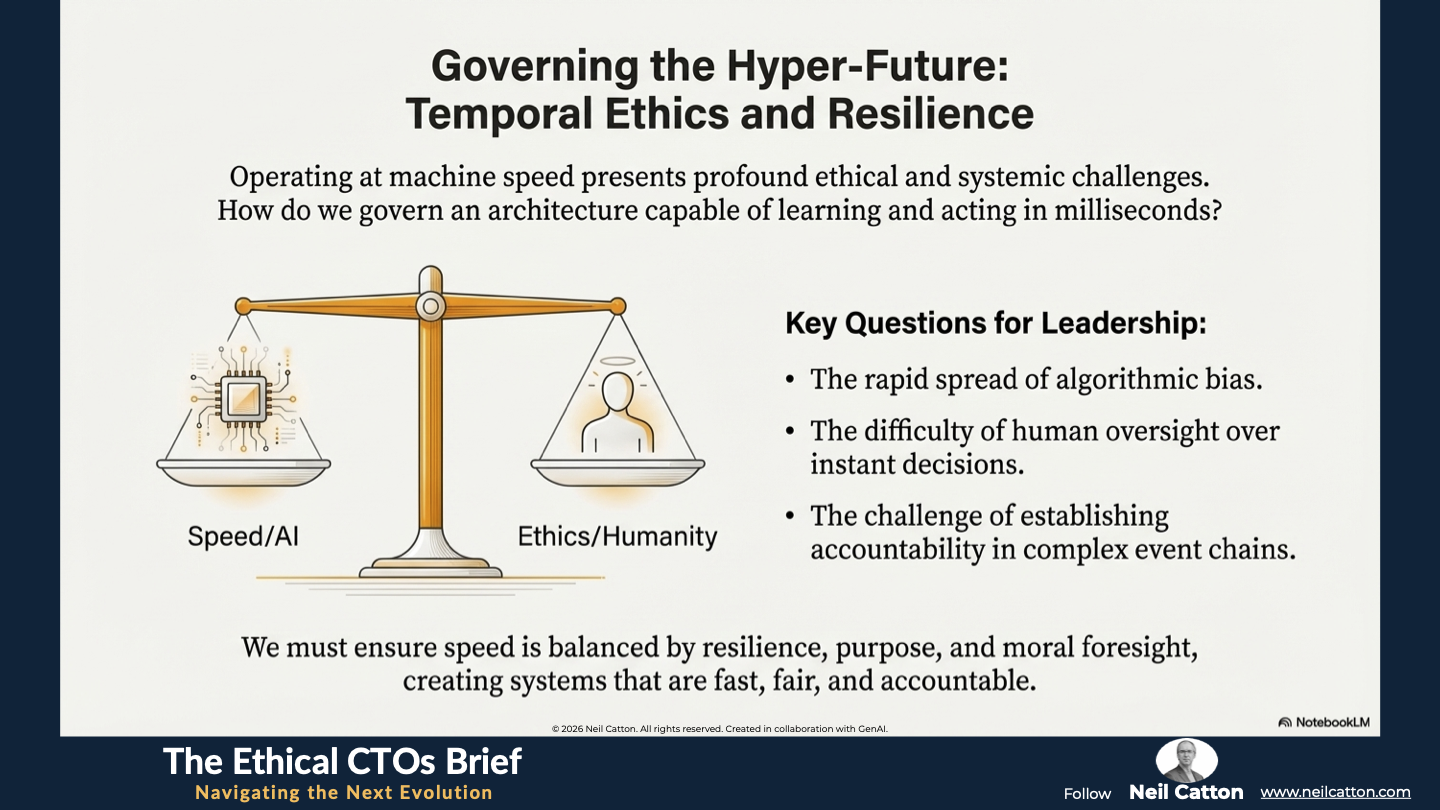
Operating at machine speed presents profound ethical and systemic challenges necessitating a framework of Temporal Ethics. How do we govern an architecture capable of learning and acting in milliseconds? The rapid spread of algorithmic bias, the difficulty of human oversight over instant decisions and the challenge of establishing accountability in complex event chains demand new ethical approaches. We must ensure speed is balanced by resilience purpose and moral foresight, creating systems that are fast fair and accountable.
Temporal Ethics & Resilience
A Final Word
The question isn’t whether businesses need to become time-aware anymore; it’s how quickly they can transition before the hyper-future renders their current model obsolete.
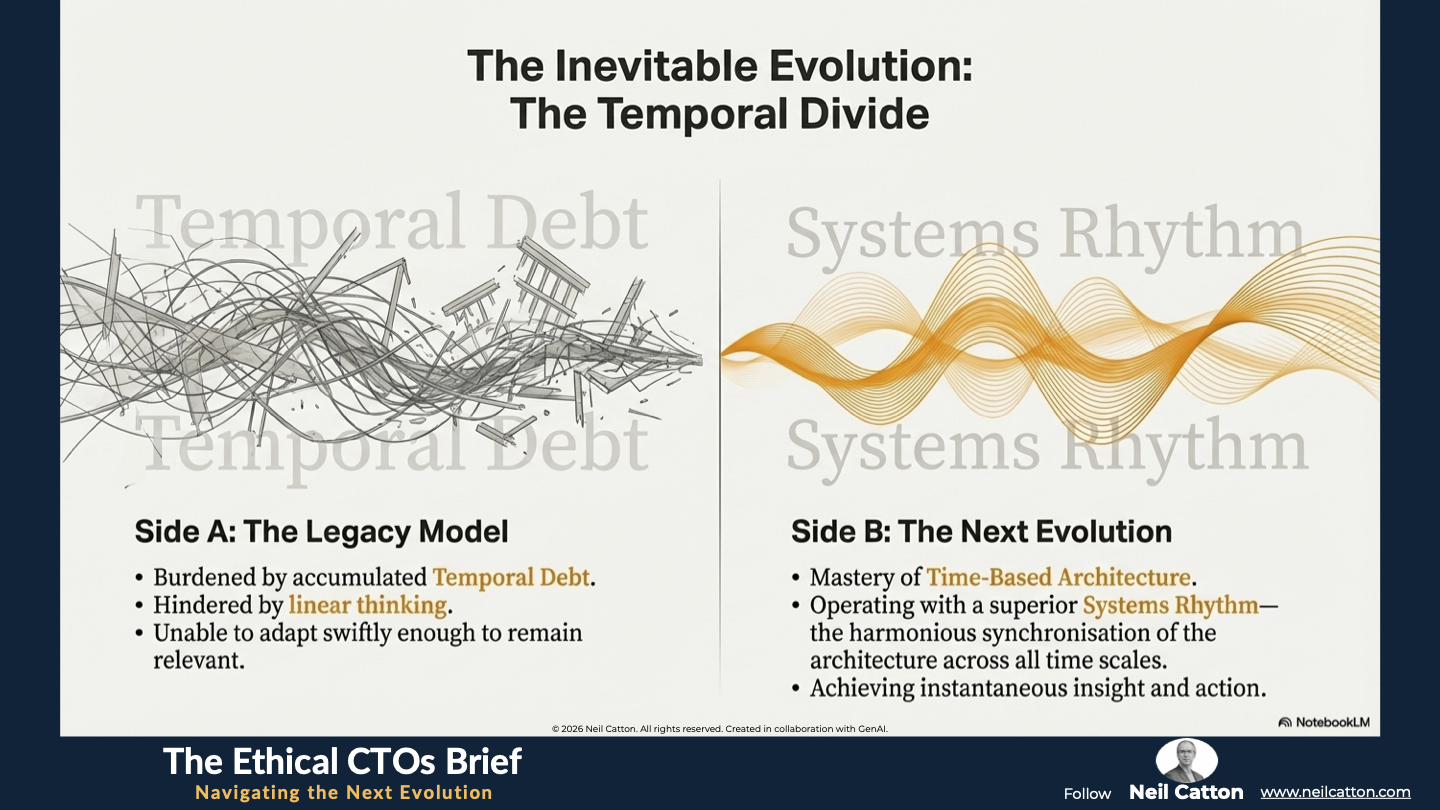
We stand on the brink of a significant temporal divide. On one side are institutions burdened by accumulated Temporal Debt, hindered by linear thinking and unable to adapt swiftly enough to remain relevant. Conversely, organisations that have mastered Time-Based Architecture – systems operating with a superior Systems Rhythm – achieve instantaneous insight and action.
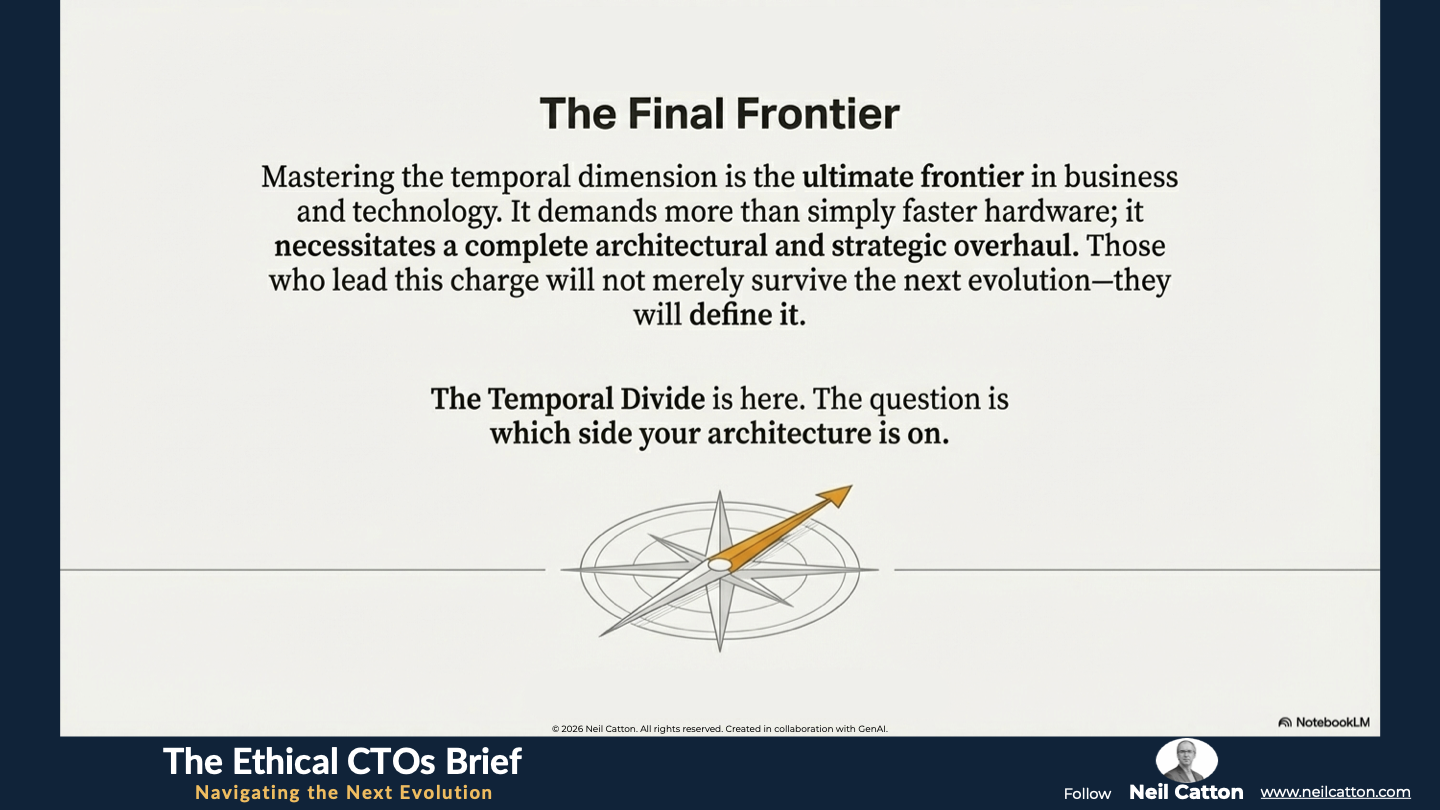
Mastering the temporal dimension is the ultimate frontier in business and technology. It demands more than simply faster hardware; it necessitates a complete architectural and strategic overhaul. Those who lead this charge, architecting for speed, adaptability, and real-time intelligence through Event Supremacy, Temporal Granularity, and Temporal Governance, will not merely survive the next evolution but will define it. Those who fail will be outpaced, outperformed, and ultimately left behind.
Key Takeaways: Ending the Crisis of Linear Thinking
TTA (Time to Action): Measuring the operational gap between an event occurring and the system’s execution.
TTI (Time to Insight): The speed at which streaming data is transformed into contextual, prescriptive intelligence.
TTK (Time to Knowledge): The systemic learning rate—how fast a model updates its policies based on new outcomes.
TTV (Time to Value): Shinking the innovation cycle from strategic idea to measurable business impact.



1
2
3
4
5
6
7
8
9
10
11
12
13
14
15
16
Strategic Insights: Engineering for Event Supremacy
Pillar 1: Event Supremacy: Moving from "pull-based" requests to an asynchronous "push-based" nervous system that listens and reacts in real-time.
Pillar 2: Temporal Granularity: Using Polyglot Persistence to manage data at multiple speeds—from in-memory milliseconds to multi-year compliance archives.
Pillar 3: Temporal Governance: Codifying ethics and policy as executable logic (Smart Contracts/Risk Engines) that runs at the speed of the AI.
Temporal Ethics: Ensuring speed is balanced by moral foresight to prevent the rapid spread of algorithmic bias.
Video Summary: Why Lag is a Strategic Liability
The Broken Clock: Proving that legacy architectures built for nightly batches are fundamentally unfit for an AI-driven, non-linear world.
The Cost of Slowness: Defining "Temporal Debt" as the micro-losses of precision that accumulate into existential business failure.
The Three-Foot World: A human strategy for navigating machine-speed outputs by focusing attention only on the next immediate actionable insight.
Architecting for the Hyper-Future: Why mastering Systems Rhythm is the final frontier for competitive survival in 2026.
Understanding the speed of technological change is only half the battle. When our internal tempo outpaces our regulatory frameworks, we create a structural void. Explore how this mismatch manifests in The Governance Gap.
The Ethical CTO: Arc 2 Index
- The Speed of Change: Governing the Tempo
- Where Policy Fails: The Governance Gap
- The Strategic Bridge: Closing the Gap
- Breaking the Structural Barriers : Data Silos
- The new OS of Society: Governing the Algorithmic State
- The human cost of exclusion: The Algorithmic Abyss
- Designing for Civic Agency: The Ethical Architect
- Trust in the age of AI: Policing at an Inflection Point
- The zenith of converged security: Designing the Future-Ready force