how to leverage simple solutions for big problems in order to maximise efficiency and foster innovation.
Innovation is often seen as a complex, high-cost endeavour involving cutting-edge technology, intricate solutions, and massive teams. However, the most impactful innovations are not always those that require the most sophisticated tools or the largest budgets. Instead, some of the most effective innovations are simple, practical solutions that solve big problems efficiently and sustainably.
In my experience, companies often overcomplicate innovation, overlooking straightforward fixes that can yield massive returns. In this article, we’ll explore why simplicity should be at the core of innovation, share examples of smart, simple solutions, and discuss how CTOs can cultivate a culture that prioritises practical problem-solving over flashy, complex projects.
What is Impact-Led Innovation?
Impact-Led Innovation is a strategic approach that prioritises the solution to a critical problem over the technology used to solve it. In the "Tech Truths" landscape, big impact is rarely the result of a single "magic bullet" technology; instead, it comes from:
Scalability: Choosing solutions that can grow across the enterprise rather than remaining in a pilot phase.
Value Alignment: Ensuring every technical shift directly supports a core organisational or societal goal.
Continuous Iteration: Moving from a "one-off project" mindset to a culture of constant, measurable improvement.
Why Simple Innovation Works
In a world where we’re bombarded with ever-evolving technologies and buzzwords like AI, blockchain, and quantum computing, it’s easy to think that innovation must be complex to be meaningful. However, true innovation doesn’t always come from chasing the next big technological advancement. Often, it comes from identifying a problem, understanding its root cause, and finding a solution that is effective and easy to implement.
In one of my previous organisations there was a yearly competition open to everyone, the remit was simple as it was about challenging whatever might need changing. Teams formed by themselves around daily business challenges and they were given the time and resources to develop out their pitch. All the pitches were reviewed and those that progressed were given the opportunity to present to senior leaders (Dragons Den), culminating in a gala event for the finalists. The result - the winning proposal was backed and implemented by the successful team.
This was a big global activity so it took some doing, but the proposals were about tackling things which employees saw everyday in their work. Anything from a spreadsheet with the weekend football scores for the customer support teams, to engineering solutions to help keep fibre cables in order whilst being worked on, to new data platforms to bring together the plethora of data across the organisation.
The point was it was practical innovation led by people who saw a solution. The lesson here is clear: overcomplicating innovation can lead to wasted resources. Simple solutions are often more sustainable, cost-effective, and easier to scale. They address the core issue without introducing unnecessary layers of complexity.
What CTOs Should Consider:
- Start Small, Think Big: When approaching a problem, start by asking, "What’s the simplest way to solve this?" Look for solutions that address the root of the problem directly and which can be implemented quickly, even if they seem low-tech or basic.
- Focus on Value, Not Complexity: Just because a solution is simple doesn’t mean it’s less valuable. In fact, simple innovations often deliver the best return on investment because they solve the problem without incurring additional complexity.
- Minimal Viable Solution: Ask yourself, what is the minimum we need to solve the problem and aim for that. Once the solution is proven it can be expanded as needed/necessary.
- No New Technology: Most organisations will already have technology that can be used to solve a problem, don’t do and buy something else before looking at what’s available.
- People know Better: Before heading into something, ask the people impacted first for their thoughts and ideas as it’s the people doing the role who know better what might be needed.
Examples of Simple, Effective Innovations
There are countless examples across industries where simple innovations have had profound impacts. Here are a couple that demonstrate how practical solutions can solve big problems:
- Google’s Search Algorithm: While Google is now a technological giant, one of its earliest innovations was a simple but revolutionary algorithm called PageRank. Instead of trying to outdo competitors with complex, overloaded web directories, Google used a simple ranking system based on backlinks, which led to far more relevant search results. The elegance and simplicity of this approach transformed the internet.
- Toyota’s Lean Manufacturing: Toyota’s approach to lean manufacturing is a classic example of simple innovation. By implementing just-in-time production and reducing waste at every step, Toyota became a leader in efficiency. The philosophy of continuous improvement, or Kaizen, focuses on making small, simple improvements that collectively lead to significant gains in productivity.
What CTOs Should Consider:
- Encourage a Practical Mindset: Promote a culture where practical, straightforward solutions are valued just as highly as complex innovations. Reward teams for solving problems efficiently, not just for adopting the latest tech trends.
- Simplify Processes: Review your company’s existing processes and identify areas where complexity is hindering progress. Simplifying workflows can lead to immediate improvements in productivity and performance.
The Pitfalls of Over-complication
One of the major reasons why organisations fail to innovate effectively is because they overcomplicate the process. CTOs often feel pressure to adopt cutting-edge technology, regardless of whether it fits the company’s needs or capabilities. While new technologies are exciting, they can introduce unnecessary layers of complexity, leading to longer implementation times, higher costs, increased risk of failure, and they may not deliver the value expected.
For example, a company might be tempted to deploy artificial intelligence (AI) to improve customer service by automating responses, but if the customer queries are simple, deploying a straightforward FAQ chatbot may achieve the same result at a fraction of the cost and complexity.
In many cases, the biggest challenge isn’t finding a solution, it’s resisting the urge to over-engineer it.
What CTOs Should Consider:
- Avoid Shiny Object Syndrome: Don’t get distracted by the latest tech trends or buzzwords. Focus on the technology that solves your business’s specific problems rather than adopting new tools for the sake of it.
- Test Solutions in Stages: Before implementing a complex solution across the organisation, test a simple version in a limited capacity. If the simpler approach solves the problem effectively, there’s no need to add extra layers of technology or complexity.
- Glass Half Full or Empty: Don’t over think or engineer the problem-solution, make it fit for purpose.
Fostering a Culture of Practical Innovation
One of the most important roles a CTO plays is fostering a culture that encourages practical, efficient innovation. This means building a mindset within your organisation that focuses on solving problems pragmatically, rather than seeking out the most advanced or sophisticated technology for every challenge.
This isn’t an easy task as organisations can become locked into silo thinking which blocks innovation. Where you have multiple teams all vying for resources and ownership it can be difficult to have clarity on solving a problem. But consider the possibility of Swarming Teams tasked with looking for and developing fast-paced innovation from across the business. Some other things to consider are:
- Encourage Creative Problem-Solving: Encourage your teams to approach problems with a creative, solution-oriented mindset. Give them the freedom to explore different approaches, even if they seem unconventional.
- Promote Collaboration: Often, the best innovations come from cross-functional teams working together. By bringing together people with different perspectives and expertise, you can generate ideas that might otherwise be overlooked.
- Reward Simplicity: Create incentives for teams to solve problems in the simplest way possible. Recognise and reward employees who come up with cost-effective, low-tech solutions that still have a significant impact.
- Focus on Continuous Improvement: Adopt the principle of Kaizen, which focuses on making small, incremental improvements over time. By continuously refining processes, your organisation can innovate smarter and more sustainably.
Innovation isn’t one thing
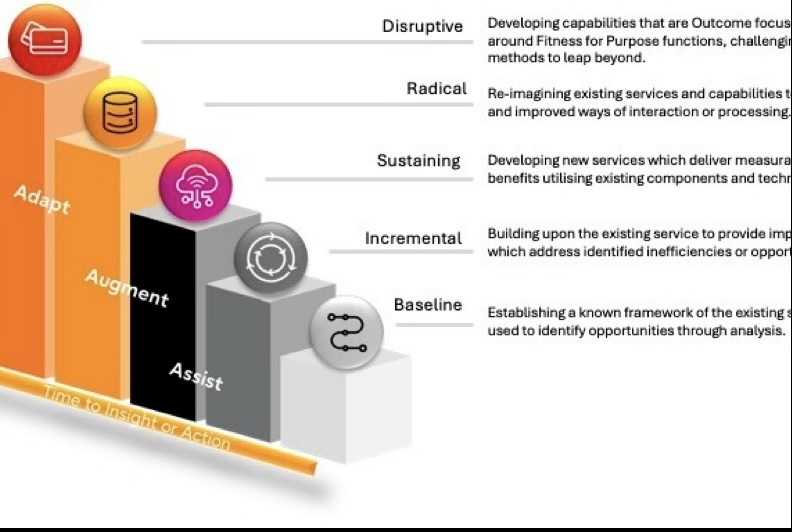
Organisations see Innovation as a “thing” when in fact it is a mindset of how to make changes that make a difference. The scale of the change needs to be consider to understand when, where, what, how and why value can be realised. I use a 5 layer model for describing innovation - level 1 is the Baseline where it’s reviewing the existing People, Process, and Technology landscape to identify simple candidates for change; Level 2 is Incremental change which builds upon existing capabilities to make them better; Level 3 is Sustaining where it’s about developing new services/capabilities using existing components and/or technologies; Level 4 is Radical and it’s about re-imagining services and capabilities to do them in totally different ways; and Level 5 Disruptive which is about challenging everything and implementing totally new ways of doing things.
What is important in any innovative change is to understand a couple of dimensions, firstly Time to Insight or Action - how long do you have to perform something based on an input; and secondly Time to Value - how quickly will you see benefits. The more disruptive the innovation the longer the Time to Insight or Action becomes, and the benefit realisation can be way longer.
So when looking for “Innovation” have a clear understanding of what it is you are trying to change, why you are doing it, how you will go about it and when will you realise value.
Conclusion: Simplicity is the Key to Innovation
Innovation doesn’t have to be complex, in fact, some of the most successful innovations are simple solutions to big problems. Businesses often overlook straightforward fixes in favour of expensive, high-tech solutions, however, CTOs who focus on practical problem-solving can unlock immense value by keeping things simple.
By fostering a culture of practical innovation, promoting creative problem-solving, and avoiding the trap of over-complication, CTOs can lead their organisations toward more sustainable, cost-effective solutions. Remember, the goal of innovation isn’t to adopt the flashiest technology, it’s to solve real problems and create value in the most efficient way possible.
The next time you face a big problem, ask yourself: What’s the simplest way to solve this? You might find that the best solution is far simpler than you imagined
Distinguishing automation from cognition: Cognitive Computing and AI
Separating hype from reality: Dispelling Technology Myths
Driving measurable strategic value: Innovate for Big Impact
Cultivating long-term strategic foresight: Looking Up and Forward
Navigating the technology adoption curve: Hype to Reality
Mastering fundamental industry shifts: Changing the Name of the Game
Committing to purposeful innovation: Innovating for a Better World
Addressing the human element of adoption: Behavioural Change is Hard