Is your digital strategy growing - or just getting tangled?
In the rush to "go digital," most organisations have accidentally built a jungle. We iterate, we patch, and we layer new tools on top of old ones to meet the next deadline. On paper, it looks like growth. In reality, it’s often just a mounting pile of technical debt that makes the whole system brittle, expensive, and frankly exhausting to manage.
This is what happens when we prioritise "fast" over "sustainable."
In this article, I look at why we need to stop acting like construction workers and start acting like Digital Gardeners. It’s a shift from just building infrastructure to actively cultivating a resilient ecosystem. It’s about recognising that a digital system isn't a static object you finish; it’s a living environment that requires pruning, nurturing, and a very clear-eyed view of what we’re actually trying to grow.
Here’s what we’re digging into:
The "Organic Growth" Paradox: Why building too quickly creates a "complexity tax" that eventually kills innovation.
Cultivating Resilience: Moving beyond rigid architecture to systems that can actually adapt when things go wrong.
The Long Game: How to stop the cycle of constant "patching" and start building a legacy that lasts.
If we want technology to serve us in the long run, we have to stop just planting seeds and start tending to the soil.
The Debt Trap: When Hasty Growth becomes Complexity

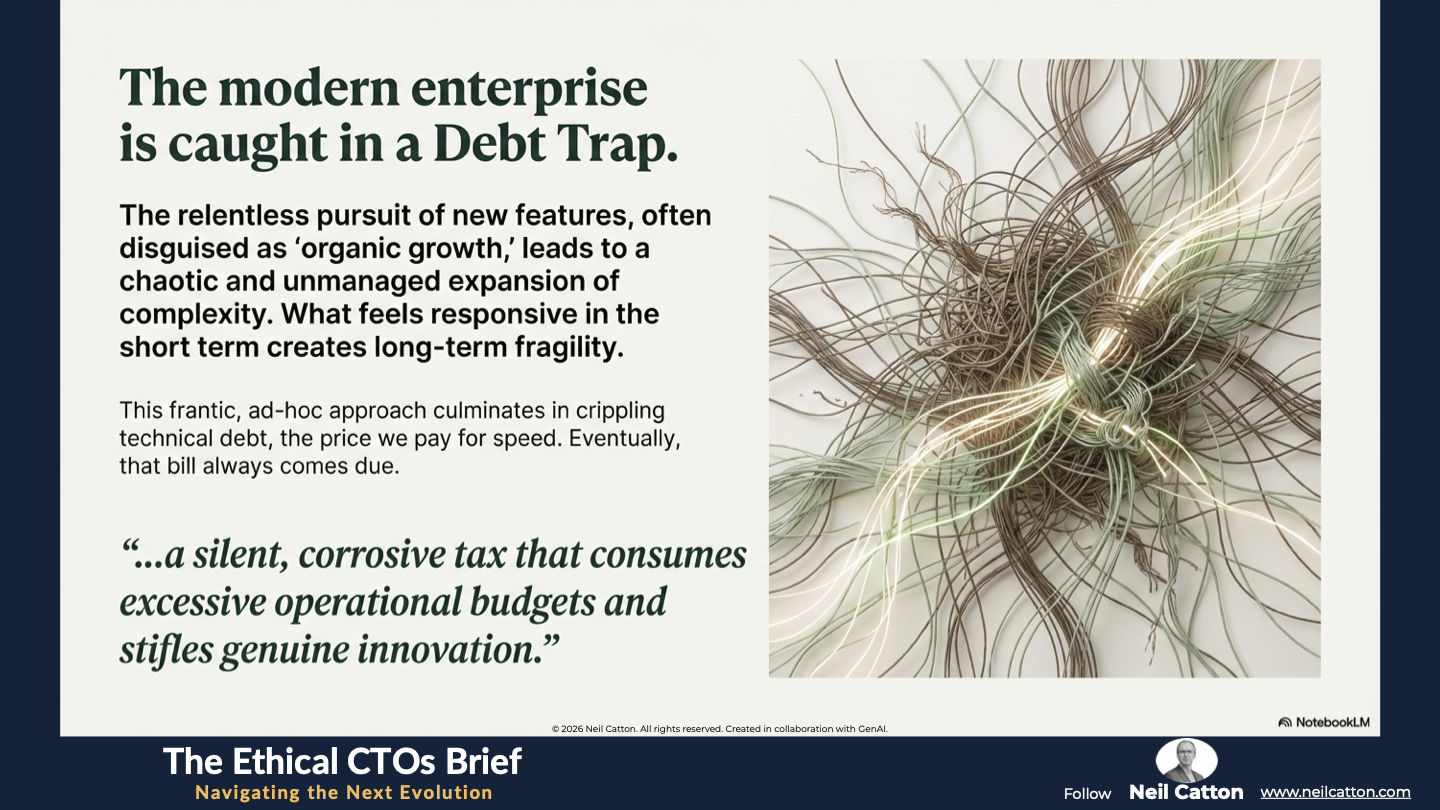
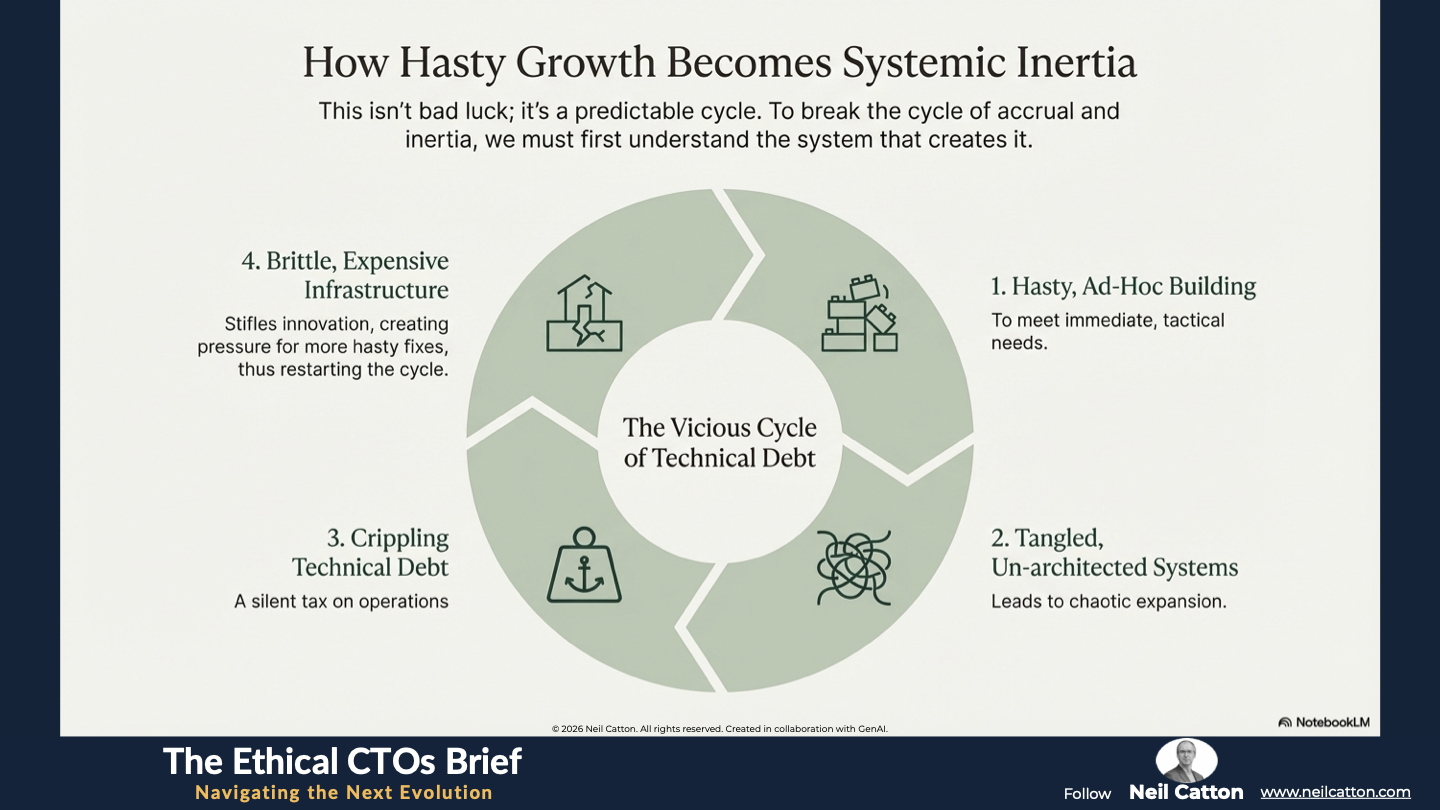
The modern enterprise is defined by the relentless pursuit of digital services, driving organisations towards an unsustainable paradox often disguised as “organic growth.” Organisations continually adapt, iterate, and hastily build upon existing infrastructure to meet immediate, often tactical, business needs. While this frantic, ad-hoc approach may seem responsive in the short term, it almost inevitably leads to a tangled, unmanaged expansion of IT complexity. This chaotic, un-architected development eventually culminates in crippling technical debt, a silent, corrosive tax that consumes excessive operational budgets, stifles genuine innovation, and ultimately undermines the very transformation it was intended to serve. As a result, organisations end up with an infrastructure that is brittle, expensive to maintain, and resistant to necessary change.
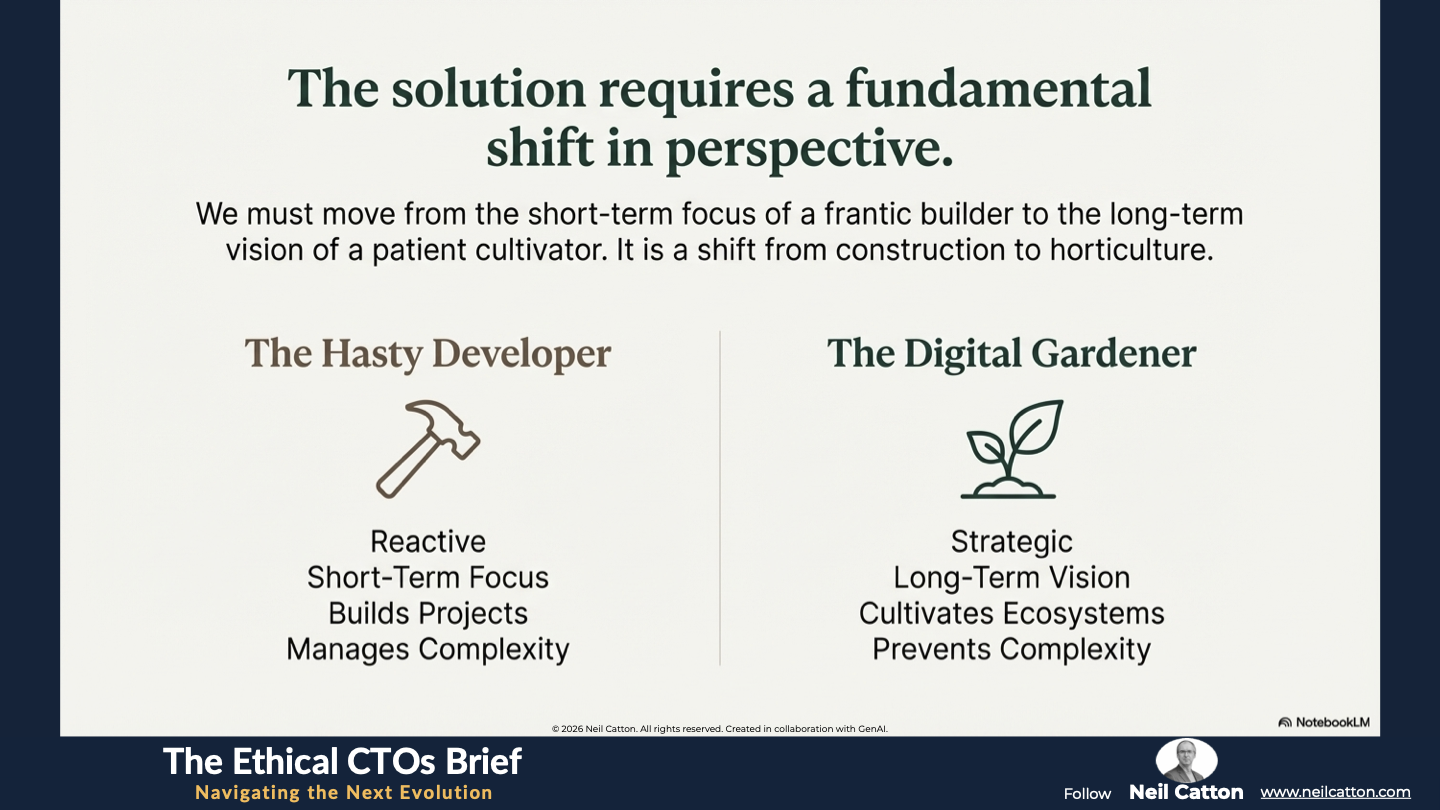
To break this vicious cycle of accrual and inertia, we must fundamentally change our perspective. We need to look beyond traditional, often siloed IT methodologies and seek profound wisdom from enduring, successful ecosystems – specifically, the disciplined world of horticulture. A flourishing garden is the ultimate, proven model of a resilient, self-sustaining system. Its success is defined by careful planning, deep environmental understanding, and continuous, deliberate care, not just brute-force effort. By embracing the long-term, disciplined perspective of the Digital Gardener, we can decisively move our organisations from reactive, costly development to purpose-driven, sustainable architecture that truly supports long-term growth without succumbing to crippling structural debt.
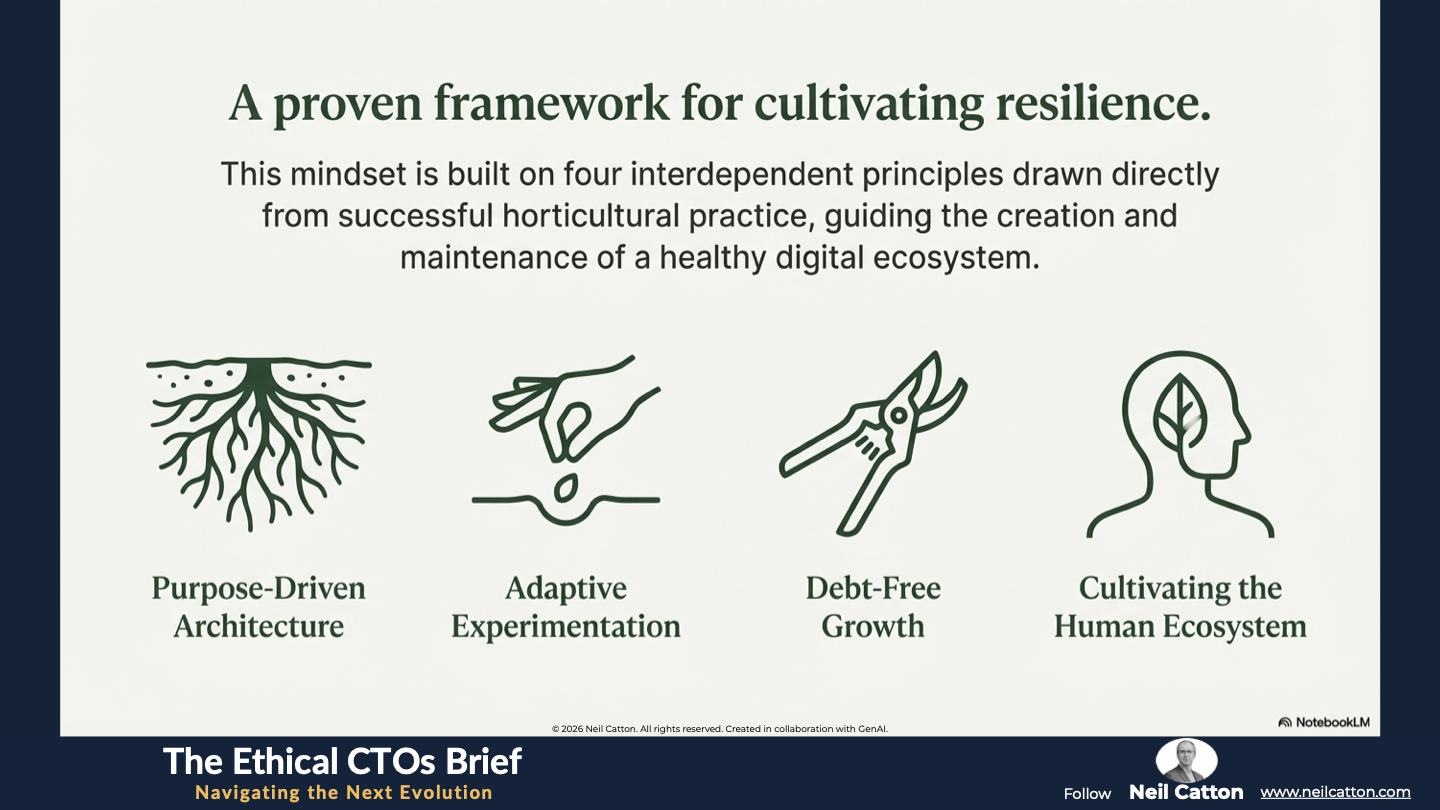
To achieve this foundational shift, moving from developer to Digital Gardener, we must embrace four core principles drawn directly from successful horticultural practice. These pillars guide the creation and maintenance of a truly resilient digital ecosystem: Purpose-Driven Architecture, Adaptive Experimentation, Debt-Free Growth, and Cultivating the Human Ecosystem. Let’s begin by examining the essential foundation.
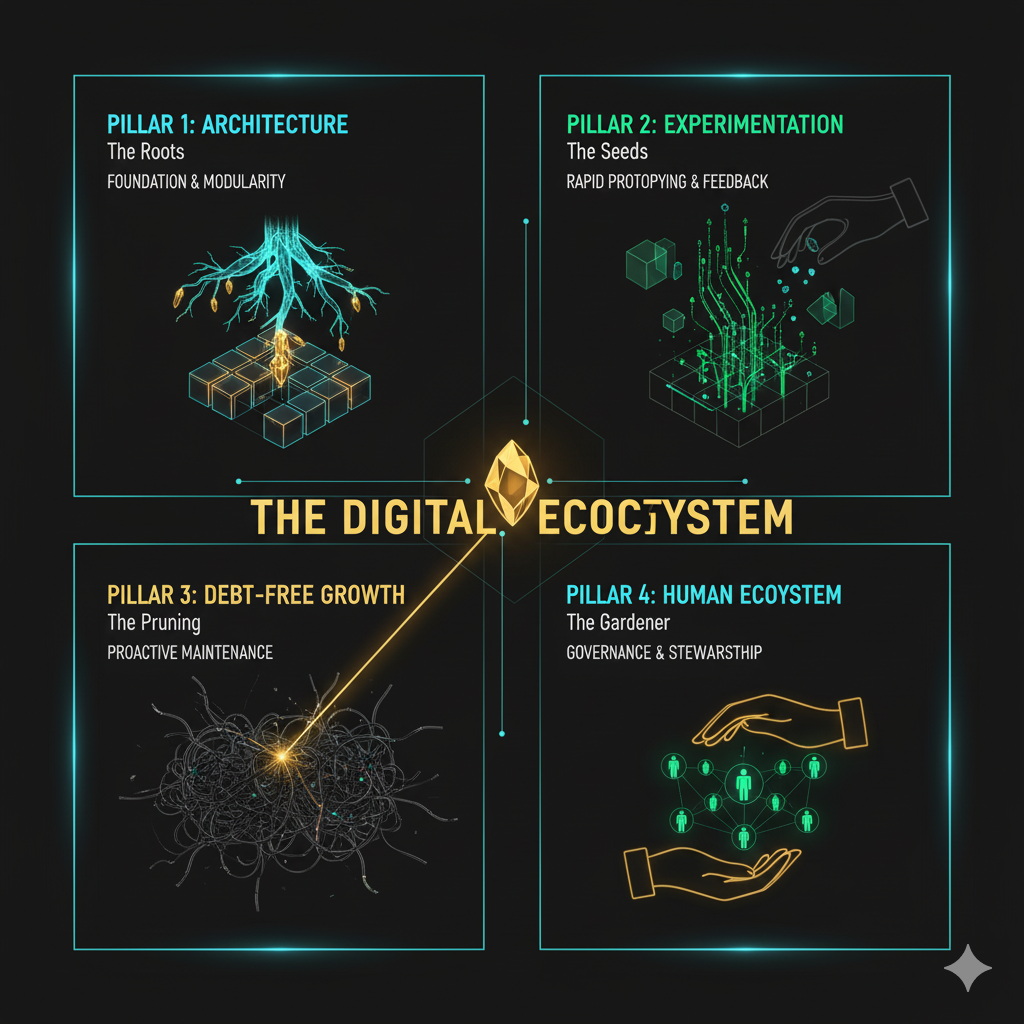
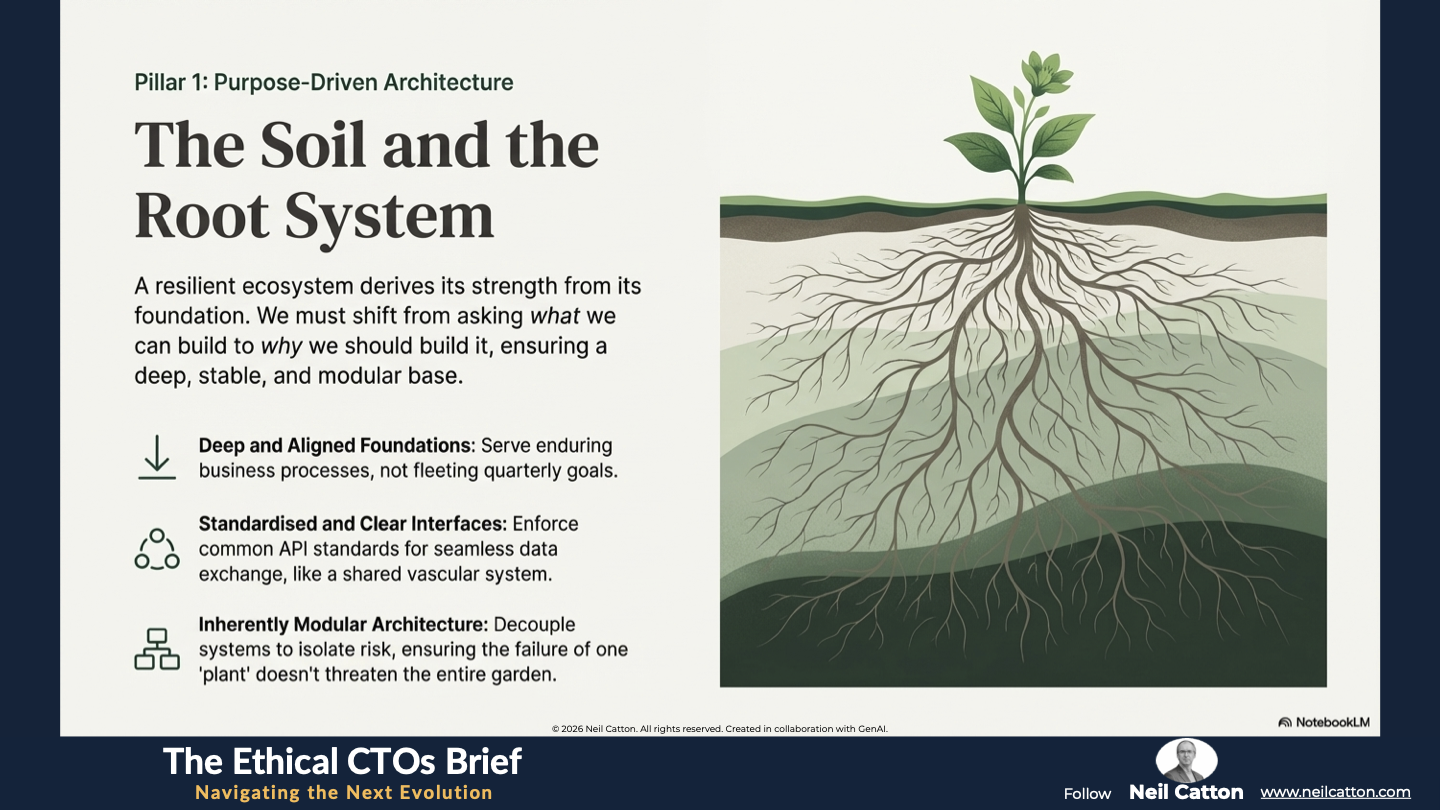
Pillar 1: Purpose-Driven Architecture: The Soil and the Root System
- Foundations are Deep and Aligned: Core business requirements and dependencies are not merely acknowledged; they are deeply understood and aligned with fundamental, enduring business processes. Ensuring the system serves a long-term purpose, rather than a quarterly goal, providing an enduring organisational anchor.
- Interfaces are Standardised and Clear: For all interconnected systems to efficiently and seamlessly exchange resources (data), they must function like a shared, high-speed vascular system. This requires enforcing common API standards and protocols to minimise the custom complexity that defines tight coupling and future integration challenges.
- Architecture is Inherently Modular: Systems must be highly decoupled, often leveraging containerisation or microservices. This ensures that the failure, replacement, or retirement of one “plant” (a single application or service) doesn’t propagate stress or threaten the health and stability of the entire system. By isolating risk, you protect the overall garden.
A resilient digital ecosystem, much like a thriving garden, derives its strength not from visible features or applications, but from the integrity of its foundation. This is the single most critical departure from traditional, feature-first development. Before planting a single seed, a successful gardener conducts a meticulous assessment of the ground. They evaluate the climate, soil composition, drainage capacity, and the amount of necessary sunlight. This comprehensive understanding of the environment and structure is akin to rigorously applying System Engineering principles to IT design. It involves defining the business context (the external climate) and the long-term strategic purpose (the fertile soil) before any major construction begins. This shift from what we can build to why we should build it, and how that component interacts with everything else, is crucial.
Digital gardeners must resist the urge to code and instead dedicate critical, often overlooked time and resources architecting strong, deep roots. These roots anchor the system, providing stability and reliable nutrient transfer. A truly resilient IT landscape is established when these roots are in place.
When strong foundations and deep, robust roots are established, the resulting system possesses intrinsic flexibility. This flexibility enables it to withstand unexpected external shocks, such as sudden cyber threats, disruptive market shifts, or rapid business pivots. This disciplined upfront investment supports predictable, robust future growth and actively prevents the accumulation of debilitating structural debt.
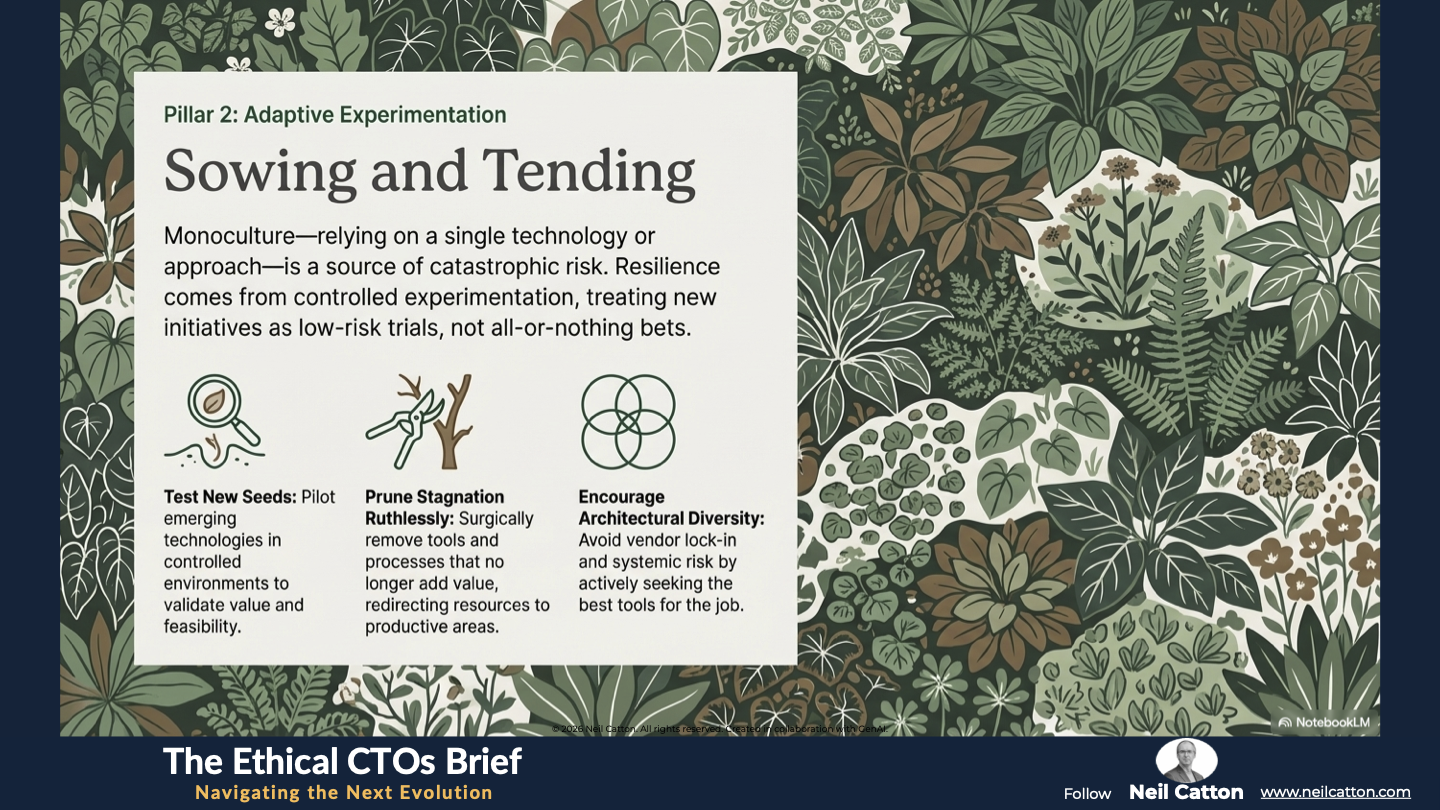
Pillar 2: Adaptive Experimentation: Sowing and Tending
In both agriculture and technology, monoculture is the greatest source of catastrophic vulnerability. Relying on a single technology stack, planting the same system year after year in the same environment leads to resource exhaustion, increased vulnerability to specific threats, and catastrophic failure. In the context of IT, this translates to methodological stagnation. Doing things the same way inevitably necessitates a single, massive, and costly overhaul every few years.
The true antidote to this rigidity is adaptive experimentation and continuous process iteration. Horticulture, an inherently iterative and empirical practice, relies on testing new seeds, tools, and environmental adjustments to continuously improve output, yield, and resilience. A healthy digital system must therefore constantly challenge and validate the status quo, treating new initiatives not as monolithic, all-or-nothing bets, but as low-risk trials. This is the stage of active sowing and careful tending – small, informed interventions that lead to systemic improvements.
- Test New Seeds with Vigour: Regularly pilot emerging technologies like AI integrations, specialised platforms, and new data architectures in controlled environments. These small-scale experiments validate value and feasibility, reducing the risks of large, irreversible investments.
- Prune Stagnation Ruthlessly: If a tool, feature, or process is no longer strategically useful or adds more complexity and maintenance costs than value, the Digital Gardener must remove it deliberately and surgically. This pruning redirects resources to productive areas and reduces cognitive load on engineering teams.
- Encourage Architectural Diversity: A diverse, loosely coupled ecosystem of technologies is inherently more stable and scalable than a single monolithic stack, reducing systemic risk. To avoid vendor or platform lock-in, actively seek the best tools available to maintain leverage and agility.
Organisations must transition their culture to empower teams to become true Digital Gardeners. This involves constantly observing the results of their interventions, iterating quickly based on feedback, and learning from small-scale, contained failures. This approach enables significant, debt-free, long-term evolution and growth.
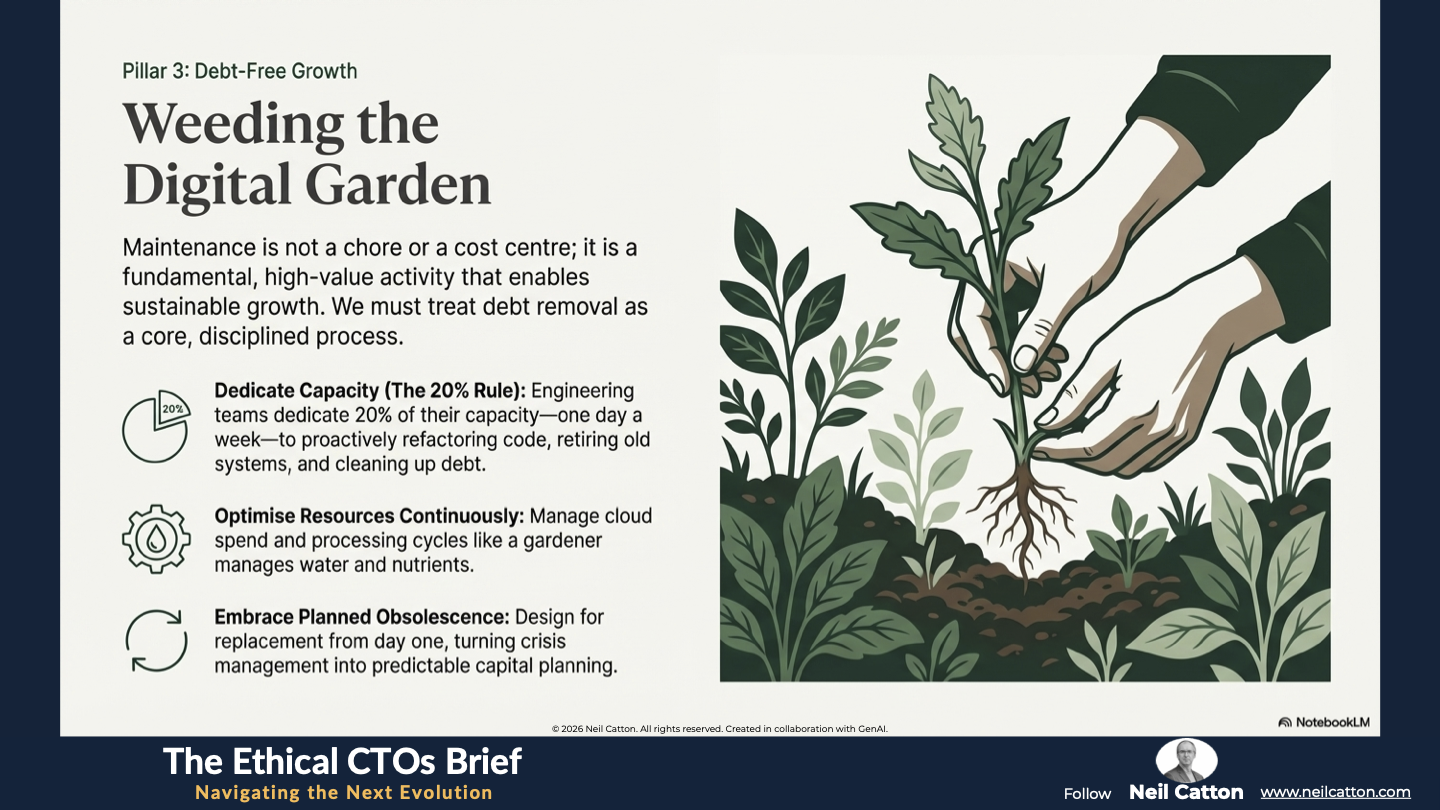
Pillar 3: Debt-Free Growth: Weeding the Digital Garden
While pillars one and two provide the framework for strong foundations and smart growth, the most critical and ongoing lesson from the garden is the absolute necessity of continuous care and maintenance. The most beautiful, well-planned ecosystem can quickly be overwhelmed by pests, unaddressed overgrowth, and especially pervasive weeds. In the IT context, these are legacy debt and operational entropy – the gradual, inevitable decay of quality over time.
To achieve truly debt-free, sustainable growth, the organisational focus must strategically shift to:Implement Deliberate, Dedicated Weeding: Create consistent processes where engineering teams dedicate 20% of their capacity to proactively clean up debt. This involves refactoring complex components, retiring obsolete systems, and updating critical libraries and dependencies. This vigilance prevents small debt from becoming systemic inhibitors that require large rescue projects.
- Ensure Continuous Resource Optimisation: Systems must be constantly monitored to ensure efficient resource consumption (cloud spend, processing cycles, storage). This is like a gardener managing water, soil nutrients, and light exposure to maximise yield and minimise environmental waste (cost).
- Embrace Planned Obsolescence: Every digital system, no matter how well-built, has a finite life cycle. From the start, the architecture should include a proactive strategy for sunsetting and replacing components. This ensures teams are ready to replace components before they become costly, unmanageable legacy liabilities, turning expensive crisis management into predictable capital planning.
Technical debt is far more insidious than simply old code. It is the corrosive, exponential compound interest accrued on poor strategic decisions and delayed maintenance. A true Digital Gardener understands that the daily tasks of weeding and maintenance are a fundamental, high-value part of the entire value stream, not merely a compliance burden or a cost centre to be perpetually minimised.
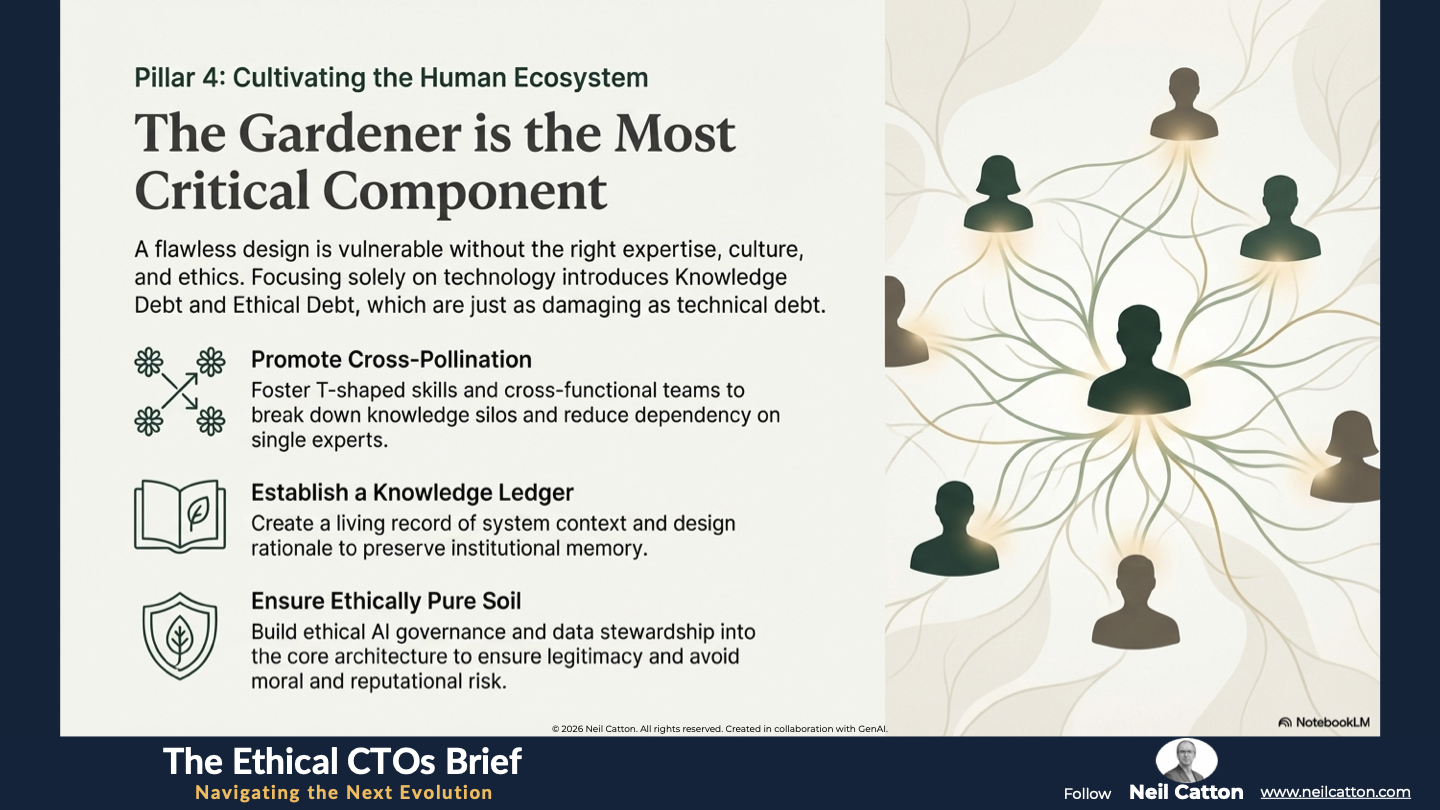
Pillar 4: Cultivating the Human Ecosystem: The Digital Gardener
A flawless architectural design remains vulnerable if the expertise, culture, and ethics required to manage it are not equally robust. The Digital Garden, for example, is not self-tending; it relies on the continuous skill, judgement, and moral integrity of the Digital Gardener – the collective human capital of the organisation. Focusing solely on the structure without nurturing the people introduces Knowledge Debt and Ethical Debt, which are just as damaging as technical debt.
To ensure the long-term health and moral legitimacy of the system, organisations must nurture the human and ethical aspects.
- Promote Cross-Pollination and Skill Diversity: Just as a garden thrives on biological diversity, IT teams must avoid skill silos. Resilient organisations foster T-shaped skills: deep expertise in one area, but broad knowledge across systems, operations, and security. Cross-functional teams (e.g., DevSecOps, SRE) ensure shared maintenance and architectural insights, reducing dependency on single experts.
- Establish a Knowledge Ledger: A gardener keeps a detailed journal of planting dates, soil treatments, and yields. The Digital Gardener should create a mandatory Knowledge Ledger—a comprehensive, living record of system context, design choices, and architectural rationale—to prevent Knowledge Debt. This ensures institutional memory is captured and easily transferable, making new hires more productive and reducing the risk of key personnel loss.
- Ensure the Soil is Ethically Pure: The data that powers the system is crucial. Ethical AI/ML Governance and Data Stewardship must be part of the system’s architecture. If the foundation is flawed, with biased data, hidden algorithms, or weak privacy controls, the results are illegitimate and can lead to legal, moral, and reputational problems. The Digital Gardener’s first responsibility is to ensure the architecture is sound, morally sound, and aligned with human purpose.
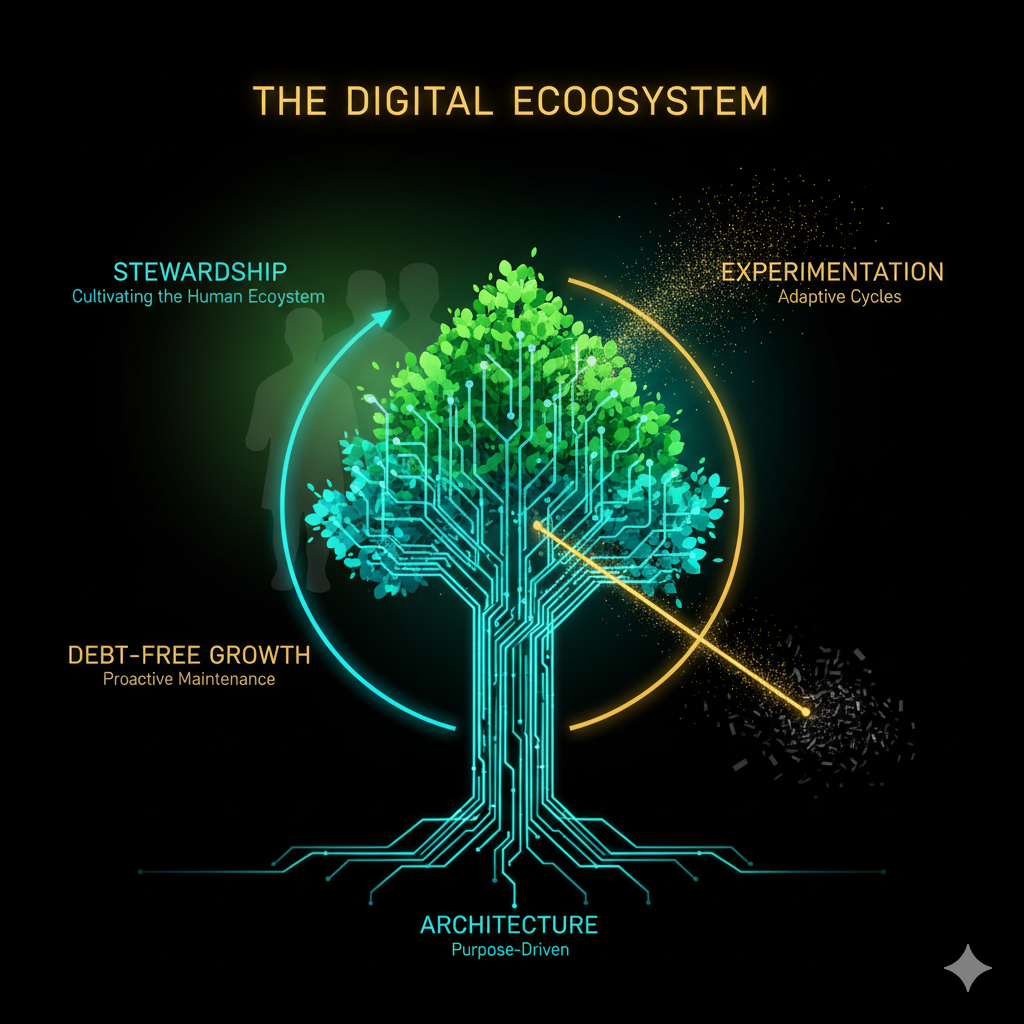
The Independent Ecosystem
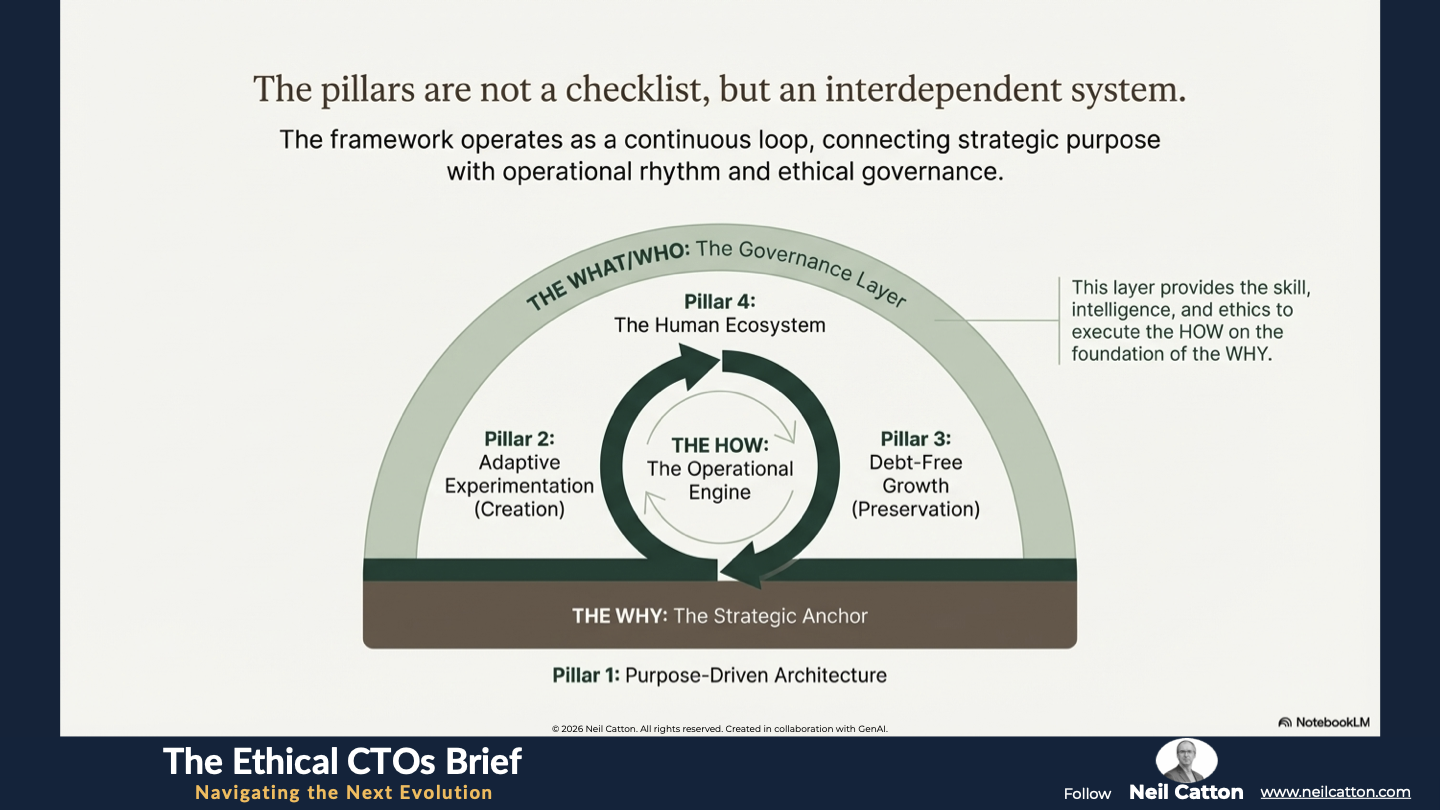
The four pillars of the Digital Gardener framework are not a sequential checklist but an interdependent, continuously operating system designed for sustainable, resilient growth. They work together in a cohesive loop, defining the strategic purpose (WHY), the operational rhythm (HOW), and the non-negotiable standards (WHAT) for system stewardship.
The WHY: Defining the Anchor (Pillar 1)
Pillar 1 (Purpose-Driven Architecture) The WHY of the effort answers the fundamental question: ”Why?” It dictates strategic alignment, deep environmental understanding, and a modular foundation. A weak WHY leads to busywork and further debt. This pillar, the Strategic Anchor, determines the organisation’s roots.
The HOW: Powering the Engine (Pillars 2 & 3)
The HOW is the engine of continuous improvement, driven by the tension and balance between Pillar 2 (Adaptive Experimentation) and Pillar 3 (Debt-Free Growth).
- Pillar 2 is the force of creation and learning (sowing new seeds and testing them). It proactively generates small, controlled changes.
- Pillar 3 is the force of preservation and hygiene (pruning and weeding). It systematically eliminates the debt and waste created by both age and failed experiments.
These operational pillars run constantly in balance; experimentation without maintenance leads to chaos (debt), and maintenance without experimentation leads to stagnation (monoculture).
The WHAT: Governing the Integrity (Pillar 4)
Pillar 4 (Cultivating the Human Ecosystem) is the essential Governance Layer. It answers the what by providing the intelligence, skill, and ethical code necessary to execute the HOW correctly on the foundation of the WHY.
- The Gardener (Pillar 4) uses their skill and shared knowledge to ensure the Experimentation (Pillar 2) is informed and that the Maintenance (Pillar 3) is surgical.
- Pillar 4 ultimately ensures the entire effort remains aligned with the ethical and business purpose established by Pillar 1.
In combination, the pillars transform an organisation from a reactive feature into a proactive steward of a living ecosystem, where health, clarity, and adaptability are engineered into the culture itself.
A Final Word
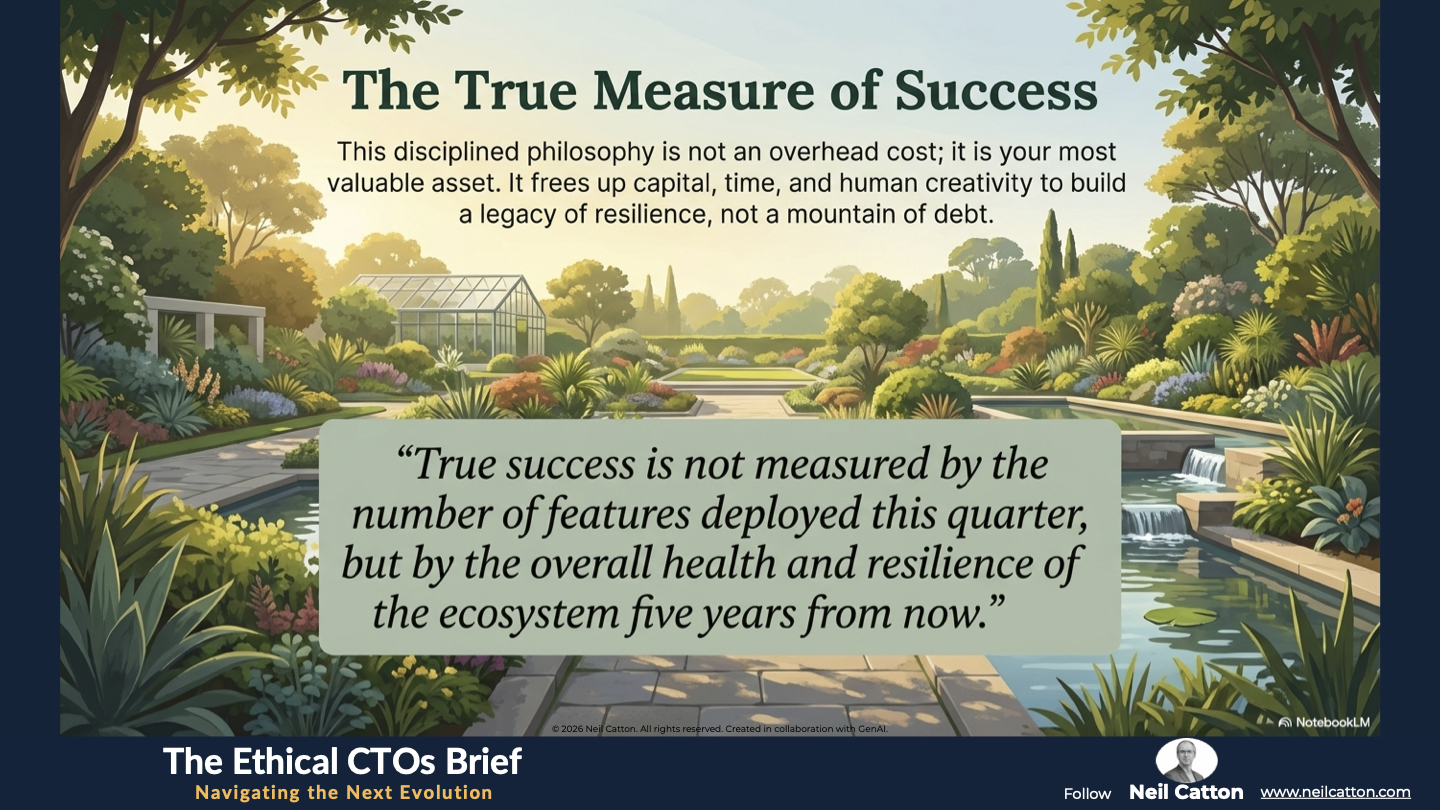
The core challenge of modern enterprise lies in the transition from a reactive, short-sighted developer to a strategic Digital Gardener. This change transcends technical aspects, representing a profound cultural shift. It involves moving from viewing IT as a series of construction projects with defined endpoints to embracing it as a continuous, living ecosystem that demands perpetual stewardship. True success is not measured by the number of features deployed this quarter, but by the overall health and resilience of the ecosystem five years from now. This commitment necessitates a patient, disciplined philosophy that prioritises structural integrity over superficial speed and tactical wins.
If we continue to rush and plant quick-fix solutions in poorly prepared ground, we guarantee a harvest of crippling technical debt and organisational brittleness that will ultimately choke out future potential. In contrast, adopting a horticultural mindset – by tending the soil, diversifying the crops, and pruning relentlessly – we cultivate an environment where innovation is not only possible but inevitable. Sustainable architecture is not an overhead cost; it is the most valuable asset in the modern digital age. This approach frees up capital, time, and human ingenuity, allowing organisations to build a legacy of resilience. By doing so, they ensure the digital ecosystem is always growing, adapting, and robustly ready for the next evolution, effectively designing the future rather than simply reacting to it.
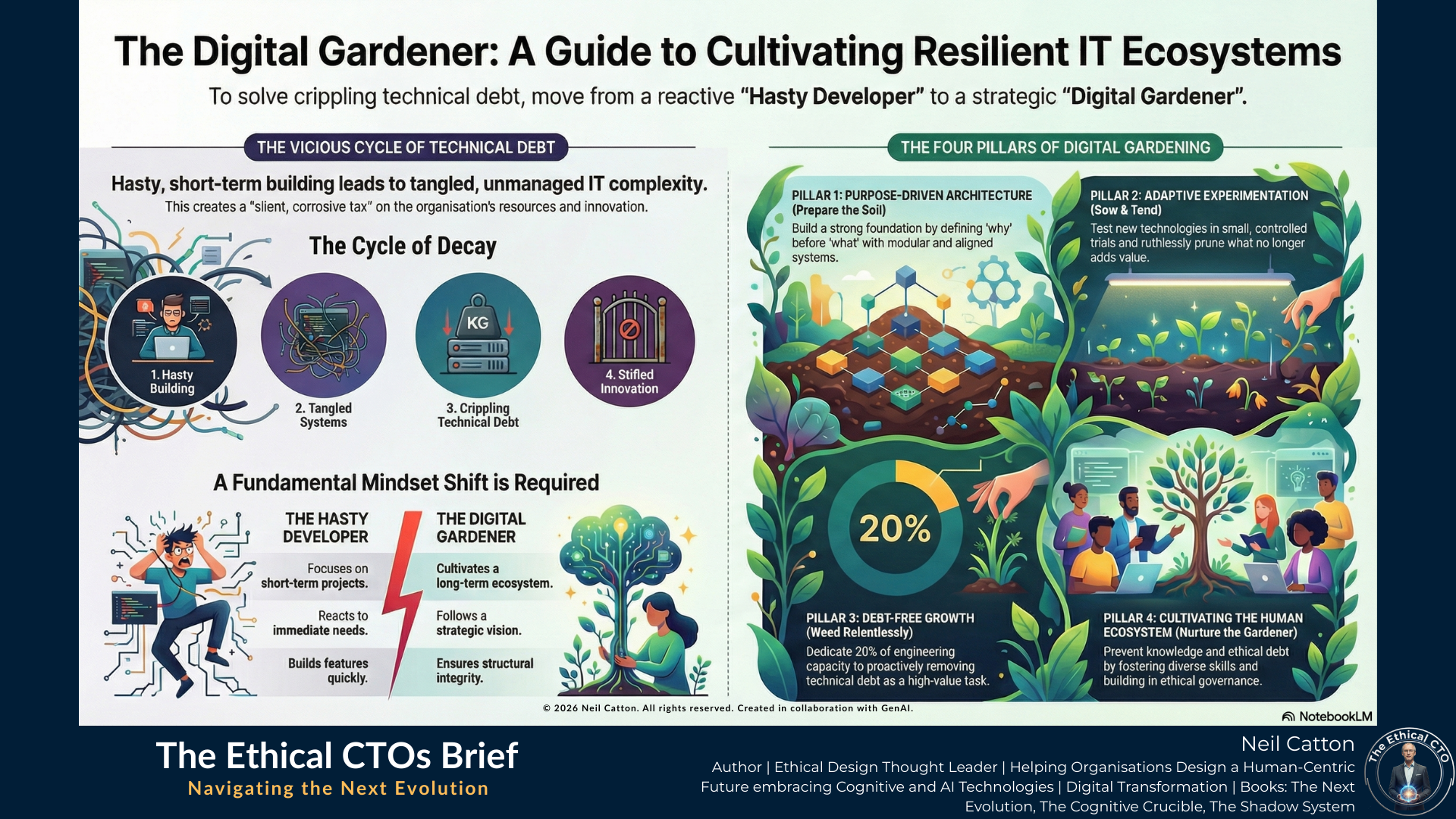
Key Takeaways: Tending the Soil of Innovation
The Root System (Purpose): Architecting deep, modular foundations before writing code.
Adaptive Sowing (Experimentation): Testing "new seeds" with low-risk pilots to avoid rigid monocultures.
Ruthless Pruning (Maintenance): Dedicating 20% of capacity to "weeding" technical debt.
The Human Gardener (Culture): Nurturing T-shaped skills and an "Ethically Pure" knowledge ledger.
1
2
3
4
5
6
7
8
9
10
11
12
13
Strategic Insights: The Next Evolution: Cultivating Resilience
The Complexity Tax: Why hasty growth leads to brittle, expensive systems.
Modular Diversity: Avoiding vendor lock-in by treating applications as loosely coupled plants.
Planned Obsolescence: Preparing for the retirement of systems before they become crisis liabilities.
The Knowledge Ledger: Capturing architectural rationale to prevent institutional memory loss.
Video Summary: Why Your Digital Strategy is a Living Organism
Construction vs. Horticulture: Moving from "finished" projects to "perpetual" stewardship.
The Butterfly Effect of Debt: How unaddressed "weeds" choke out future innovation.
The Strategic WHY: Aligning system foundations with enduring business processes, not quarterly wins.
The Moral Gardener: Ensuring the "soil" (data) is ethically sound and aligned with human purpose.
A garden is grown one inch at a time. To manage systemic growth, you must master the immediate space around you. Enter The Three-Foot World.
The Ethical CTO: Arc 3 Index
Aligning Code with Soul: The Humanisation of Technology
Prioritising Human-Centric Experiences: Beyond Digital First
Where Technology Disappears Inward: The Age of the Invisible Interface
Regulating Unseen Digital Forces: Governing the Ambient Future
Architecting for Future Generations: Temporal Empathy
- Stewardship of Sustainable Systems: The Digital Gardener
Reclaiming our Shared Story: Mythos and the Machine
- Managing High-Speed Systemic Duality: The Mirror Machine
Inhabiting Immersive Public Services: Beyond The Screen
- Mastering Focus Amidst Complexity: The Three-Foot World