Book II · The Cognitive Crucible · Pause to Reflect · No. 12
Your Social Media Habits
For the scroll that goes on longer than you meant, and the choice you get back once you see why.
Your feed isn't neutral — it's persuasive design, built to keep you scrolling. This pause makes that engineering visible enough to choose.

You open the app to check one thing — a message, a notification, the time — and twenty minutes later you're still there, and you couldn't say what any of it was for.
That's not a failure of willpower. The card's own opening line puts it plainly: platforms have moved past simple advertising into persuasive design — architecture built specifically to maximise engagement, not serve your interest. Once that engineering is visible, feeding it becomes a choice rather than a reflex.
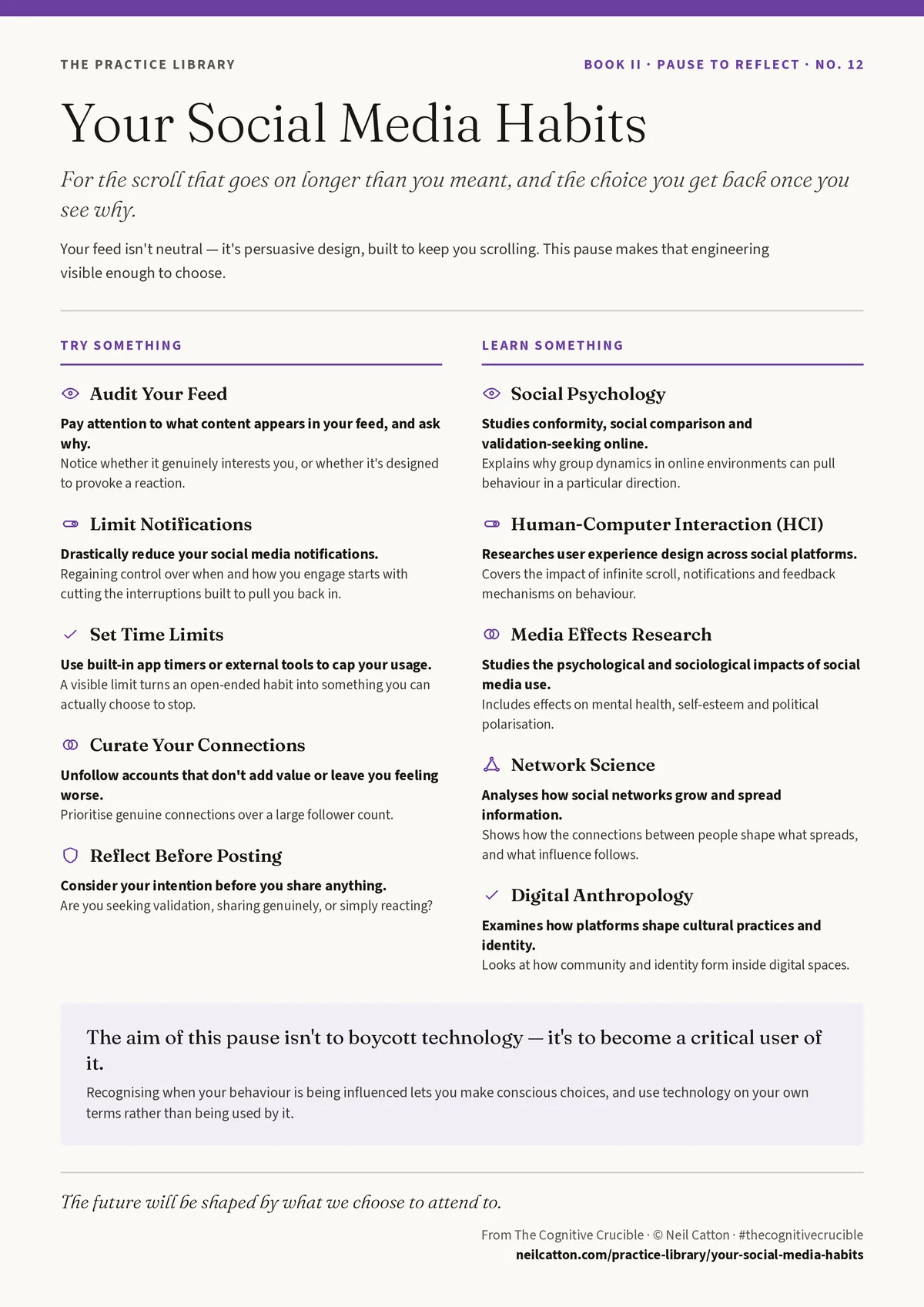
The card holds ten prompts across two columns. Five habits to try this week — auditing what actually shows up in your feed and why, cutting the notifications built to pull you back in, setting a real time limit, curating who you follow down to connections that add something, pausing before you post to ask what you're actually seeking. And five fields of research if you want to understand the mechanics behind the pull, from the social psychology of validation-seeking to the network science of how influence spreads.
It comes from The Cognitive Crucible, where the fuller argument about persuasive design and attention plays out. The card stands on its own — you don't need the book to use it.
Print it, or keep it somewhere you'll see it before you next open the app without thinking.
And here's the question I'd leave you with: the next time you reach for it without deciding to, whose habit is that — yours, or the one it was built to form?
Your Social Media Habits
Try Something
Audit Your Feed
- Pay attention to what content appears in your feed, and ask why. Notice whether it genuinely interests you, or whether it's designed to provoke a reaction.
Limit Notifications
- Drastically reduce your social media notifications. Regaining control over when and how you engage starts with cutting the interruptions built to pull you back in.
Set Time Limits
- Use built-in app timers or external tools to cap your usage. A visible limit turns an open-ended habit into something you can actually choose to stop.
Curate Your Connections
- Unfollow accounts that don't add value or leave you feeling worse. Prioritise genuine connections over a large follower count.
Reflect Before Posting
- Consider your intention before you share anything. Are you seeking validation, sharing genuinely, or simply reacting?
Learn Something
Social Psychology
- Studies conformity, social comparison and validation-seeking online. Explains why group dynamics in online environments can pull behaviour in a particular direction.
Human-Computer Interaction (HCI)
- Researches user experience design across social platforms. Covers the impact of infinite scroll, notifications and feedback mechanisms on behaviour.
Media Effects Research
- Studies the psychological and sociological impacts of social media use. Includes effects on mental health, self-esteem and political polarisation.
Network Science
- Analyses how social networks grow and spread information. Shows how the connections between people shape what spreads, and what influence follows.
Digital Anthropology
- Examines how platforms shape cultural practices and identity. Looks at how community and identity form inside digital spaces.
The future will be shaped by what we choose to attend to.
From The Cognitive Crucible · © Neil Catton · Filed under attention and focus, wellbeing and mental load
Read it alongside
 Also from The Cognitive Crucible · No. 14Reclaiming Your Quiet MomentsFor the pause you fill before you’ve noticed there’s a pause at all, and the thinking that comes back once you leave it alone.
 Also from The Cognitive Crucible · No. 8Shielding Your FocusFor the moment a message demands you act now, and the pause you get to insert before you do.
 Also from The Cognitive Crucible · No. 16Decoding Weaponised MessagesFor the moment persuasion tips into manipulation, and the habit of catching it before it lands.