Book I · The Next Evolution · How To · No. 55
Use Technology as Mirror and Instrument
For when a tool starts showing you more about yourself than you expected.
Every tool you use reflects your habits back at you, and reshapes them at the same time — mirror and instrument, working together.

A recommendation lands and it's uncomfortably accurate — not because the system understands you, but because it's been quietly logging the pattern in what you click, skip and linger on for months. The tool didn't just record a habit. It amplified it, then handed it back as a suggestion.
Every piece of technology reflects something about the person using it, and reshapes them a little in return. Most people only ever notice the reflecting, and stop questioning what's being reshaped. The mirror gets all the attention. The instrument does the quieter work, one small adjustment to behaviour at a time, long after the novelty of being seen this accurately has worn off.
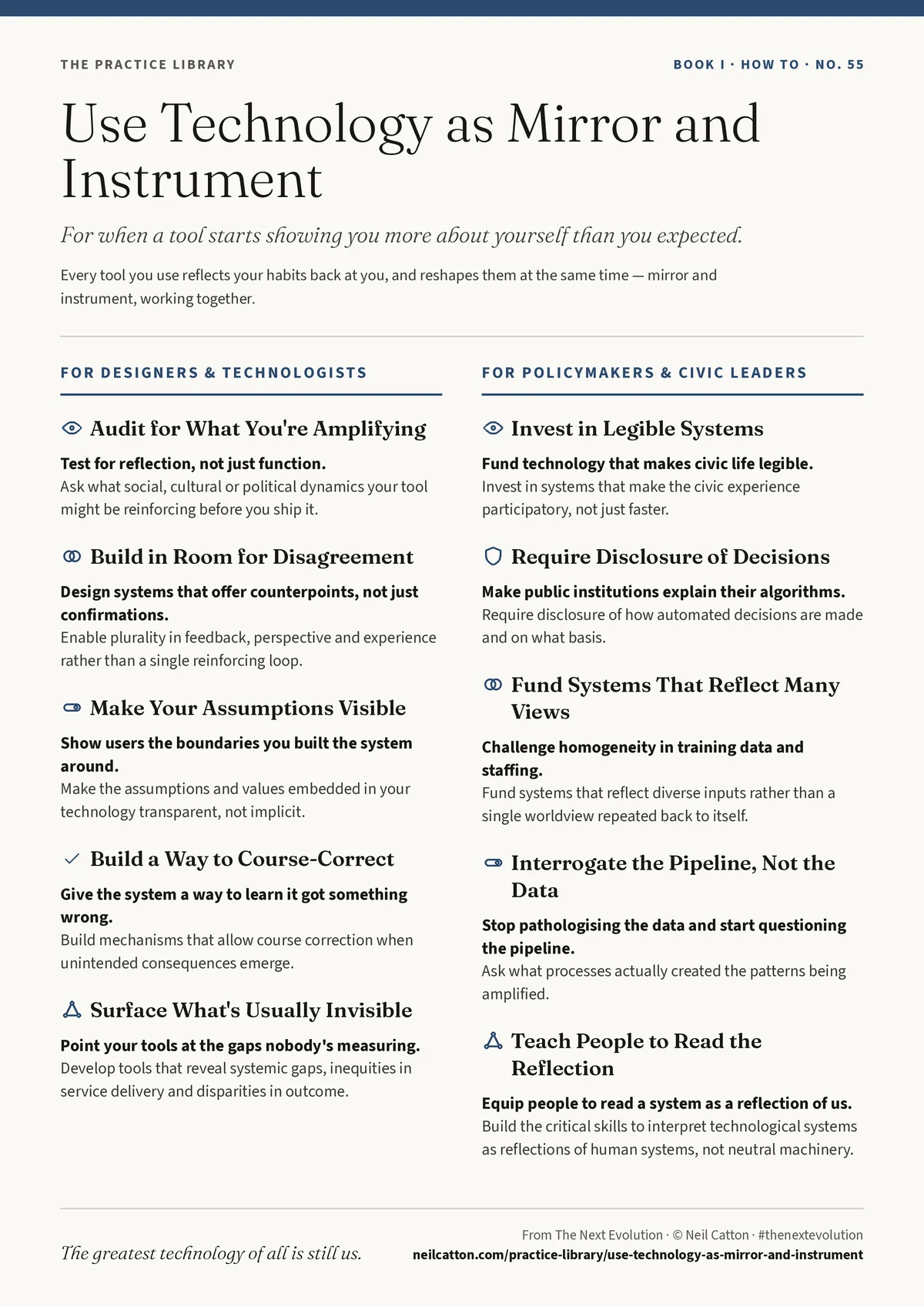
The card splits into two columns — five practices for designers and technologists building the tools, and five for the policymakers and civic leaders deciding how those tools get used in public life. It's for anyone ready to treat a piece of technology as evidence of something, not just a convenience.
It comes from The Next Evolution, where the fuller argument about technology, reflection and responsibility gets made at length. The card doesn't need the book to make sense — it stands on its own.
Print it, or send it to whoever just described an algorithm as neutral.
If a tool is reflecting you back at yourself, who decided what got left out of the picture?
Use Technology as Mirror and Instrument
For Designers & Technologists
Audit for What You're Amplifying
- Test for reflection, not just function. Ask what social, cultural or political dynamics your tool might be reinforcing before you ship it.
Build in Room for Disagreement
- Design systems that offer counterpoints, not just confirmations. Enable plurality in feedback, perspective and experience rather than a single reinforcing loop.
Make Your Assumptions Visible
- Show users the boundaries you built the system around. Make the assumptions and values embedded in your technology transparent, not implicit.
Build a Way to Course-Correct
- Give the system a way to learn it got something wrong. Build mechanisms that allow course correction when unintended consequences emerge.
Surface What's Usually Invisible
- Point your tools at the gaps nobody's measuring. Develop tools that reveal systemic gaps, inequities in service delivery and disparities in outcome.
For Policymakers & Civic Leaders
Invest in Legible Systems
- Fund technology that makes civic life legible. Invest in systems that make the civic experience participatory, not just faster.
Require Disclosure of Decisions
- Make public institutions explain their algorithms. Require disclosure of how automated decisions are made and on what basis.
Fund Systems That Reflect Many Views
- Challenge homogeneity in training data and staffing. Fund systems that reflect diverse inputs rather than a single worldview repeated back to itself.
Interrogate the Pipeline, Not the Data
- Stop pathologising the data and start questioning the pipeline. Ask what processes actually created the patterns being amplified.
Teach People to Read the Reflection
- Equip people to read a system as a reflection of us. Build the critical skills to interpret technological systems as reflections of human systems, not neutral machinery.
The greatest technology of all is still us.
From The Next Evolution · © Neil Catton · Filed under design and leadership, governance and institutions
Read it alongside
 Also from The Next Evolution · No. 53Redesign Integrity for Exponential TimesFor when a small oversight scales faster than anyone can catch it.
 Also from The Next Evolution · No. 58Reimagine GovernanceFor when the system meant to represent you stopped feeling like it does.
 Also from The Next Evolution · No. 59Find Meaning in a Mechanised WorldFor when the tasks that used to prove your worth get automated before you've worked out what proves it now.