Book II · The Cognitive Crucible · Pause to Reflect · No. 19
Understanding Your Cognitive Limits
For the moment you realise you’ve read the same paragraph three times and none of it landed.
Attention is a finite resource, and your brain has built-in limitations. This pause turns that theory into a practical awareness of where your focus actually goes.

You've read the same paragraph three times and still can't repeat it back. Not because the material is hard — because your attention left the page ten minutes ago and your eyes kept moving without it. It happens by mid-afternoon, in the middle of the one email that actually mattered, on the fourth hour of a task that needed maybe ninety minutes of real focus.
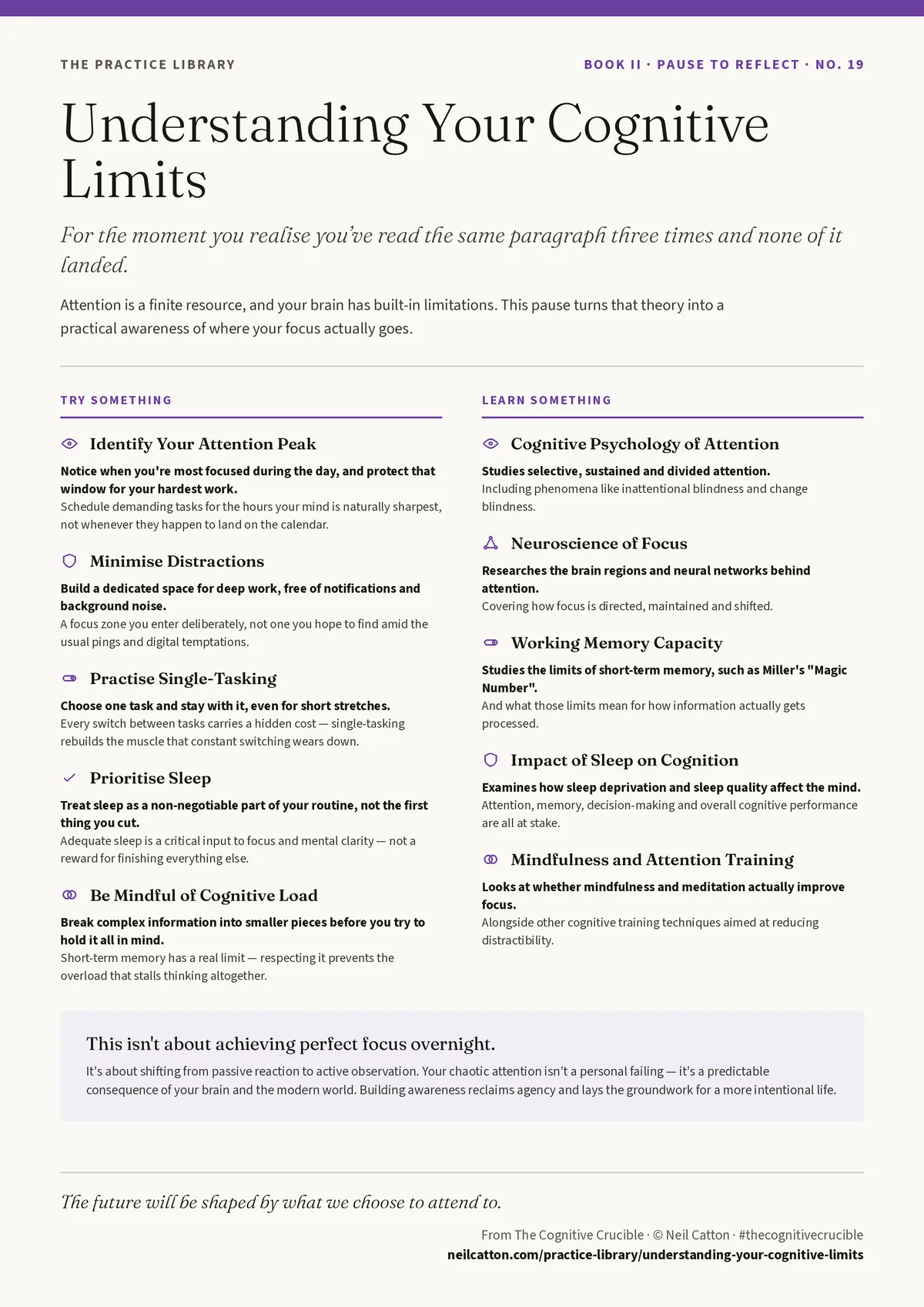
That's not a discipline problem. Attention is a finite resource, and the brain that keeps drifting has real, built-in limits — not a character flaw showing itself. The card's own framing is plain about this: it isn't about achieving perfect focus overnight, it's about turning that theory into a practical awareness of where your attention is actually going.
The card holds ten prompts across two columns. Five habits to try this week — finding your natural attention peak and protecting it, building a space genuinely free of distraction, practising single tasks instead of switching between them, treating sleep as non-negotiable, and breaking complex information down before it overwhelms you. And five fields of research if you want the science behind the pull, from the real limits of working memory to what sleep deprivation actually costs your thinking.
It comes from The Cognitive Crucible, where the fuller argument about attention as a finite, contested resource plays out. The card stands on its own — you don't need the book to use it.
Print it, or pin it somewhere you'll see it before the next task that needs your full attention.
So next time you catch yourself rereading the same line: is the material actually hard, or did your attention leave the room a while ago?
Understanding Your Cognitive Limits
Try Something
Identify Your Attention Peak
- Notice when you're most focused during the day, and protect that window for your hardest work. Schedule demanding tasks for the hours your mind is naturally sharpest, not whenever they happen to land on the calendar.
Minimise Distractions
- Build a dedicated space for deep work, free of notifications and background noise. A focus zone you enter deliberately, not one you hope to find amid the usual pings and digital temptations.
Practise Single-Tasking
- Choose one task and stay with it, even for short stretches. Every switch between tasks carries a hidden cost — single-tasking rebuilds the muscle that constant switching wears down.
Prioritise Sleep
- Treat sleep as a non-negotiable part of your routine, not the first thing you cut. Adequate sleep is a critical input to focus and mental clarity — not a reward for finishing everything else.
Be Mindful of Cognitive Load
- Break complex information into smaller pieces before you try to hold it all in mind. Short-term memory has a real limit — respecting it prevents the overload that stalls thinking altogether.
Learn Something
Cognitive Psychology of Attention
- Studies selective, sustained and divided attention. Including phenomena like inattentional blindness and change blindness.
Neuroscience of Focus
- Researches the brain regions and neural networks behind attention. Covering how focus is directed, maintained and shifted.
Working Memory Capacity
- Studies the limits of short-term memory, such as Miller's "Magic Number". And what those limits mean for how information actually gets processed.
Impact of Sleep on Cognition
- Examines how sleep deprivation and sleep quality affect the mind. Attention, memory, decision-making and overall cognitive performance are all at stake.
Mindfulness and Attention Training
- Looks at whether mindfulness and meditation actually improve focus. Alongside other cognitive training techniques aimed at reducing distractibility.
The future will be shaped by what we choose to attend to.
From The Cognitive Crucible · © Neil Catton · Filed under attention and focus
Read it alongside
 Also from The Cognitive Crucible · No. 21Asserting Your Data RightsFor the moment you click “Accept All” without reading past the first line, and want to change that.
 Also from The Cognitive Crucible · No. 16Decoding Weaponised MessagesFor the moment persuasion tips into manipulation, and the habit of catching it before it lands.
 Also from The Cognitive Crucible · No. 23Navigating the AI-Curated WorldFor when you can't tell whether an idea found you, or was placed in front of you.