Book II · The Cognitive Crucible · Pause to Reflect · No. 42
The Web's Shifting Promise
For when the site you opened to look up one thing is still open forty minutes later.
The web wasn't built to hold you hostage. This pause is about remembering what it was actually for.

The early web was built by people who genuinely believed it would open the world up — a commons, not a container. Somewhere between the first portal and the feed you're using now, the promise didn't disappear so much as get quietly redirected.
A service that costs nothing to join still has to make money somewhere, and where it makes that money shapes everything about how it's designed to keep you there. The dependency isn't an accident of good engineering — it's the business model, working exactly as built.
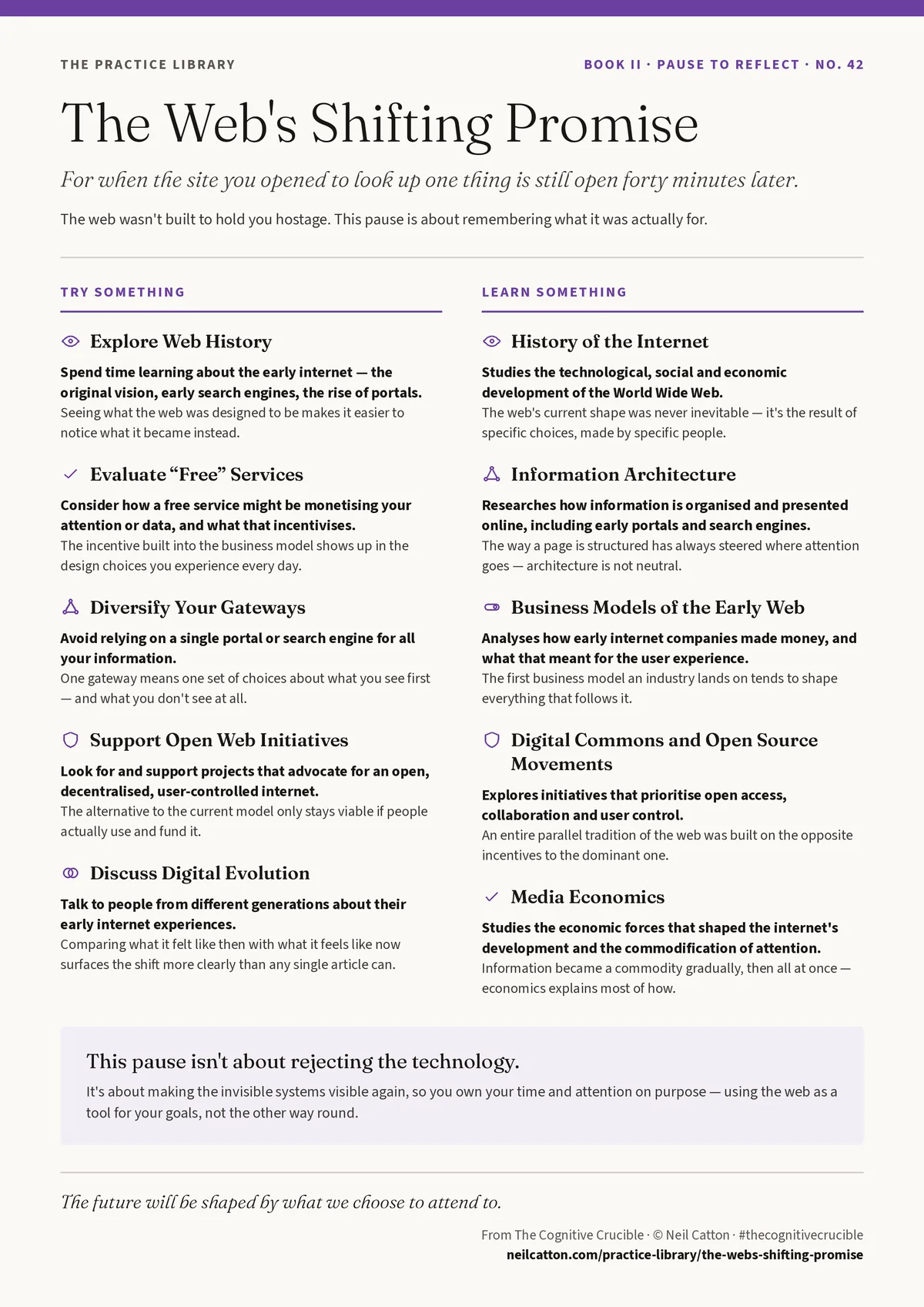
The card splits into two columns — five things to try, from exploring the web's own early history to diversifying the gateways you rely on, and five research threads for anyone who wants to go further, from information architecture to the economics of the early internet. It's for anyone who wants to remember what the thing was actually for.
It comes from The Cognitive Crucible, where the fuller argument about attention, technology and the mind lives. The card stands on its own — you don't need the book to use it.
Print it, pin it somewhere you'll see it, or send it to whoever still remembers what the internet felt like before this version of it.
What would the web look like if it were still being built for the reasons it started?
The Web's Shifting Promise
Try Something
Explore Web History
- Spend time learning about the early internet — the original vision, early search engines, the rise of portals. Seeing what the web was designed to be makes it easier to notice what it became instead.
Evaluate “Free” Services
- Consider how a free service might be monetising your attention or data, and what that incentivises. The incentive built into the business model shows up in the design choices you experience every day.
Diversify Your Gateways
- Avoid relying on a single portal or search engine for all your information. One gateway means one set of choices about what you see first — and what you don't see at all.
Support Open Web Initiatives
- Look for and support projects that advocate for an open, decentralised, user-controlled internet. The alternative to the current model only stays viable if people actually use and fund it.
Discuss Digital Evolution
- Talk to people from different generations about their early internet experiences. Comparing what it felt like then with what it feels like now surfaces the shift more clearly than any single article can.
Learn Something
History of the Internet
- Studies the technological, social and economic development of the World Wide Web. The web's current shape was never inevitable — it's the result of specific choices, made by specific people.
Information Architecture
- Researches how information is organised and presented online, including early portals and search engines. The way a page is structured has always steered where attention goes — architecture is not neutral.
Business Models of the Early Web
- Analyses how early internet companies made money, and what that meant for the user experience. The first business model an industry lands on tends to shape everything that follows it.
Digital Commons and Open Source Movements
- Explores initiatives that prioritise open access, collaboration and user control. An entire parallel tradition of the web was built on the opposite incentives to the dominant one.
Media Economics
- Studies the economic forces that shaped the internet's development and the commodification of attention. Information became a commodity gradually, then all at once — economics explains most of how.
The future will be shaped by what we choose to attend to.
From The Cognitive Crucible · © Neil Catton · Filed under persuasion and information
Read it alongside
 Also from The Cognitive Crucible · No. 40Strengthening Your Digital DefencesFor when you realise the password you're proudest of remembering is also the one you've used four times.
 Also from The Cognitive Crucible · No. 44Bridging Generational FocusFor when the family group chat and the family dinner table can't agree on what deserves attention.
 Also from The Cognitive Crucible · No. 37Monetising the MindFor when you notice you've read the privacy policy of exactly nothing you've ever signed up for.