Book II · The Cognitive Crucible · Pause to Reflect · No. 26
The Digital Sieve
For when you realise the version of the world you're reacting to was assembled before you ever looked at it.
Most of what reaches you was already filtered before you saw it. This pause hands that filtering back to you.

Open your phone at any moment today and something is already waiting — a headline, a notification, a video queued up next. None of it arrived by accident. Somewhere between the event and your screen, a sieve decided what got through and what didn't, and it wasn't you holding it.
That sieve doesn't just filter information. It reinforces whatever you already lean toward, narrows the range of what you actually see, and hands you the result as your view of the world. This pause asks the simpler question underneath: who's doing the filtering, and how much of that job can you take back?
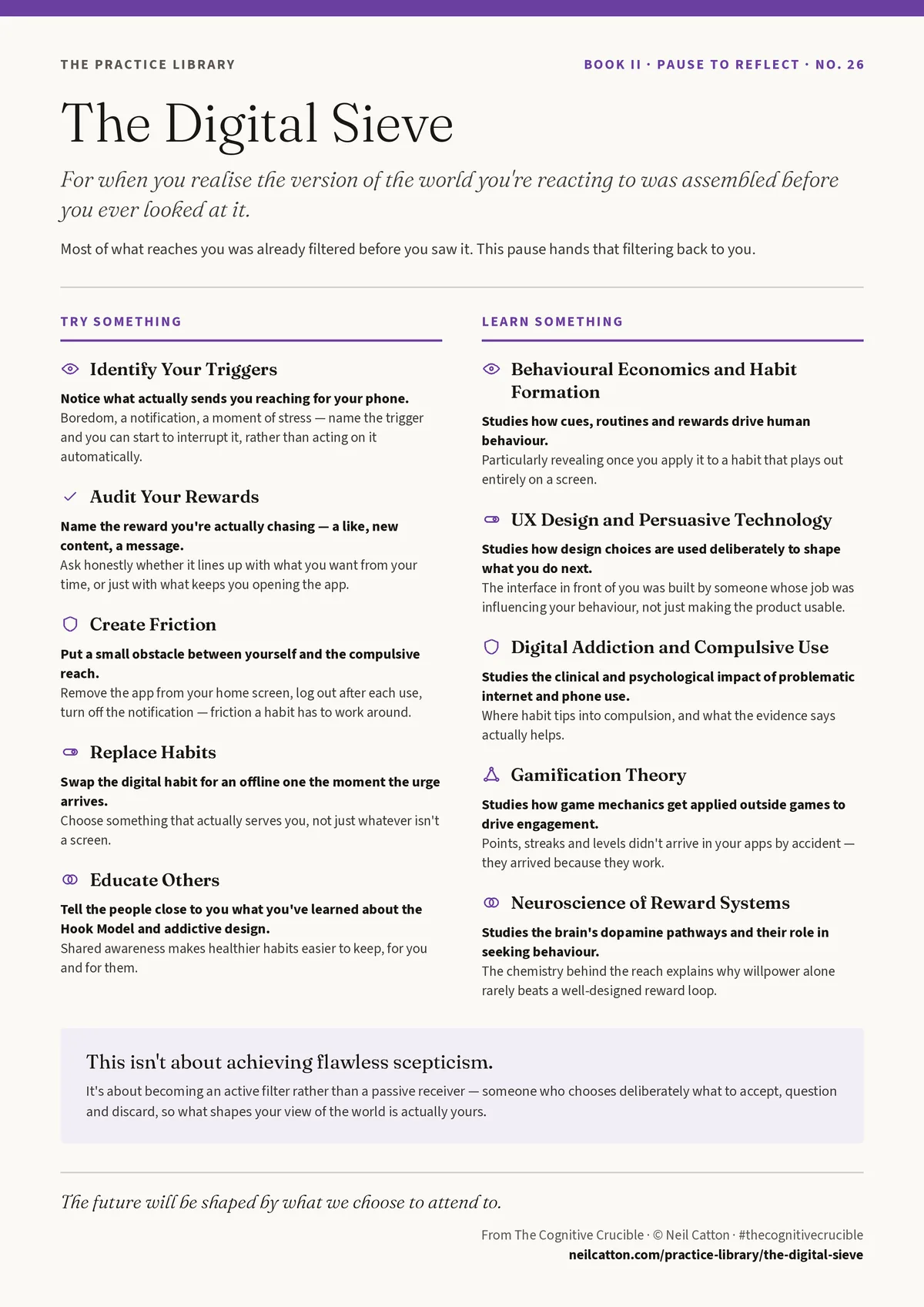
The card lays out ten things to explore, in two columns. Try Something is five habits for noticing your own patterns before reacting to them — naming what triggers the reach for a phone, auditing the reward a platform is actually giving you, building friction into a habit that currently has none. Learn Something is five fields worth a longer look, from the behavioural economics of habit formation to the neuroscience of the reward systems those habits run on.
It comes from The Cognitive Crucible, where the fuller argument about the Digital Sieve and the Cognitive Crucible it feeds gets made at length. The card doesn't need the book to make sense — it stands on its own.
Print it, pin it somewhere you'll actually see it, or send it to whoever in your life has stopped asking where their feed comes from.
The card doesn't resolve the harder part: once you can name the sieve, how much of what's already settled in your head are you willing to go back and re-examine?
The Digital Sieve
Try Something
Identify Your Triggers
- Notice what actually sends you reaching for your phone. Boredom, a notification, a moment of stress — name the trigger and you can start to interrupt it, rather than acting on it automatically.
Audit Your Rewards
- Name the reward you're actually chasing — a like, new content, a message. Ask honestly whether it lines up with what you want from your time, or just with what keeps you opening the app.
Create Friction
- Put a small obstacle between yourself and the compulsive reach. Remove the app from your home screen, log out after each use, turn off the notification — friction a habit has to work around.
Replace Habits
- Swap the digital habit for an offline one the moment the urge arrives. Choose something that actually serves you, not just whatever isn't a screen.
Educate Others
- Tell the people close to you what you've learned about the Hook Model and addictive design. Shared awareness makes healthier habits easier to keep, for you and for them.
Learn Something
Behavioural Economics and Habit Formation
- Studies how cues, routines and rewards drive human behaviour. Particularly revealing once you apply it to a habit that plays out entirely on a screen.
UX Design and Persuasive Technology
- Studies how design choices are used deliberately to shape what you do next. The interface in front of you was built by someone whose job was influencing your behaviour, not just making the product usable.
Digital Addiction and Compulsive Use
- Studies the clinical and psychological impact of problematic internet and phone use. Where habit tips into compulsion, and what the evidence says actually helps.
Gamification Theory
- Studies how game mechanics get applied outside games to drive engagement. Points, streaks and levels didn't arrive in your apps by accident — they arrived because they work.
Neuroscience of Reward Systems
- Studies the brain's dopamine pathways and their role in seeking behaviour. The chemistry behind the reach explains why willpower alone rarely beats a well-designed reward loop.
The future will be shaped by what we choose to attend to.
From The Cognitive Crucible · © Neil Catton · Filed under wellbeing and mental load
Read it alongside
 Also from The Cognitive Crucible · No. 28Reclaiming Your Inner LandscapeFor when the fog by mid-afternoon has started to feel less like a mood and more like a fact of the day.
 Also from The Cognitive Crucible · No. 23Navigating the AI-Curated WorldFor when you can't tell whether an idea found you, or was placed in front of you.
 Also from The Cognitive Crucible · No. 30The Historical Roots of PersuasionFor when the ad you just watched felt like it knew you a little too well.