Book III · The Shadow System · How To · No. 52
The Citizen's Role
For when the state can't be the only line of defence.
A nation's security is a shared enterprise — every citizen is not only a potential target but the final, indispensable defender.

A regional water company gets breached, and the story that dominates the news cycle is the ransom, not the years of underfunded infrastructure decisions that made the breach possible. Nobody votes for infrastructure spending. Everybody wants the water to work.
A nation's digital resilience gets built long before any single breach, in decisions most citizens never see themselves as part of — the products they buy, the representatives they write to, the claims they share without checking. The state can enforce standards. It can't manufacture attention or vigilance on your behalf.
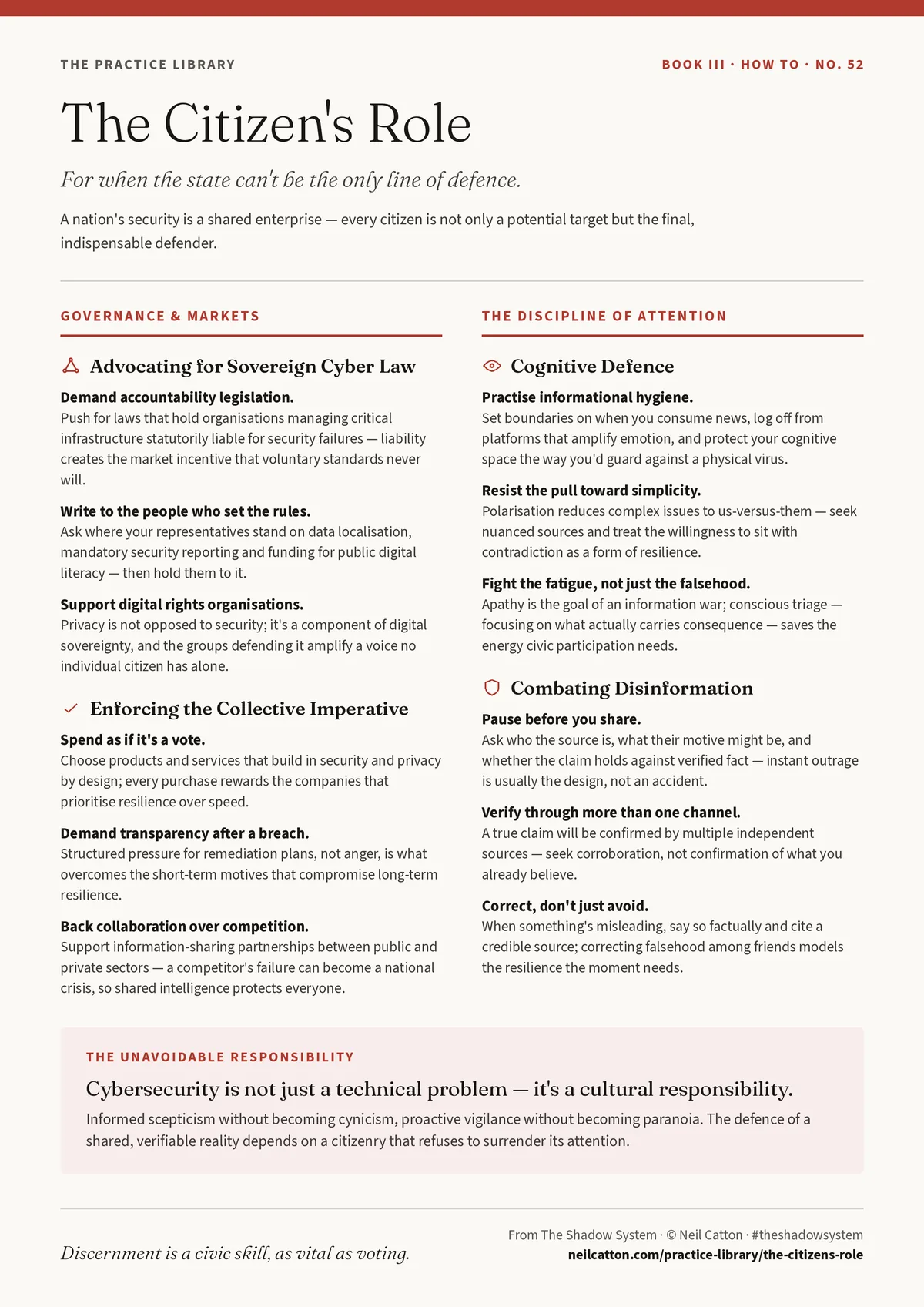
The card sets out four pillars, two to a column. Advocating for the cyber law that holds infrastructure operators liable for failure. Enforcing that standard through what you buy and who you hold accountable. Practising the discipline of attention that keeps you from becoming the weak link. Pausing before you share something to ask who benefits if you don't.
It comes from The Shadow System, the closing book of the trilogy, where the fuller argument for a citizen's role in national digital resilience gets made at length — this is the longest source chapter in the whole card series, and the one that needed the most compression to fit. The card doesn't need the book to make sense — it stands on its own.
Print it, pin it, or send it to whoever in your life still thinks this is someone else's responsibility.
Three of the four pillars here are things you can start today, alone. The fourth, holding infrastructure operators legislatively accountable, only works if enough people decide it matters before the next breach, not after. Which pillar is the one you're actually neglecting?
The Citizen's Role
Governance & Markets
Advocating for Sovereign Cyber Law
- Demand accountability legislation. Push for laws that hold organisations managing critical infrastructure statutorily liable for security failures — liability creates the market incentive that voluntary standards never will.
- Write to the people who set the rules. Ask where your representatives stand on data localisation, mandatory security reporting and funding for public digital literacy — then hold them to it.
- Support digital rights organisations. Privacy is not opposed to security; it's a component of digital sovereignty, and the groups defending it amplify a voice no individual citizen has alone.
Enforcing the Collective Imperative
- Spend as if it's a vote. Choose products and services that build in security and privacy by design; every purchase rewards the companies that prioritise resilience over speed.
- Demand transparency after a breach. Structured pressure for remediation plans, not anger, is what overcomes the short-term motives that compromise long-term resilience.
- Back collaboration over competition. Support information-sharing partnerships between public and private sectors — a competitor's failure can become a national crisis, so shared intelligence protects everyone.
The Discipline of Attention
Cognitive Defence
- Practise informational hygiene. Set boundaries on when you consume news, log off from platforms that amplify emotion, and protect your cognitive space the way you'd guard against a physical virus.
- Resist the pull toward simplicity. Polarisation reduces complex issues to us-versus-them — seek nuanced sources and treat the willingness to sit with contradiction as a form of resilience.
- Fight the fatigue, not just the falsehood. Apathy is the goal of an information war; conscious triage — focusing on what actually carries consequence — saves the energy civic participation needs.
Combating Disinformation
- Pause before you share. Ask who the source is, what their motive might be, and whether the claim holds against verified fact — instant outrage is usually the design, not an accident.
- Verify through more than one channel. A true claim will be confirmed by multiple independent sources — seek corroboration, not confirmation of what you already believe.
- Correct, don't just avoid. When something's misleading, say so factually and cite a credible source; correcting falsehood among friends models the resilience the moment needs.
Discernment is a civic skill, as vital as voting.
From The Shadow System · © Neil Catton · Filed under civic and collective, persuasion and information
Read it alongside
 Also from The Shadow System · No. 45The Blueprint for the FutureFor the citizen roles that don't fit inside your own four walls.
 Also from The Shadow System · No. 62A New Set of RulesFor the fortitude that outlasts any single defence.
 Also from The Shadow System · No. 38The Citizen SoldierFor when defence stops being someone else's job.