Book II · The Cognitive Crucible · Pause to Reflect · No. 8
Shielding Your Focus
For the moment a message demands you act now, and the pause you get to insert before you do.
Your attention can be exploited — through scams, deepfakes and disinformation. This pause is about recognising the vulnerabilities, not fear.

The message arrives at the wrong moment — mid-meeting, half asleep, walking to the car — and it doesn't ask, it insists. Your account's been compromised. Verify now. Or it isn't a message at all: a clip surfaces of someone you'd trust, saying something they never said.
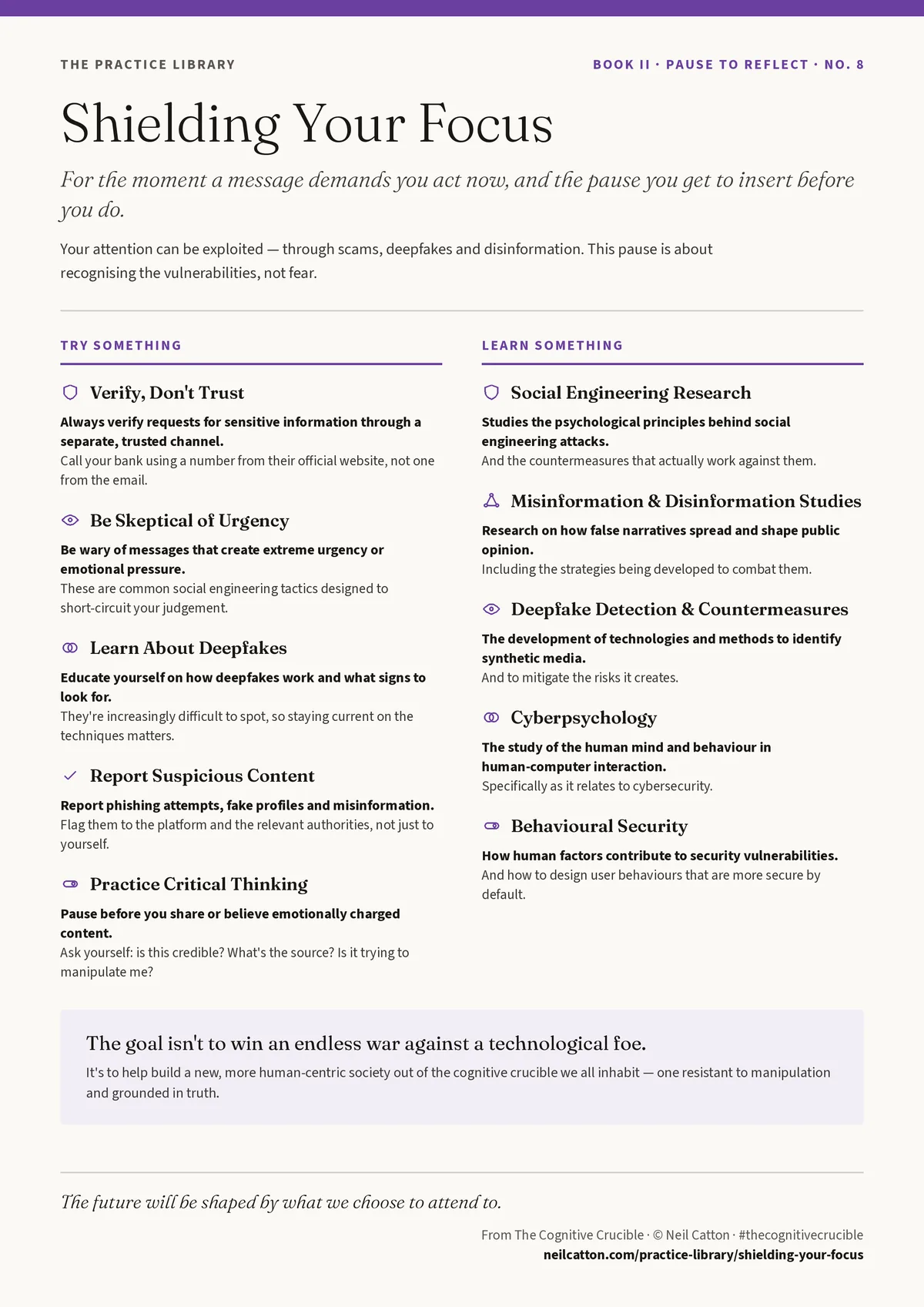
The card's own framing names what's actually happening. Your attention is being exploited, not because you're careless, but because the systems behind scams, deepfakes and disinformation are built to outrun your judgement rather than persuade it. Noticing that in the moment is most of the defence.
The card holds ten prompts across two columns. Five habits to try this week — verifying any urgent request through a separate channel you trust, treating urgency itself as a warning sign, learning what a deepfake actually looks like, reporting what you catch instead of scrolling past it, pausing before you share anything built to make you feel first and think second. And five fields of research if you want to know why the manipulation works, from the psychology behind social engineering to the study of what makes some people harder to fool than others.
It comes from The Cognitive Crucible, where the fuller argument about attention as contested ground plays out. The card stands on its own — you don't need the book to use it.
Print it, or keep it somewhere you'll see it before you next reach for your phone.
And here's the question I'd leave you with: the next time a message tells you to act immediately, whose interest does that urgency actually serve?
Shielding Your Focus
Try Something
Verify, Don't Trust
- Always verify requests for sensitive information through a separate, trusted channel. Call your bank using a number from their official website, not one from the email.
Be Skeptical of Urgency
- Be wary of messages that create extreme urgency or emotional pressure. These are common social engineering tactics designed to short-circuit your judgement.
Learn About Deepfakes
- Educate yourself on how deepfakes work and what signs to look for. They're increasingly difficult to spot, so staying current on the techniques matters.
Report Suspicious Content
- Report phishing attempts, fake profiles and misinformation. Flag them to the platform and the relevant authorities, not just to yourself.
Practice Critical Thinking
- Pause before you share or believe emotionally charged content. Ask yourself: is this credible? What's the source? Is it trying to manipulate me?
Learn Something
Social Engineering Research
- Studies the psychological principles behind social engineering attacks. And the countermeasures that actually work against them.
Misinformation & Disinformation Studies
- Research on how false narratives spread and shape public opinion. Including the strategies being developed to combat them.
Deepfake Detection & Countermeasures
- The development of technologies and methods to identify synthetic media. And to mitigate the risks it creates.
Cyberpsychology
- The study of the human mind and behaviour in human-computer interaction. Specifically as it relates to cybersecurity.
Behavioural Security
- How human factors contribute to security vulnerabilities. And how to design user behaviours that are more secure by default.
The future will be shaped by what we choose to attend to.
From The Cognitive Crucible · © Neil Catton · Filed under security and safety
Read it alongside
 Also from The Cognitive Crucible · No. 6Your Smartphone’s GripFor the habit that formed without your permission, and the attention you get to take back once you notice it.
 Also from The Cognitive Crucible · No. 12Your Social Media HabitsFor the scroll that goes on longer than you meant, and the choice you get back once you see why.
 Also from The Cognitive Crucible · No. 14Reclaiming Your Quiet MomentsFor the pause you fill before you’ve noticed there’s a pause at all, and the thinking that comes back once you leave it alone.