Book I · The Next Evolution · How To · No. 29
Reclaim Your Engagement
For when you look up and can't remember choosing to scroll this far.
Every swipe and pause is measured and monetised by systems built to hold you, not inform you — reclaiming it starts with seeing the architecture.

Jordan opens the phone to check one thing. Twenty minutes disappear before the original question even gets answered. Nothing about those twenty minutes was accidental — the interface, the notification, the infinite feed, all of it was built by people who understood exactly which nudge would keep a thumb moving.
Attention isn't just spent there. It's shaped there — what you focus on for that long starts shaping what you believe matters, whether you meant it to or not. The apps calling themselves free were never really free. Somebody paid for the engineering that made twenty minutes disappear, and the payment came out of exactly the resource that just vanished.
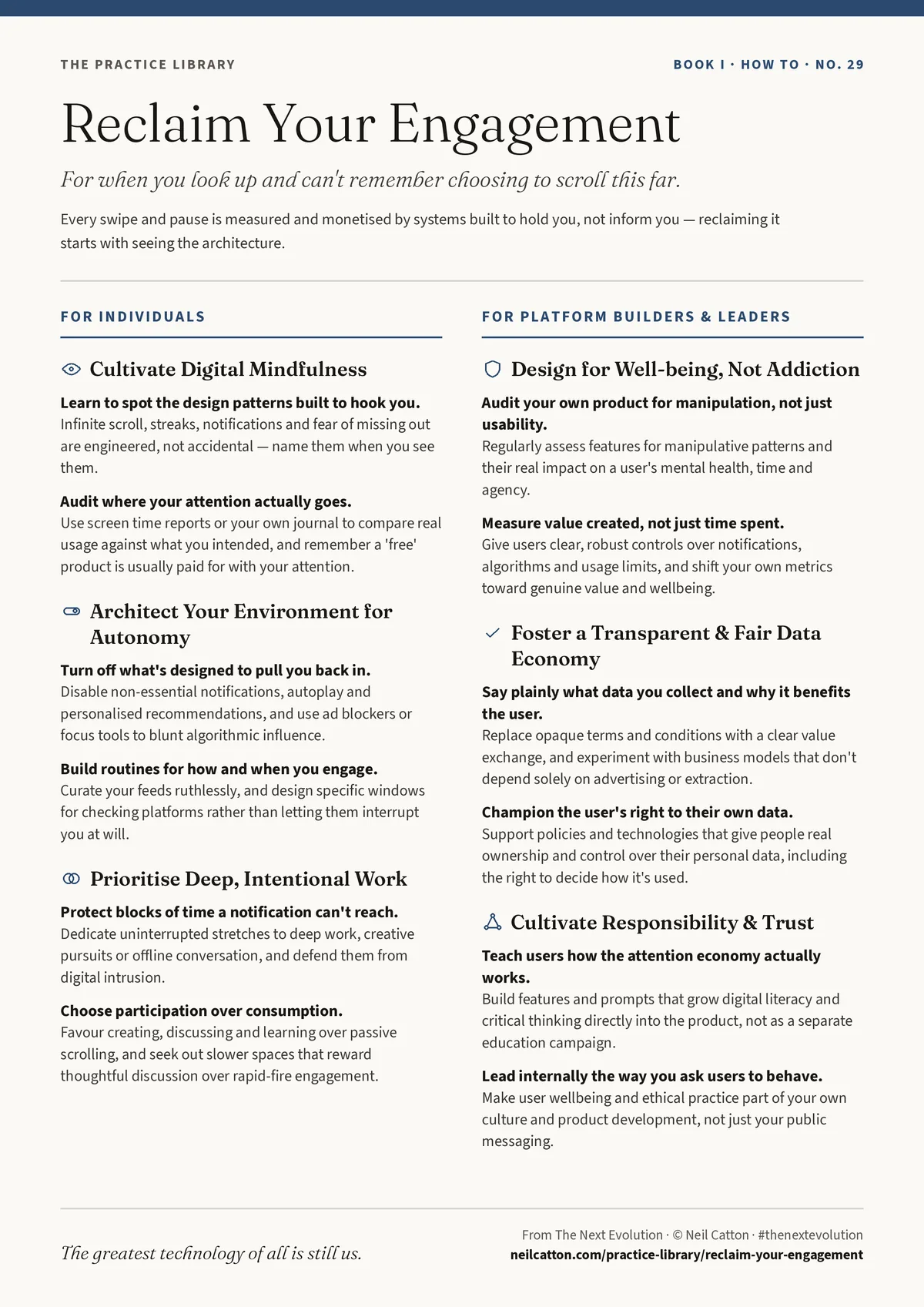
The card splits into two columns — three practices for anyone trying to take their attention back, and three for the platform builders and product leaders deciding what gets built in the first place. It's for the person on either side of that design decision.
It comes from The Next Evolution, where the fuller argument about attention, engagement and the systems built to hold it gets made at length. The card stands on its own — you don't need the book to use it.
Print it, or send it to whoever just told you they don't have time to read any more.
If the platform is optimising for your attention, what exactly are you optimising for?
Reclaim Your Engagement
For Individuals
Cultivate Digital Mindfulness
- Learn to spot the design patterns built to hook you. Infinite scroll, streaks, notifications and fear of missing out are engineered, not accidental — name them when you see them.
- Audit where your attention actually goes. Use screen time reports or your own journal to compare real usage against what you intended, and remember a 'free' product is usually paid for with your attention.
Architect Your Environment for Autonomy
- Turn off what's designed to pull you back in. Disable non-essential notifications, autoplay and personalised recommendations, and use ad blockers or focus tools to blunt algorithmic influence.
- Build routines for how and when you engage. Curate your feeds ruthlessly, and design specific windows for checking platforms rather than letting them interrupt you at will.
Prioritise Deep, Intentional Work
- Protect blocks of time a notification can't reach. Dedicate uninterrupted stretches to deep work, creative pursuits or offline conversation, and defend them from digital intrusion.
- Choose participation over consumption. Favour creating, discussing and learning over passive scrolling, and seek out slower spaces that reward thoughtful discussion over rapid-fire engagement.
For Platform Builders & Leaders
Design for Well-being, Not Addiction
- Audit your own product for manipulation, not just usability. Regularly assess features for manipulative patterns and their real impact on a user's mental health, time and agency.
- Measure value created, not just time spent. Give users clear, robust controls over notifications, algorithms and usage limits, and shift your own metrics toward genuine value and wellbeing.
Foster a Transparent & Fair Data Economy
- Say plainly what data you collect and why it benefits the user. Replace opaque terms and conditions with a clear value exchange, and experiment with business models that don't depend solely on advertising or extraction.
- Champion the user's right to their own data. Support policies and technologies that give people real ownership and control over their personal data, including the right to decide how it's used.
Cultivate Responsibility & Trust
- Teach users how the attention economy actually works. Build features and prompts that grow digital literacy and critical thinking directly into the product, not as a separate education campaign.
- Lead internally the way you ask users to behave. Make user wellbeing and ethical practice part of your own culture and product development, not just your public messaging.
The greatest technology of all is still us.
From The Next Evolution · © Neil Catton · Filed under attention and focus, design and leadership
Read it alongside
 Also from The Next Evolution · No. 27Navigate the Geopolitics of Technology and Global GovernanceFor when a technical standard turns out to be a foreign policy decision nobody voted on.
 Also from The Next Evolution · No. 32Engage with Human Augmentation for Cognitive EnhancementFor when the tool meant to sharpen your thinking starts doing some of the thinking for you.
 Also from The Next Evolution · No. 25Shape Your Networked SelfFor when the version of you online no longer feels like a decision you made.