Book I · The Next Evolution · How To · No. 27
Navigate the Geopolitics of Technology and Global Governance
For when a technical standard turns out to be a foreign policy decision nobody voted on.
Digital infrastructure now shapes global power as much as any treaty does, and governance keeps arriving after the decisions that matter are already made.

A single company sets the protocol that every connected device in a region ends up speaking, and a government three time zones away finds its infrastructure now depends on a standard it had no hand in writing. Nobody signed a treaty. There was no vote. The standard simply won, because it shipped first and governance hadn't caught up yet.
That pattern repeats across chips, cloud contracts, undersea cables and the training data behind the models a country's own services now run on. Technology has stopped being just a tool nations use and become a form of power they compete over — and the rules meant to govern that competition are still being drafted while the competition is already well under way.
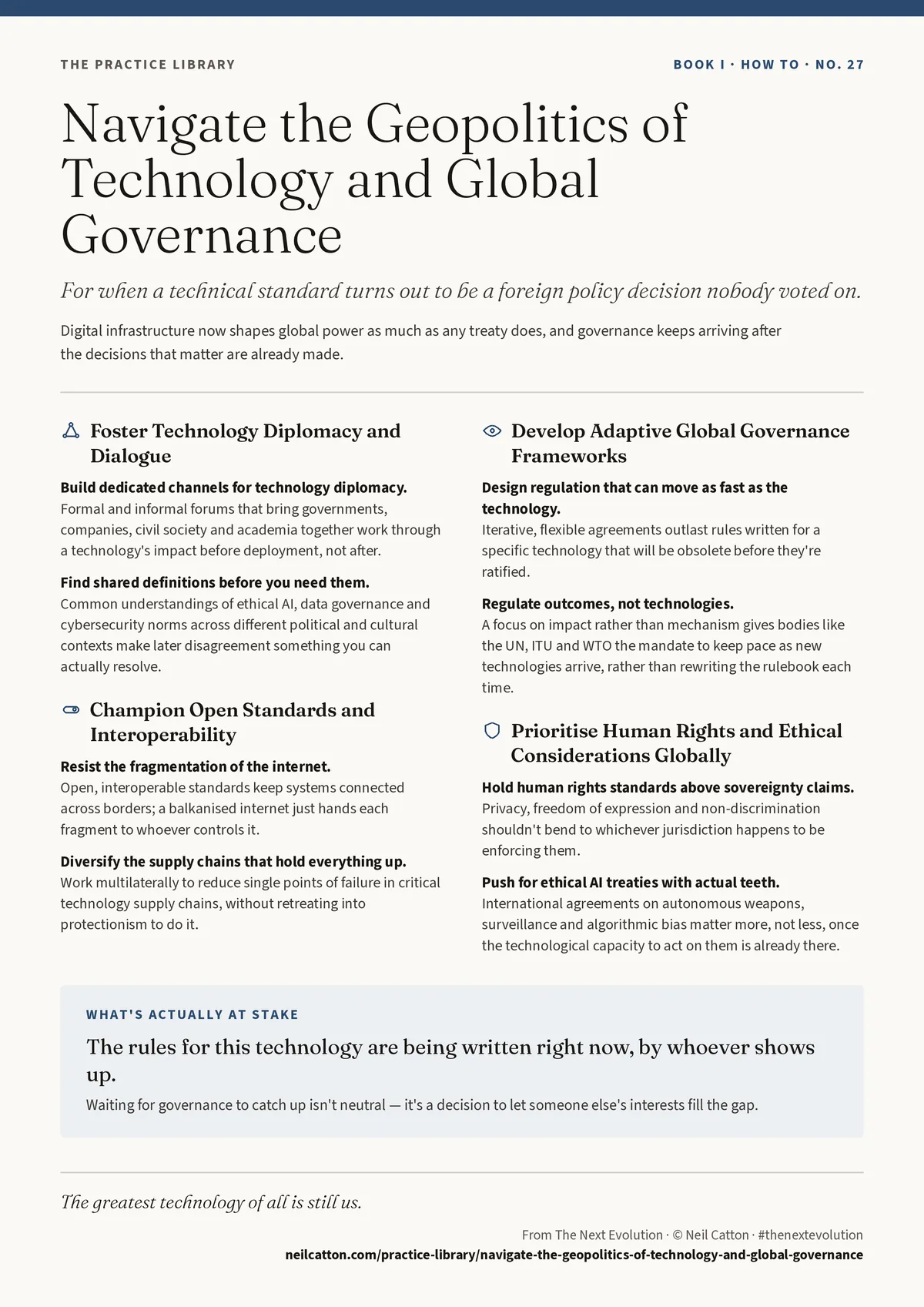
The card holds four practice areas in one column: fostering real technology diplomacy between governments, companies and civil society; championing open standards against the pull toward a fragmented internet; building governance frameworks flexible enough to survive contact with a fast-moving technology; and holding human rights above whichever jurisdiction's convenience is being served. Written for anyone who wants to see the politics inside the technology, not just the engineering.
It comes from The Next Evolution, where the fuller argument lives. The card stands on its own — you don't need the book to use it.
Print it, or send it to whoever keeps saying this is a technical decision, not a political one.
If the standard is already decided by the time governance arrives, who was actually in the room?
Navigate the Geopolitics of Technology and Global Governance
Foster Technology Diplomacy and Dialogue
- Build dedicated channels for technology diplomacy. Formal and informal forums that bring governments, companies, civil society and academia together work through a technology's impact before deployment, not after.
- Find shared definitions before you need them. Common understandings of ethical AI, data governance and cybersecurity norms across different political and cultural contexts make later disagreement something you can actually resolve.
Champion Open Standards and Interoperability
- Resist the fragmentation of the internet. Open, interoperable standards keep systems connected across borders; a balkanised internet just hands each fragment to whoever controls it.
- Diversify the supply chains that hold everything up. Work multilaterally to reduce single points of failure in critical technology supply chains, without retreating into protectionism to do it.
Develop Adaptive Global Governance Frameworks
- Design regulation that can move as fast as the technology. Iterative, flexible agreements outlast rules written for a specific technology that will be obsolete before they're ratified.
- Regulate outcomes, not technologies. A focus on impact rather than mechanism gives bodies like the UN, ITU and WTO the mandate to keep pace as new technologies arrive, rather than rewriting the rulebook each time.
Prioritise Human Rights and Ethical Considerations Globally
- Hold human rights standards above sovereignty claims. Privacy, freedom of expression and non-discrimination shouldn't bend to whichever jurisdiction happens to be enforcing them.
- Push for ethical AI treaties with actual teeth. International agreements on autonomous weapons, surveillance and algorithmic bias matter more, not less, once the technological capacity to act on them is already there.
The greatest technology of all is still us.
From The Next Evolution · © Neil Catton · Filed under governance and institutions
Read it alongside
 Also from The Next Evolution · No. 25Shape Your Networked SelfFor when the version of you online no longer feels like a decision you made.
 Also from The Next Evolution · No. 29Reclaim Your EngagementFor when you look up and can't remember choosing to scroll this far.
 Also from The Next Evolution · No. 22Design Digital Humans with IntentionFor when the voice on the other end of a public service turns out not to be a person, and no one thought to say so.