Book I · The Next Evolution · How To · No. 15
Manage Your Algorithmic Reputation
For when you realise the profile shaping what you see was never one you agreed to.
The systems form an opinion of you long before you're in the room — built from data exhaust, rarely visible, and rarely yours to correct.

A mortgage broker declines an application and cites "affordability concerns" the applicant doesn't recognise from their own accounts. Somewhere behind that phrase sits a score, built from months of transaction data, shopping patterns and search history nobody asked permission to use. The applicant never sees the score. They only see the decision.
This is happening across ordinary life — the price quoted for insurance, the job advert that never appears, the loan offer that's slightly worse than a neighbour's. None of it is illegal, and most of it was technically disclosed in terms nobody read. It is simply invisible, assembled from data most people never think of as a file with their name on it.
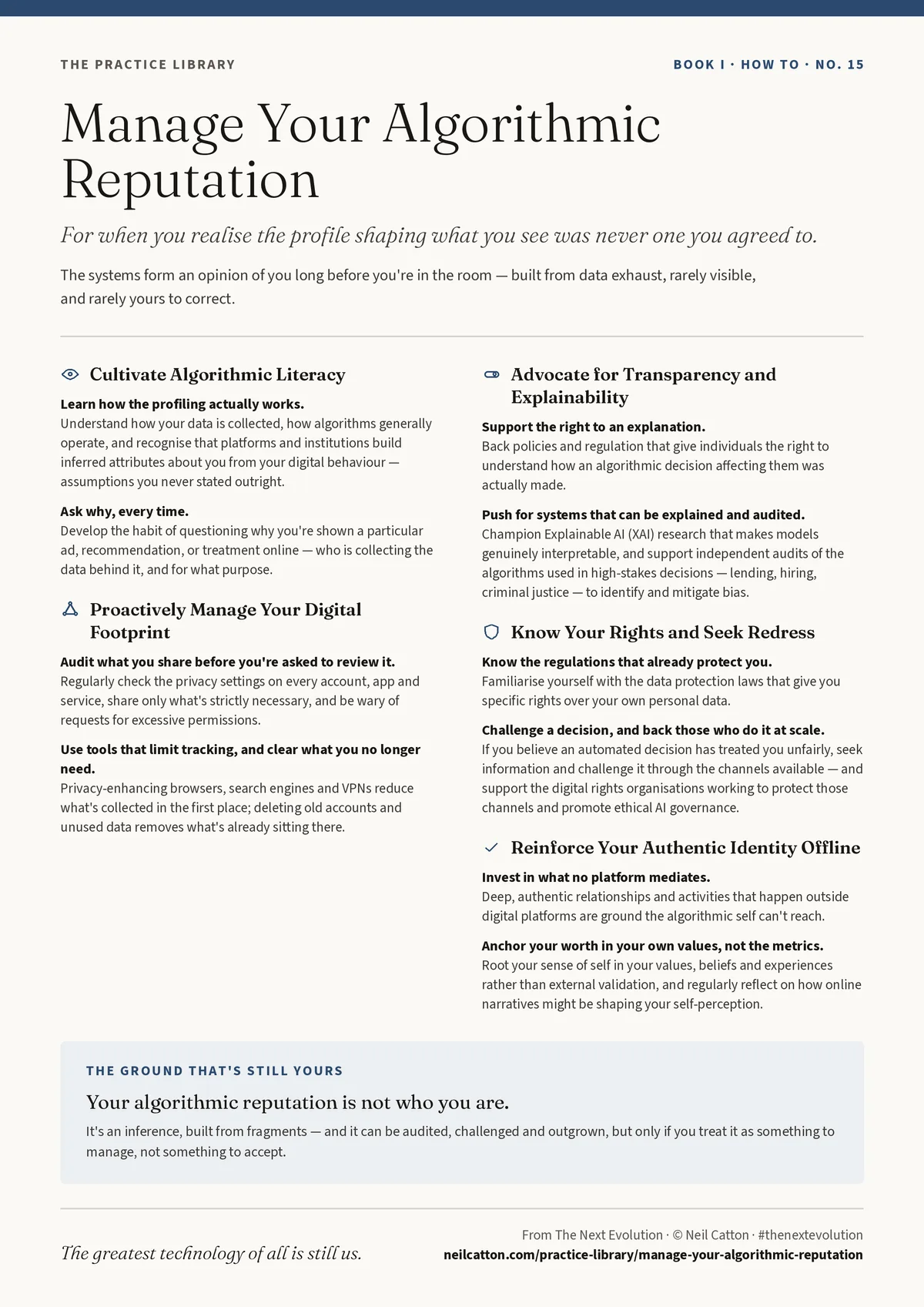
The card holds five practice areas in one column: building real literacy in how the profiling works, actively managing what you feed into it, pushing for systems that can explain themselves, knowing the rights and routes for redress that already exist, and keeping a version of yourself that lives outside the data entirely. Written for anyone who has been treated a certain way online and wanted to know why.
It comes from The Next Evolution, where the fuller argument lives. The card stands on its own — you don't need the book to use it.
Print it, or send it to whoever just got a decision from a system that can't say why.
So the next time a screen quietly decides something about you: whose version of you is it working from, and did anyone check?
Manage Your Algorithmic Reputation
Cultivate Algorithmic Literacy
- Learn how the profiling actually works. Understand how your data is collected, how algorithms generally operate, and recognise that platforms and institutions build inferred attributes about you from your digital behaviour — assumptions you never stated outright.
- Ask why, every time. Develop the habit of questioning why you're shown a particular ad, recommendation, or treatment online — who is collecting the data behind it, and for what purpose.
Proactively Manage Your Digital Footprint
- Audit what you share before you're asked to review it. Regularly check the privacy settings on every account, app and service, share only what's strictly necessary, and be wary of requests for excessive permissions.
- Use tools that limit tracking, and clear what you no longer need. Privacy-enhancing browsers, search engines and VPNs reduce what's collected in the first place; deleting old accounts and unused data removes what's already sitting there.
Advocate for Transparency and Explainability
- Support the right to an explanation. Back policies and regulation that give individuals the right to understand how an algorithmic decision affecting them was actually made.
- Push for systems that can be explained and audited. Champion Explainable AI (XAI) research that makes models genuinely interpretable, and support independent audits of the algorithms used in high-stakes decisions — lending, hiring, criminal justice — to identify and mitigate bias.
Know Your Rights and Seek Redress
- Know the regulations that already protect you. Familiarise yourself with the data protection laws that give you specific rights over your own personal data.
- Challenge a decision, and back those who do it at scale. If you believe an automated decision has treated you unfairly, seek information and challenge it through the channels available — and support the digital rights organisations working to protect those channels and promote ethical AI governance.
Reinforce Your Authentic Identity Offline
- Invest in what no platform mediates. Deep, authentic relationships and activities that happen outside digital platforms are ground the algorithmic self can't reach.
- Anchor your worth in your own values, not the metrics. Root your sense of self in your values, beliefs and experiences rather than external validation, and regularly reflect on how online narratives might be shaping your self-perception.
The greatest technology of all is still us.
From The Next Evolution · © Neil Catton · Filed under identity and reputation
Read it alongside
 Also from The Next Evolution · No. 13Navigate the Ethics of Algorithmic IntelligenceFor when a judgement call that used to be yours quietly became the system’s.
 Also from The Next Evolution · No. 18Foster Human-AI SymbiosisFor when the AI stops feeling like a tool and starts feeling like a colleague nobody agreed to hire.
 Also from The Next Evolution · No. 11Design for Digital Well-being and Mental HealthFor when the phone in your pocket has more say over your mood than you do.