Book I · The Next Evolution · How To · No. 18
Foster Human-AI Symbiosis
For when the AI stops feeling like a tool and starts feeling like a colleague nobody agreed to hire.
The boundary between decision-maker and decision-support keeps blurring — shaping that relationship deliberately is now part of the work.

A radiologist reviewing a stack of scans notices they've started agreeing with the AI's flag before they've finished looking at the image themselves. Not because they checked and it matched — because it's been right the last dozen times, and matching is faster than looking. They catch themselves mid-glance on scan thirteen and force themselves to look again, properly. It's clean. The AI was right. They still don't know, in that moment, whether they looked or whether they trusted.
This is happening in offices, hospitals, courtrooms and classrooms — wherever a system offers a recommendation fast enough to arrive before the person has finished forming their own view. None of it is malicious, and most of it looks like good practice: using the tool for what it's good at. The risk isn't that AI takes over. It's that the habit of checking quietly erodes, one correct answer at a time, until nobody notices when it stops being checked at all.
The card holds four practice areas across two columns: knowing precisely where AI's strengths and limits actually sit, integrating tools deliberately rather than by default, building the collaborative skills and literacy that keep pace with the tools, and staying honest about privacy, bias and disclosure as the relationship deepens. Written for anyone who has caught themselves trusting an AI's output before they'd finished forming their own.
It comes from The Next Evolution, where the fuller argument lives. The card stands on its own — you don't need the book to use it.
Print it, or send it to whoever just told you AI "basically decided" something and seemed relieved about it.
So next time a system hands you an answer before you've finished thinking it through: did you decide, or did you just agree?
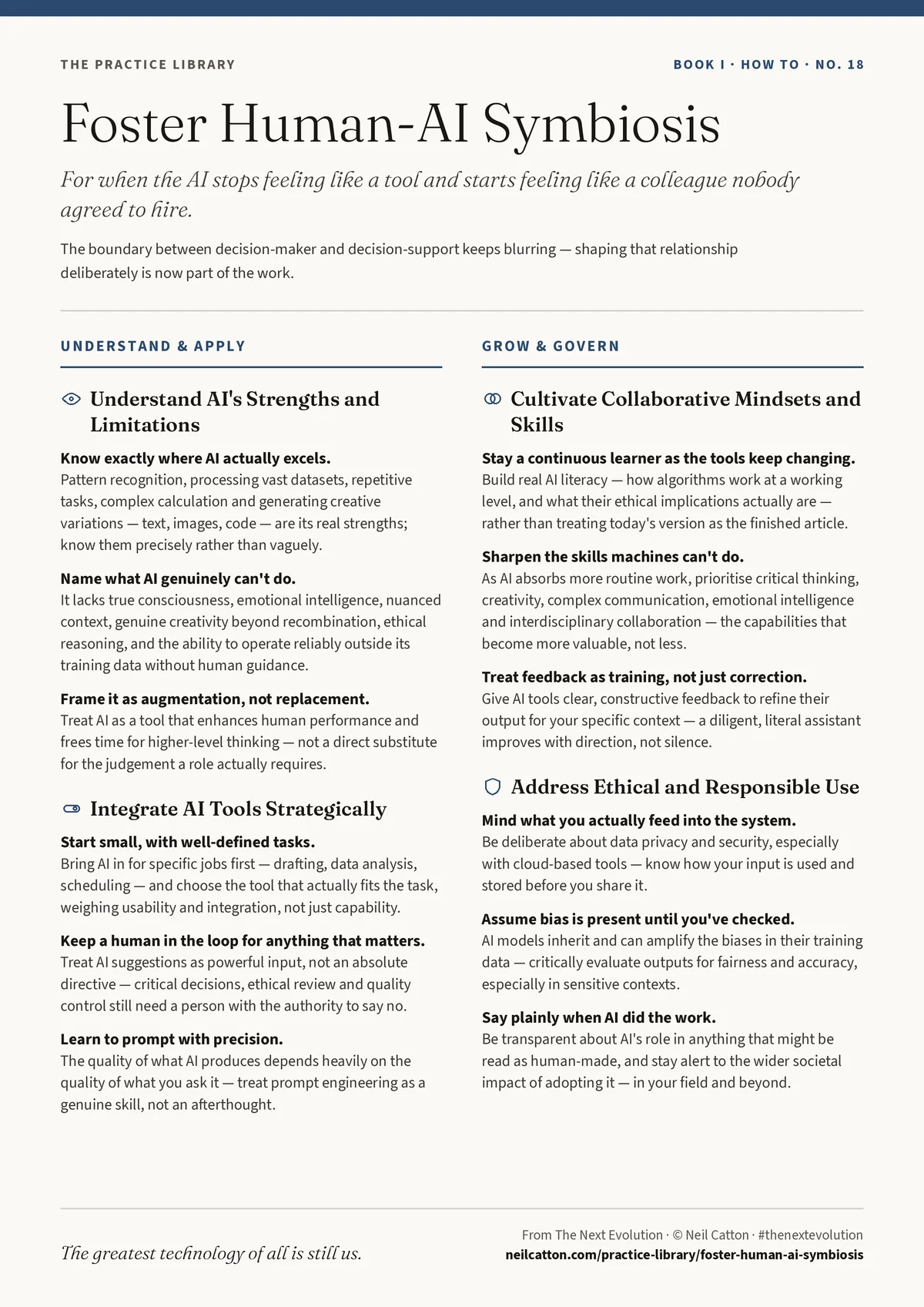
Foster Human-AI Symbiosis
Understand & Apply
Understand AI's Strengths and Limitations
- Know exactly where AI actually excels. Pattern recognition, processing vast datasets, repetitive tasks, complex calculation and generating creative variations — text, images, code — are its real strengths; know them precisely rather than vaguely.
- Name what AI genuinely can't do. It lacks true consciousness, emotional intelligence, nuanced context, genuine creativity beyond recombination, ethical reasoning, and the ability to operate reliably outside its training data without human guidance.
- Frame it as augmentation, not replacement. Treat AI as a tool that enhances human performance and frees time for higher-level thinking — not a direct substitute for the judgement a role actually requires.
Integrate AI Tools Strategically
- Start small, with well-defined tasks. Bring AI in for specific jobs first — drafting, data analysis, scheduling — and choose the tool that actually fits the task, weighing usability and integration, not just capability.
- Keep a human in the loop for anything that matters. Treat AI suggestions as powerful input, not an absolute directive — critical decisions, ethical review and quality control still need a person with the authority to say no.
- Learn to prompt with precision. The quality of what AI produces depends heavily on the quality of what you ask it — treat prompt engineering as a genuine skill, not an afterthought.
Grow & Govern
Cultivate Collaborative Mindsets and Skills
- Stay a continuous learner as the tools keep changing. Build real AI literacy — how algorithms work at a working level, and what their ethical implications actually are — rather than treating today's version as the finished article.
- Sharpen the skills machines can't do. As AI absorbs more routine work, prioritise critical thinking, creativity, complex communication, emotional intelligence and interdisciplinary collaboration — the capabilities that become more valuable, not less.
- Treat feedback as training, not just correction. Give AI tools clear, constructive feedback to refine their output for your specific context — a diligent, literal assistant improves with direction, not silence.
Address Ethical and Responsible Use
- Mind what you actually feed into the system. Be deliberate about data privacy and security, especially with cloud-based tools — know how your input is used and stored before you share it.
- Assume bias is present until you've checked. AI models inherit and can amplify the biases in their training data — critically evaluate outputs for fairness and accuracy, especially in sensitive contexts.
- Say plainly when AI did the work. Be transparent about AI's role in anything that might be read as human-made, and stay alert to the wider societal impact of adopting it — in your field and beyond.
The greatest technology of all is still us.
From The Next Evolution · © Neil Catton · Filed under ai ethics
Read it alongside
 Also from The Next Evolution · No. 20Practise the Three-Foot World in a Digital AgeFor the evening you’ve read about four crises on three continents and haven’t spoken to anyone in the house.
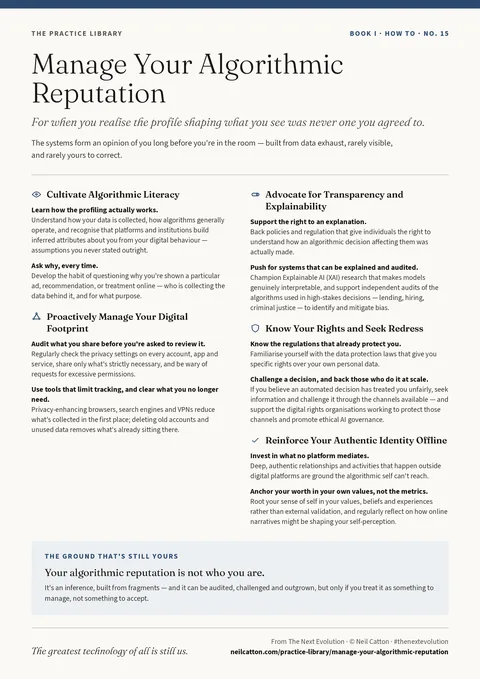 Also from The Next Evolution · No. 15Manage Your Algorithmic ReputationFor when you realise the profile shaping what you see was never one you agreed to.
 Also from The Next Evolution · No. 22Design Digital Humans with IntentionFor when the voice on the other end of a public service turns out not to be a person, and no one thought to say so.