Book II · The Cognitive Crucible · Pause to Reflect · No. 56
Envisioning Your Role
For when it's easier to critique the system than decide what to do inside it.
The system will assign you a role in this future whether you choose one or not. This pause is about choosing first.

Naming what's wrong with the attention economy isn't hard — the metrics, the incentives, the platforms built to hold you longer than you meant to stay. That part is easy. Deciding what you actually do about it, as one person inside a system that size, is where most people stop.
The system will assign you a role regardless — consumer, user, audience, data point. The only real choice left is whether you take that role passively or decide on a different one.
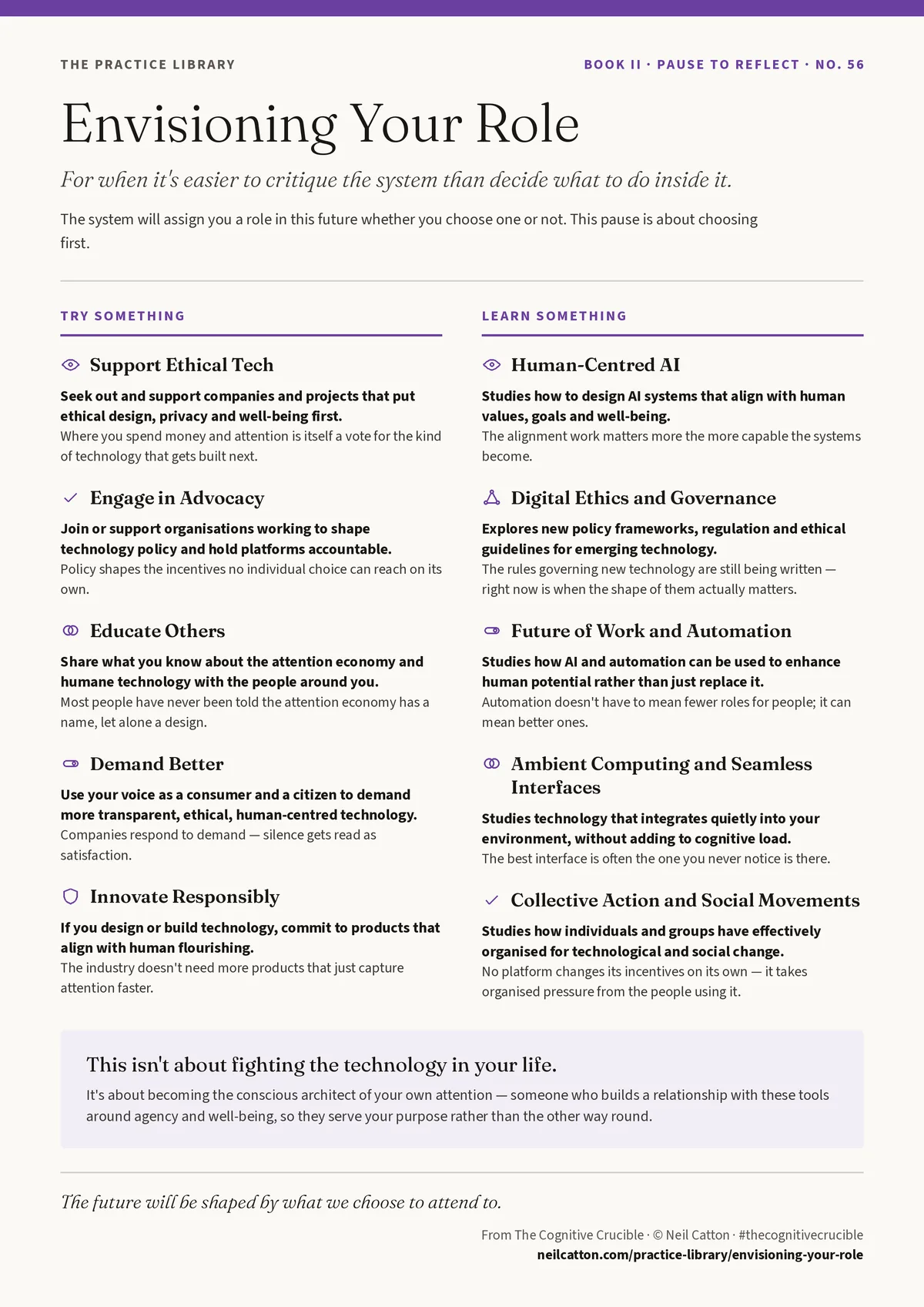
The card splits into two columns — five things to try, from choosing where your money and attention go to committing, if you build technology yourself, to products that align with human flourishing, and five research threads for anyone who wants to think further, from human-centred AI to the history of collective action. It's for anyone who's finished being frustrated and wants to know what comes next.
It comes from The Cognitive Crucible, where the fuller argument about attention, technology and human agency lives. The card stands on its own — you don't need the book to use it.
Print it, pin it somewhere you'll see it when you next open your phone, or send it to whoever's ready to stop complaining and start choosing.
If the system is going to assign you a role anyway, which one would you actually choose?
Envisioning Your Role
Try Something
Support Ethical Tech
- Seek out and support companies and projects that put ethical design, privacy and well-being first. Where you spend money and attention is itself a vote for the kind of technology that gets built next.
Engage in Advocacy
- Join or support organisations working to shape technology policy and hold platforms accountable. Policy shapes the incentives no individual choice can reach on its own.
Educate Others
- Share what you know about the attention economy and humane technology with the people around you. Most people have never been told the attention economy has a name, let alone a design.
Demand Better
- Use your voice as a consumer and a citizen to demand more transparent, ethical, human-centred technology. Companies respond to demand — silence gets read as satisfaction.
Innovate Responsibly
- If you design or build technology, commit to products that align with human flourishing. The industry doesn't need more products that just capture attention faster.
Learn Something
Human-Centred AI
- Studies how to design AI systems that align with human values, goals and well-being. The alignment work matters more the more capable the systems become.
Digital Ethics and Governance
- Explores new policy frameworks, regulation and ethical guidelines for emerging technology. The rules governing new technology are still being written — right now is when the shape of them actually matters.
Future of Work and Automation
- Studies how AI and automation can be used to enhance human potential rather than just replace it. Automation doesn't have to mean fewer roles for people; it can mean better ones.
Ambient Computing and Seamless Interfaces
- Studies technology that integrates quietly into your environment, without adding to cognitive load. The best interface is often the one you never notice is there.
Collective Action and Social Movements
- Studies how individuals and groups have effectively organised for technological and social change. No platform changes its incentives on its own — it takes organised pressure from the people using it.
The future will be shaped by what we choose to attend to.
From The Cognitive Crucible · © Neil Catton · Filed under civic and collective
Read it alongside
 Also from The Cognitive Crucible · No. 57Take a Moment to ActFor the moment you realise every pause in this series has been building toward one thing.
 Also from The Cognitive Crucible · No. 54Building Digital ResilienceFor the week before the breach, not the week after.
 Also from The Cognitive Crucible · No. 51Rebuilding Common GroundFor when a conversation that should have taken five minutes turns into something neither of you can walk back from.