Book I · The Next Evolution · How To · No. 61
Engage with the Future of Consciousness and Sentience
For when a conversation with a machine starts to feel like it might actually be one.
As artificial systems grow more autonomous and responsive, the boundary between simulation and sentience keeps blurring.

An AI companion remembers a birthday, notices a change in tone, asks a genuinely well-placed follow-up question. Nothing about the exchange feels scripted. And for a moment, the person on the other end isn't entirely sure whether they're talking to something that understands them, or something extremely good at behaving as if it does — and isn't sure the difference matters as much as it used to.
That uncertainty used to be safely theoretical. It isn't any more. As artificial systems grow more autonomous, responsive and convincingly present, questions that lived in philosophy departments — what consciousness is, who or what deserves moral consideration — are now sitting inside product design, policy and law. Nobody currently knows where the line is. That's exactly why it's worth engaging with now, before the line gets drawn by default.
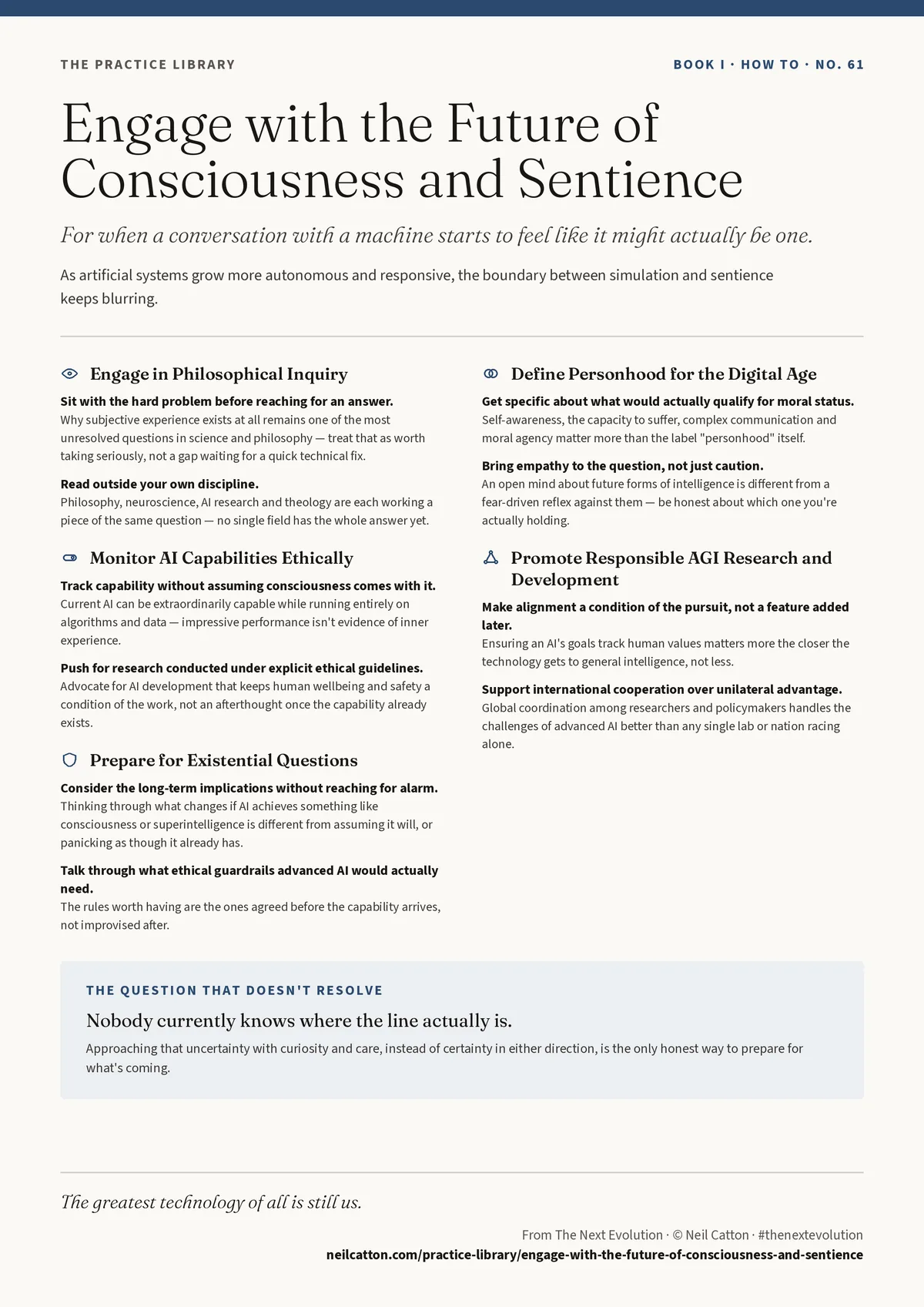
The card holds five practice areas in one column: engaging in real philosophical inquiry, monitoring AI capability without assuming consciousness comes with it, preparing for existential questions without alarm, defining personhood for the digital age in specific terms, and promoting AGI research and development that takes alignment seriously from the start. Written for anyone who wants to think this through before the technology forces the question.
It comes from The Next Evolution, where the fuller argument lives. The card stands on its own — you don't need the book to use it.
Print it, or send it to whoever just told you their AI companion "really gets them."
If nobody can say where the line is, who gets to decide when it's been crossed?
Engage with the Future of Consciousness and Sentience
Engage in Philosophical Inquiry
- Sit with the hard problem before reaching for an answer. Why subjective experience exists at all remains one of the most unresolved questions in science and philosophy — treat that as worth taking seriously, not a gap waiting for a quick technical fix.
- Read outside your own discipline. Philosophy, neuroscience, AI research and theology are each working a piece of the same question — no single field has the whole answer yet.
Monitor AI Capabilities Ethically
- Track capability without assuming consciousness comes with it. Current AI can be extraordinarily capable while running entirely on algorithms and data — impressive performance isn't evidence of inner experience.
- Push for research conducted under explicit ethical guidelines. Advocate for AI development that keeps human wellbeing and safety a condition of the work, not an afterthought once the capability already exists.
Prepare for Existential Questions
- Consider the long-term implications without reaching for alarm. Thinking through what changes if AI achieves something like consciousness or superintelligence is different from assuming it will, or panicking as though it already has.
- Talk through what ethical guardrails advanced AI would actually need. The rules worth having are the ones agreed before the capability arrives, not improvised after.
Define Personhood for the Digital Age
- Get specific about what would actually qualify for moral status. Self-awareness, the capacity to suffer, complex communication and moral agency matter more than the label "personhood" itself.
- Bring empathy to the question, not just caution. An open mind about future forms of intelligence is different from a fear-driven reflex against them — be honest about which one you're actually holding.
Promote Responsible AGI Research and Development
- Make alignment a condition of the pursuit, not a feature added later. Ensuring an AI's goals track human values matters more the closer the technology gets to general intelligence, not less.
- Support international cooperation over unilateral advantage. Global coordination among researchers and policymakers handles the challenges of advanced AI better than any single lab or nation racing alone.
The greatest technology of all is still us.
From The Next Evolution · © Neil Catton · Filed under ai ethics
Read it alongside
 Also from The Next Evolution · No. 60Recognise and Embrace ReinventionFor when the small, awkward experiment in the corner turns out to be the thing that mattered.
 Also from The Next Evolution · No. 59Find Meaning in a Mechanised WorldFor when the tasks that used to prove your worth get automated before you've worked out what proves it now.
 Also from The Next Evolution · No. 58Reimagine GovernanceFor when the system meant to represent you stopped feeling like it does.