Book I · The Next Evolution · How To · No. 32
Engage with Human Augmentation for Cognitive Enhancement
For when the tool meant to sharpen your thinking starts doing some of the thinking for you.
Neural interfaces, cognitive prosthetics and AI companions are already extending memory, focus and judgement — the question is what they're extending it toward.

A focus app promises fewer distractions and delivers them, at first — until the habit of checking whether you're focused becomes its own distraction. A nootropic promises clearer thinking. A brain-computer interface, still mostly experimental, promises something closer to a new sense. Each one is real. None of them arrives with a label explaining what it's quietly asking you to give up in exchange.
Cognitive enhancement is no longer a thought experiment. Neural interfaces, wearables and AI companions already extend memory, focus and decision-making for people using them today, and the tools are getting less experimental by the year. What's missing isn't the technology — it's the discipline of asking what a given augmentation actually does to the person using it, before adopting it because it's available.
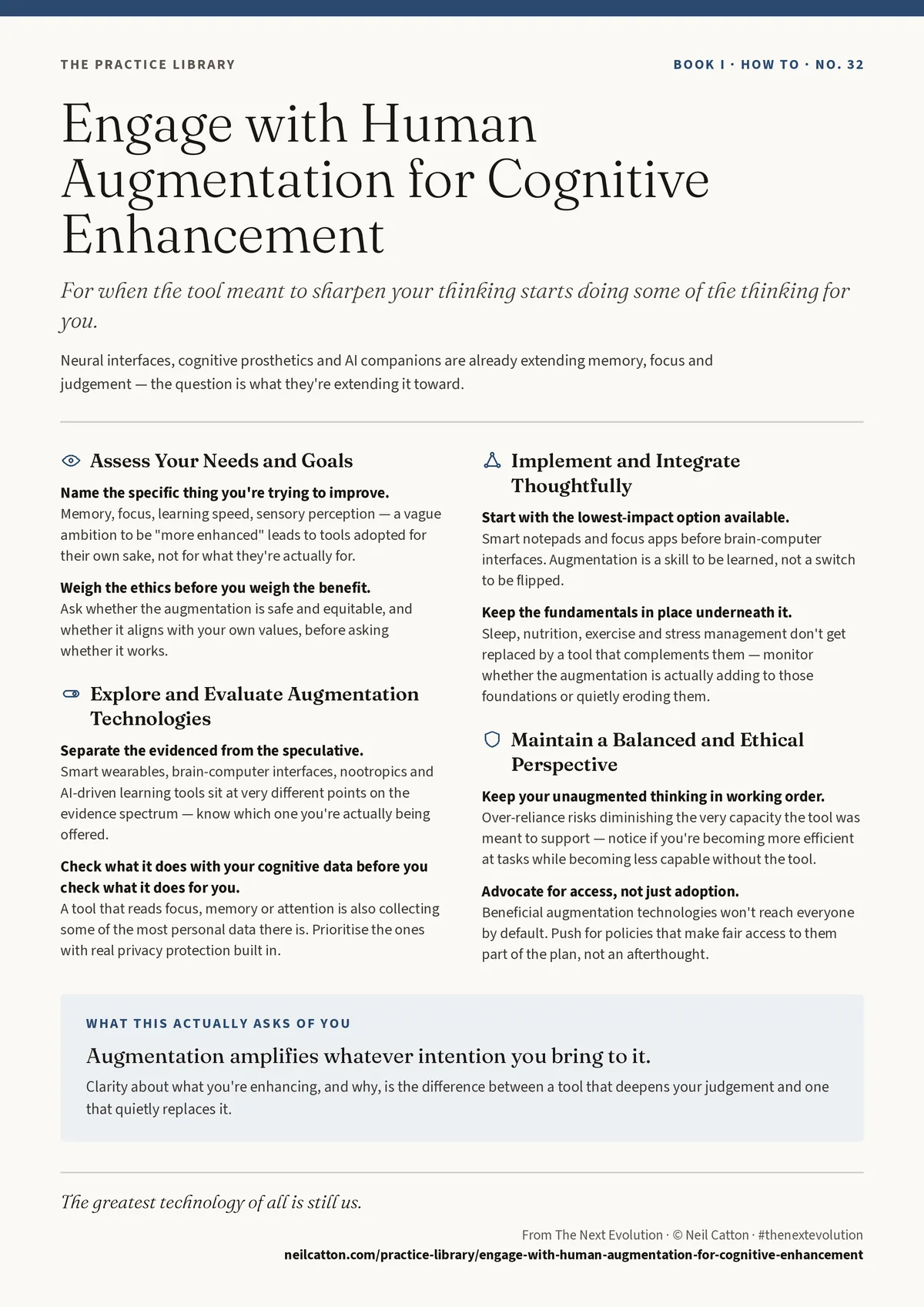
The card holds four practice areas in one column: assessing your own needs and goals before reaching for a tool, evaluating augmentation technologies on evidence rather than hype, implementing them thoughtfully starting with the lowest-impact option, and maintaining a balanced, ethical perspective on what the tool is actually doing to your own capacities. Written for anyone experimenting with these tools now, not waiting for a future version of them.
It comes from The Next Evolution, where the fuller argument lives. The card stands on its own — you don't need the book to use it.
Print it, or send it to whoever just downloaded a focus app without asking what it's tracking.
If a tool makes you more efficient and less capable without it, has it enhanced you, or replaced part of you?
Engage with Human Augmentation for Cognitive Enhancement
Assess Your Needs and Goals
- Name the specific thing you're trying to improve. Memory, focus, learning speed, sensory perception — a vague ambition to be "more enhanced" leads to tools adopted for their own sake, not for what they're actually for.
- Weigh the ethics before you weigh the benefit. Ask whether the augmentation is safe and equitable, and whether it aligns with your own values, before asking whether it works.
Explore and Evaluate Augmentation Technologies
- Separate the evidenced from the speculative. Smart wearables, brain-computer interfaces, nootropics and AI-driven learning tools sit at very different points on the evidence spectrum — know which one you're actually being offered.
- Check what it does with your cognitive data before you check what it does for you. A tool that reads focus, memory or attention is also collecting some of the most personal data there is. Prioritise the ones with real privacy protection built in.
Implement and Integrate Thoughtfully
- Start with the lowest-impact option available. Smart notepads and focus apps before brain-computer interfaces. Augmentation is a skill to be learned, not a switch to be flipped.
- Keep the fundamentals in place underneath it. Sleep, nutrition, exercise and stress management don't get replaced by a tool that complements them — monitor whether the augmentation is actually adding to those foundations or quietly eroding them.
Maintain a Balanced and Ethical Perspective
- Keep your unaugmented thinking in working order. Over-reliance risks diminishing the very capacity the tool was meant to support — notice if you're becoming more efficient at tasks while becoming less capable without the tool.
- Advocate for access, not just adoption. Beneficial augmentation technologies won't reach everyone by default. Push for policies that make fair access to them part of the plan, not an afterthought.
The greatest technology of all is still us.
From The Next Evolution · © Neil Catton · Filed under meaning and reinvention
Read it alongside
 Also from The Next Evolution · No. 34Defend Your Identity from Theft and ImpersonationFor when the voice on the phone sounds exactly like someone you trust.
 Also from The Next Evolution · No. 29Reclaim Your EngagementFor when you look up and can't remember choosing to scroll this far.
 Also from The Next Evolution · No. 36Cultivate Conscious Perception in Virtual FrontiersFor when an environment reaches your senses before it reaches your judgement.