Book II · The Cognitive Crucible · Pause to Reflect · No. 35
Designing Your Digital Life
For when the apps you didn't choose start choosing for you.
Every app you use reflects a choice someone else made about your attention. This pause is about making a few choices of your own.

Open any app you didn't design and you're using someone else's decisions — what the button says, where it sits, how many taps stand between you and closing the thing. None of it is neutral. Every choice was made by a person answering to a target that has nothing to do with your evening.
Most of the time that stays invisible. It only surfaces in a small moment — reaching for the phone and catching yourself mid-reach, wondering who actually decided you'd do that.
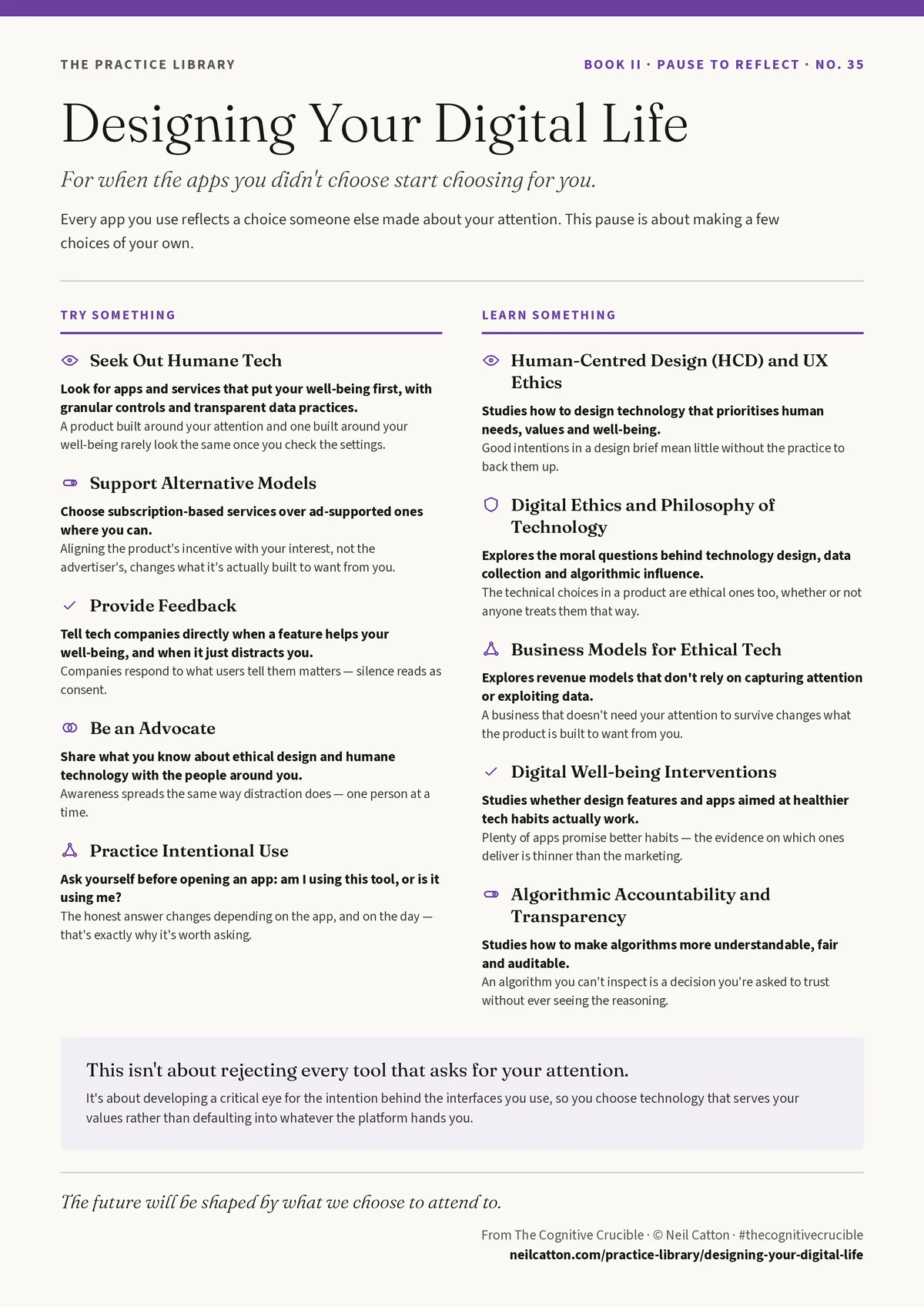
The card splits into two columns — five things to try this week, from seeking out subscription models that don't need your attention to asking one honest question before opening an app, and five research threads for anyone who wants to go further, from human-centred design to algorithmic accountability. It's for anyone who's noticed the gap between what an app claims to offer and what it's actually built to extract.
It comes from The Cognitive Crucible, where the fuller argument about attention, design and human agency lives. The card stands on its own — you don't need the book to use it.
Print it, pin it by your desk, or send it to whoever just deleted an app and felt lighter for it.
Which of your daily apps would survive being redesigned around your interest instead of theirs?
Designing Your Digital Life
Try Something
Seek Out Humane Tech
- Look for apps and services that put your well-being first, with granular controls and transparent data practices. A product built around your attention and one built around your well-being rarely look the same once you check the settings.
Support Alternative Models
- Choose subscription-based services over ad-supported ones where you can. Aligning the product's incentive with your interest, not the advertiser's, changes what it's actually built to want from you.
Provide Feedback
- Tell tech companies directly when a feature helps your well-being, and when it just distracts you. Companies respond to what users tell them matters — silence reads as consent.
Be an Advocate
- Share what you know about ethical design and humane technology with the people around you. Awareness spreads the same way distraction does — one person at a time.
Practice Intentional Use
- Ask yourself before opening an app: am I using this tool, or is it using me? The honest answer changes depending on the app, and on the day — that's exactly why it's worth asking.
Learn Something
Human-Centred Design (HCD) and UX Ethics
- Studies how to design technology that prioritises human needs, values and well-being. Good intentions in a design brief mean little without the practice to back them up.
Digital Ethics and Philosophy of Technology
- Explores the moral questions behind technology design, data collection and algorithmic influence. The technical choices in a product are ethical ones too, whether or not anyone treats them that way.
Business Models for Ethical Tech
- Explores revenue models that don't rely on capturing attention or exploiting data. A business that doesn't need your attention to survive changes what the product is built to want from you.
Digital Well-being Interventions
- Studies whether design features and apps aimed at healthier tech habits actually work. Plenty of apps promise better habits — the evidence on which ones deliver is thinner than the marketing.
Algorithmic Accountability and Transparency
- Studies how to make algorithms more understandable, fair and auditable. An algorithm you can't inspect is a decision you're asked to trust without ever seeing the reasoning.
The future will be shaped by what we choose to attend to.
From The Cognitive Crucible · © Neil Catton · Filed under design and leadership
Read it alongside
 Also from The Cognitive Crucible · No. 33Asserting Your Digital SelfFor when the profile you built stopped looking like you.
 Also from The Cognitive Crucible · No. 37Monetising the MindFor when you notice you've read the privacy policy of exactly nothing you've ever signed up for.
 Also from The Cognitive Crucible · No. 30The Historical Roots of PersuasionFor when the ad you just watched felt like it knew you a little too well.