Book I · The Next Evolution · How To · No. 34
Defend Your Identity from Theft and Impersonation
For when the voice on the phone sounds exactly like someone you trust.
Deepfakes, identity spoofing and AI-generated personas are no longer science fiction — they're operational risks to who you're taken to be.

A grandparent gets a call. The voice is unmistakable — a grandchild, panicked, in trouble, needing money sent immediately. Every inflection is right. None of it is real. Three seconds of audio pulled from a video online was enough to build a voice that could ask for anything and be believed.
Identity used to be something you protected by keeping a password secret. Now it's something that can be manufactured, in seconds, from material you never agreed to give away — a video posted years ago, a voicemail greeting, a face captured in someone else's photo. None of it required your consent to become raw material.
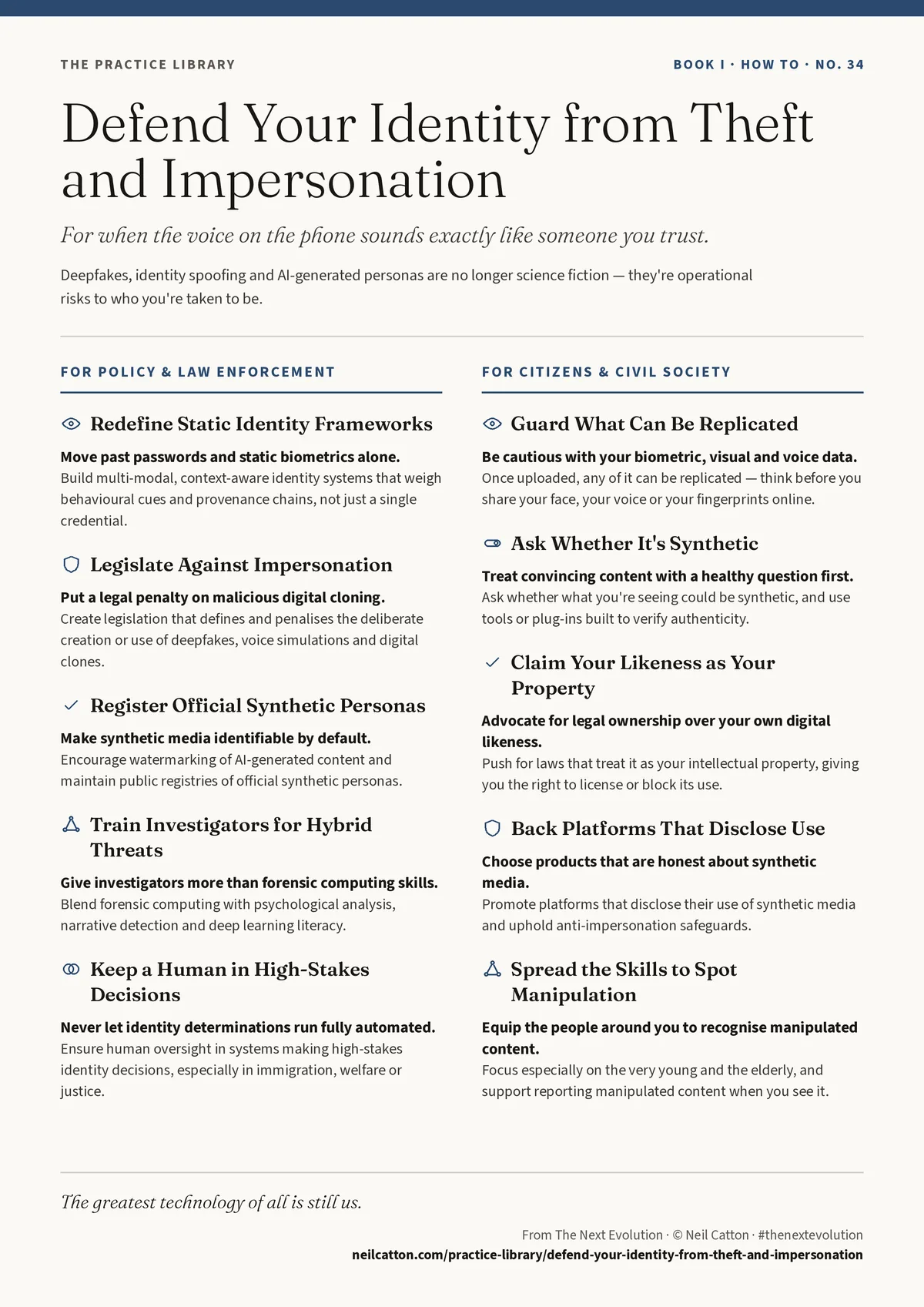
The card sets out five practice areas for policymakers and law enforcement, and five for citizens and civil society — from redesigning identity frameworks that still rely on a single static credential, to knowing when to simply ask whether what you're looking at is real. It's for anyone who assumed impersonation still took real effort.
It comes from The Next Evolution, where the fuller argument about identity, trust and emerging cybercrime gets made at length. The card doesn't need the book to make sense — it stands on its own.
Print it, or send it to the relative most likely to answer an urgent call without checking first.
If a voice can be manufactured this convincingly, what's left that actually proves it's you?
Defend Your Identity from Theft and Impersonation
For Policy & Law Enforcement
Redefine Static Identity Frameworks
- Move past passwords and static biometrics alone. Build multi-modal, context-aware identity systems that weigh behavioural cues and provenance chains, not just a single credential.
Legislate Against Impersonation
- Put a legal penalty on malicious digital cloning. Create legislation that defines and penalises the deliberate creation or use of deepfakes, voice simulations and digital clones.
Register Official Synthetic Personas
- Make synthetic media identifiable by default. Encourage watermarking of AI-generated content and maintain public registries of official synthetic personas.
Train Investigators for Hybrid Threats
- Give investigators more than forensic computing skills. Blend forensic computing with psychological analysis, narrative detection and deep learning literacy.
Keep a Human in High-Stakes Decisions
- Never let identity determinations run fully automated. Ensure human oversight in systems making high-stakes identity decisions, especially in immigration, welfare or justice.
For Citizens & Civil Society
Guard What Can Be Replicated
- Be cautious with your biometric, visual and voice data. Once uploaded, any of it can be replicated — think before you share your face, your voice or your fingerprints online.
Ask Whether It's Synthetic
- Treat convincing content with a healthy question first. Ask whether what you're seeing could be synthetic, and use tools or plug-ins built to verify authenticity.
Claim Your Likeness as Your Property
- Advocate for legal ownership over your own digital likeness. Push for laws that treat it as your intellectual property, giving you the right to license or block its use.
Back Platforms That Disclose Use
- Choose products that are honest about synthetic media. Promote platforms that disclose their use of synthetic media and uphold anti-impersonation safeguards.
Spread the Skills to Spot Manipulation
- Equip the people around you to recognise manipulated content. Focus especially on the very young and the elderly, and support reporting manipulated content when you see it.
The greatest technology of all is still us.
From The Next Evolution · © Neil Catton · Filed under identity and reputation
Read it alongside
 Also from The Next Evolution · No. 32Engage with Human Augmentation for Cognitive EnhancementFor when the tool meant to sharpen your thinking starts doing some of the thinking for you.
 Also from The Next Evolution · No. 36Cultivate Conscious Perception in Virtual FrontiersFor when an environment reaches your senses before it reaches your judgement.
 Also from The Next Evolution · No. 29Reclaim Your EngagementFor when you look up and can't remember choosing to scroll this far.