Book III · The Shadow System · How To · No. 17
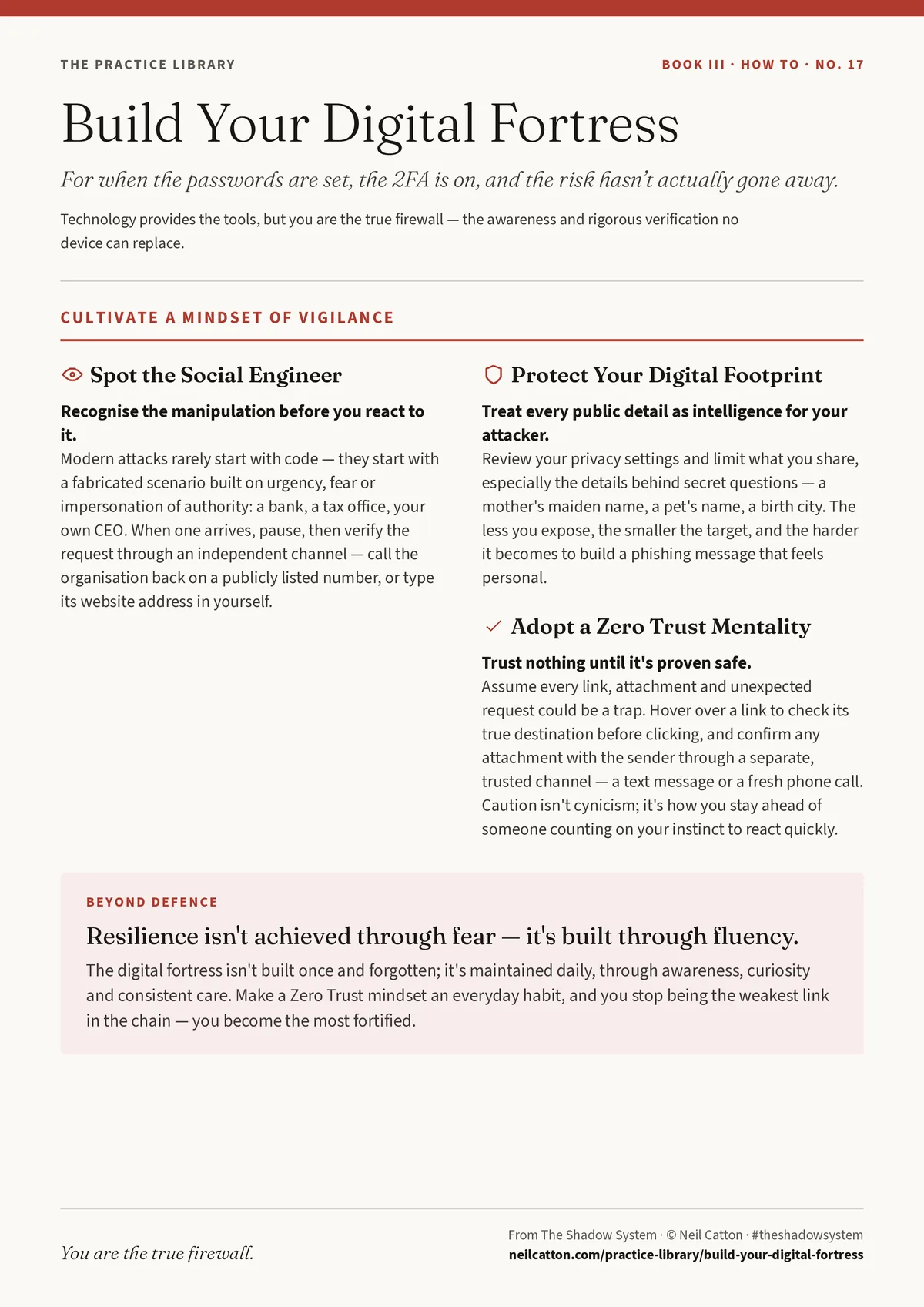
Build Your Digital Fortress
For when the passwords are set, the 2FA is on, and the risk hasn’t actually gone away.
Technology provides the tools, but you are the true firewall — the awareness and rigorous verification no device can replace.

Jordan's phone rang from a number that looked exactly like the bank's. The voice on the other end already knew the last four digits of the card, sounded exactly like every legitimate fraud-team call before it, and asked for one thing: a verification code, just sent by text, to stop a payment already in progress. Jordan almost read it out.
What stopped Jordan wasn't a piece of software. It was a habit — the pause before reacting, then hanging up and calling the bank back on the number printed on the card itself. The scam collapsed the moment it met that one second of doubt. Nothing about it was unsophisticated; it simply hadn't planned for the mindset on the other end.
The card holds three practices, each about mindset rather than hardware: spotting the fabricated urgency behind a social-engineering attempt, limiting the personal detail that turns a generic scam into a convincing one, and treating every unexpected link or attachment as unproven until it's checked. It's the layer that sits above the passwords and the authentication apps — the judgement a device can't apply for you.
It comes from The Shadow System, where the fuller anatomy of these attacks lives. The card stands alone — you don't need the book to use it.
Print it, or keep it somewhere you'll see it the next time an urgent message arrives at exactly the wrong moment.
So here's the honest question: the last time something online asked you to act fast, did you pause — or did you already know you wouldn't?
Build Your Digital Fortress
Cultivate a Mindset of Vigilance
Spot the Social Engineer
- Recognise the manipulation before you react to it. Modern attacks rarely start with code — they start with a fabricated scenario built on urgency, fear or impersonation of authority: a bank, a tax office, your own CEO. When one arrives, pause, then verify the request through an independent channel — call the organisation back on a publicly listed number, or type its website address in yourself.
Protect Your Digital Footprint
- Treat every public detail as intelligence for your attacker. Review your privacy settings and limit what you share, especially the details behind secret questions — a mother's maiden name, a pet's name, a birth city. The less you expose, the smaller the target, and the harder it becomes to build a phishing message that feels personal.
Adopt a Zero Trust Mentality
- Trust nothing until it's proven safe. Assume every link, attachment and unexpected request could be a trap. Hover over a link to check its true destination before clicking, and confirm any attachment with the sender through a separate, trusted channel — a text message or a fresh phone call. Caution isn't cynicism; it's how you stay ahead of someone counting on your instinct to react quickly.
You are the true firewall.
From The Shadow System · © Neil Catton · Filed under security and safety
Read it alongside
 Companion card · No. 24Secure the Smart HomeFor the moment you realise nobody in the house has thought about the smart speaker's security since the day it went in the box.
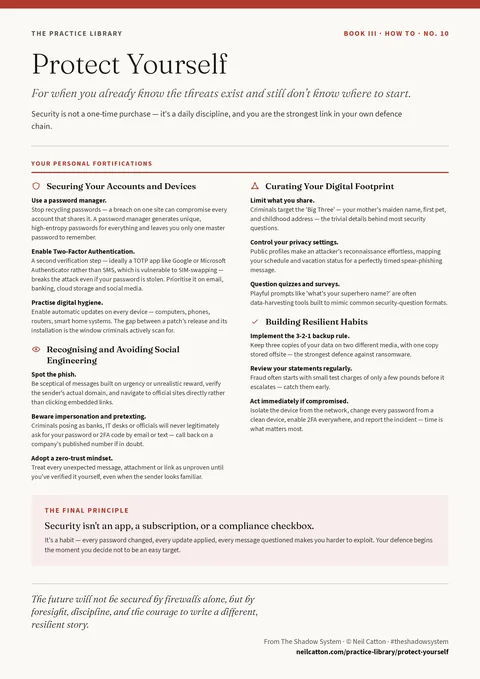 Also from The Shadow System · No. 10Protect YourselfFor when you already know the threats exist and still don’t know where to start.
 Also from The Shadow System · No. 31Fortify the EnterpriseFor when the human element is your strongest layer of defence, not your weakest.