Book II · The Cognitive Crucible · Pause to Reflect · No. 33
Asserting Your Digital Self
For when the profile you built stopped looking like you.
Your online profile was built to hold the platform's attention, not necessarily to be you. This pause is about closing that gap on purpose.

Scroll back through an old account — a profile on a platform you barely open anymore — and the person looking back can feel like a stranger. The photos are chosen, the bio is polished, the opinions performed for an audience that mostly isn't there anymore. None of that happened by accident.
Every platform nudges you toward a version of yourself that serves its own numbers: more time in the app, more content shared, more data handed over. The incentive sits with the platform, not with you — a profile engineered to hold attention is doing exactly what it was built to do. Left unattended, the gap between that curated self and the person living the rest of your life grows quietly, until closing it starts to feel like the harder task.
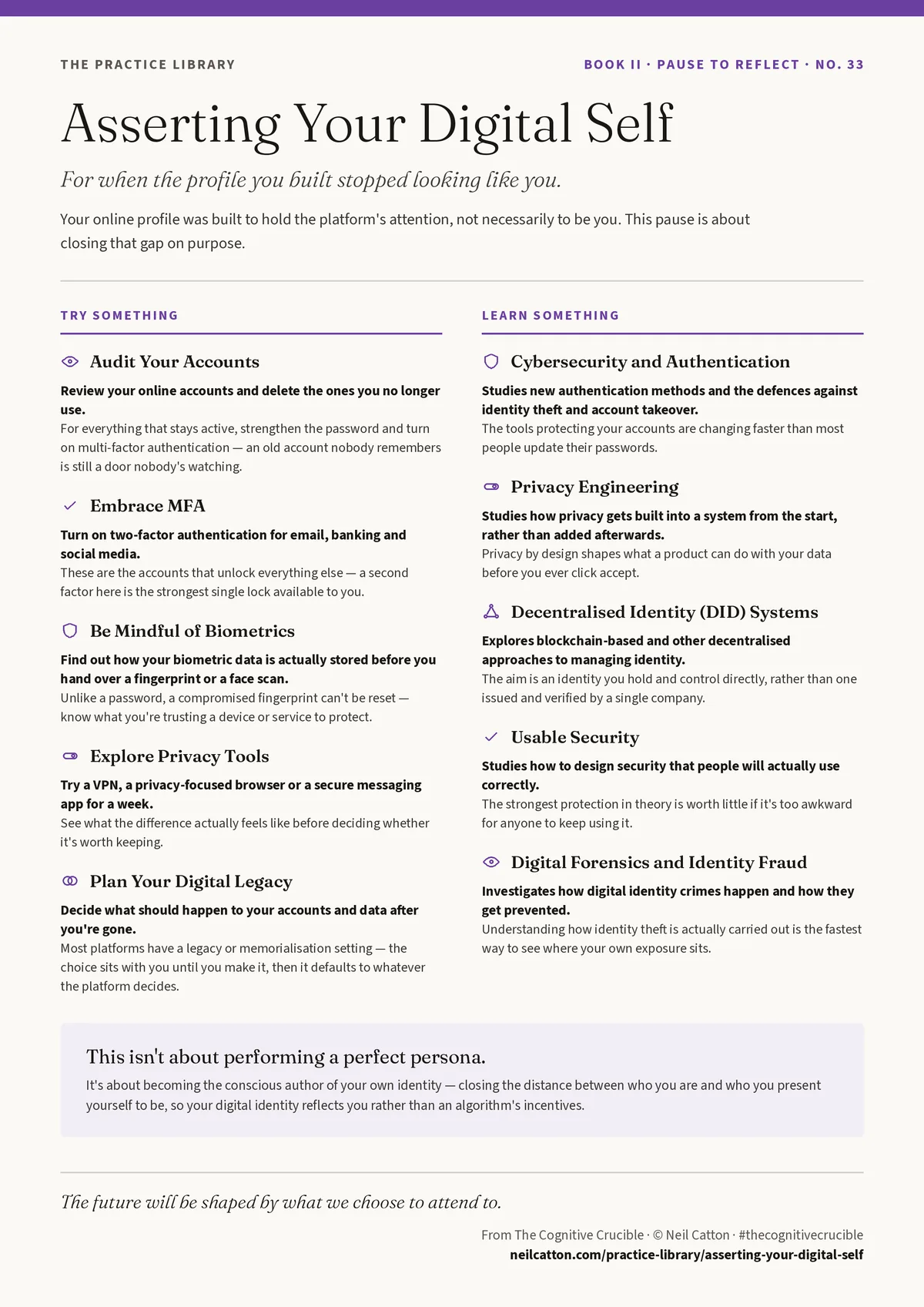
The card splits into two columns — five actions to try this week, from auditing old accounts to deciding what happens to your data when you're gone, and five research threads for anyone who wants to go further, from privacy engineering to decentralised identity systems. It's built for anyone whose online self has started to feel like someone else's project, not just the security-conscious.
It comes from The Cognitive Crucible, where the fuller argument about identity, algorithms and self-authorship lives. The card stands on its own — you don't need the book to use it.
Print it, pin it near your desk, or send it to whoever just deleted an old account and felt strangely relieved.
Which version of you would a stranger meet first — the one online, or the one in the room?
Asserting Your Digital Self
Try Something
Audit Your Accounts
- Review your online accounts and delete the ones you no longer use. For everything that stays active, strengthen the password and turn on multi-factor authentication — an old account nobody remembers is still a door nobody's watching.
Embrace MFA
- Turn on two-factor authentication for email, banking and social media. These are the accounts that unlock everything else — a second factor here is the strongest single lock available to you.
Be Mindful of Biometrics
- Find out how your biometric data is actually stored before you hand over a fingerprint or a face scan. Unlike a password, a compromised fingerprint can't be reset — know what you're trusting a device or service to protect.
Explore Privacy Tools
- Try a VPN, a privacy-focused browser or a secure messaging app for a week. See what the difference actually feels like before deciding whether it's worth keeping.
Plan Your Digital Legacy
- Decide what should happen to your accounts and data after you're gone. Most platforms have a legacy or memorialisation setting — the choice sits with you until you make it, then it defaults to whatever the platform decides.
Learn Something
Cybersecurity and Authentication
- Studies new authentication methods and the defences against identity theft and account takeover. The tools protecting your accounts are changing faster than most people update their passwords.
Privacy Engineering
- Studies how privacy gets built into a system from the start, rather than added afterwards. Privacy by design shapes what a product can do with your data before you ever click accept.
Decentralised Identity (DID) Systems
- Explores blockchain-based and other decentralised approaches to managing identity. The aim is an identity you hold and control directly, rather than one issued and verified by a single company.
Usable Security
- Studies how to design security that people will actually use correctly. The strongest protection in theory is worth little if it's too awkward for anyone to keep using it.
Digital Forensics and Identity Fraud
- Investigates how digital identity crimes happen and how they get prevented. Understanding how identity theft is actually carried out is the fastest way to see where your own exposure sits.
The future will be shaped by what we choose to attend to.
From The Cognitive Crucible · © Neil Catton · Filed under security and safety
Read it alongside
 Also from The Cognitive Crucible · No. 35Designing Your Digital LifeFor when the apps you didn't choose start choosing for you.
 Also from The Cognitive Crucible · No. 30The Historical Roots of PersuasionFor when the ad you just watched felt like it knew you a little too well.
 Also from The Cognitive Crucible · No. 37Monetising the MindFor when you notice you've read the privacy policy of exactly nothing you've ever signed up for.