Book II · The Cognitive Crucible · Pause to Reflect · No. 21
Asserting Your Data Rights
For the moment you click “Accept All” without reading past the first line, and want to change that.
Your data rights are only real if you use them. This pause turns the fine print you usually skip into leverage you can actually act on.

You've clicked "Accept All" on a cookie banner without reading it more times than you could count. Getting on with the page mattered more, in the moment, than knowing what you'd just agreed to. Somewhere in that fine print is nearly everything a company needs to know before it does what it wants with your data, and almost nobody reads far enough to find it.
That's not really a failure of attention. It's a document built long, a clause buried deep, a path of least resistance that always points towards yes. Rights exist to counter that design: to see what's held on you, to have it corrected or deleted, to ask a company what it's actually doing with what you gave it. A right nobody exercises isn't functioning as a right.
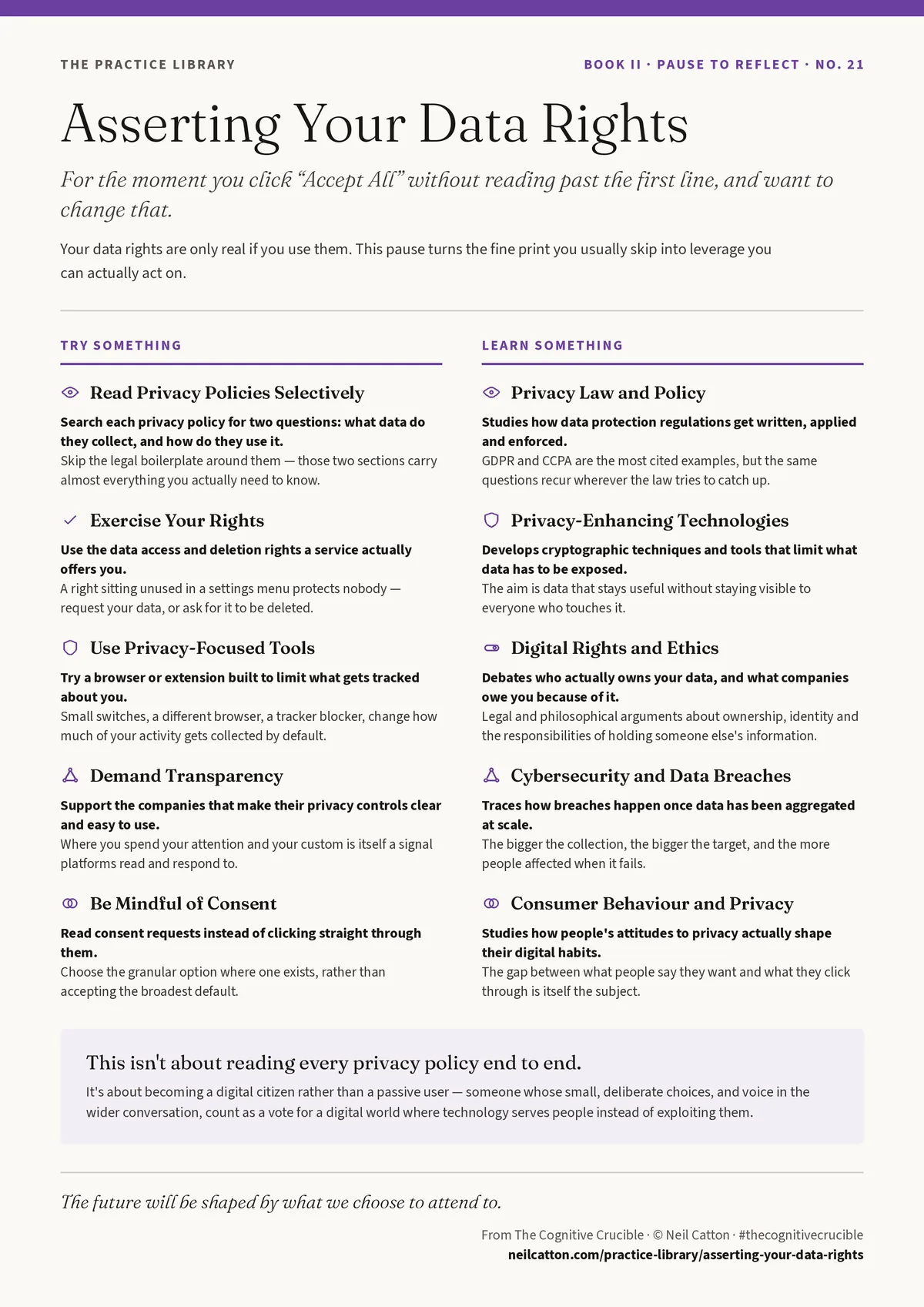
The card holds ten prompts across two columns. Five habits to try this week — reading a privacy policy for exactly two questions instead of the whole document, using the access and deletion rights already sitting in an account's settings, trying a browser or extension built to limit tracking, backing the companies that make their controls genuinely clear, and reading consent requests instead of clicking straight past them. And five fields of research if you want to go further, from the regulation behind GDPR and CCPA to the philosophy of who actually owns your data in the first place.
It comes from The Cognitive Crucible, where the fuller argument about attention and agency in a system built to erode both plays out. The card stands on its own — you don't need the book to use it.
Print it, or keep it somewhere you'll see it before the next cookie banner asks for your yes.
Next time a consent form asks for thirty seconds of your attention: will you give it, or keep scrolling past, the way you always have?
Asserting Your Data Rights
Try Something
Read Privacy Policies Selectively
- Search each privacy policy for two questions: what data do they collect, and how do they use it. Skip the legal boilerplate around them — those two sections carry almost everything you actually need to know.
Exercise Your Rights
- Use the data access and deletion rights a service actually offers you. A right sitting unused in a settings menu protects nobody — request your data, or ask for it to be deleted.
Use Privacy-Focused Tools
- Try a browser or extension built to limit what gets tracked about you. Small switches, a different browser, a tracker blocker, change how much of your activity gets collected by default.
Demand Transparency
- Support the companies that make their privacy controls clear and easy to use. Where you spend your attention and your custom is itself a signal platforms read and respond to.
Be Mindful of Consent
- Read consent requests instead of clicking straight through them. Choose the granular option where one exists, rather than accepting the broadest default.
Learn Something
Privacy Law and Policy
- Studies how data protection regulations get written, applied and enforced. GDPR and CCPA are the most cited examples, but the same questions recur wherever the law tries to catch up.
Privacy-Enhancing Technologies
- Develops cryptographic techniques and tools that limit what data has to be exposed. The aim is data that stays useful without staying visible to everyone who touches it.
Digital Rights and Ethics
- Debates who actually owns your data, and what companies owe you because of it. Legal and philosophical arguments about ownership, identity and the responsibilities of holding someone else's information.
Cybersecurity and Data Breaches
- Traces how breaches happen once data has been aggregated at scale. The bigger the collection, the bigger the target, and the more people affected when it fails.
Consumer Behaviour and Privacy
- Studies how people's attitudes to privacy actually shape their digital habits. The gap between what people say they want and what they click through is itself the subject.
The future will be shaped by what we choose to attend to.
From The Cognitive Crucible · © Neil Catton · Filed under security and safety
Read it alongside
 Also from The Cognitive Crucible · No. 19Understanding Your Cognitive LimitsFor the moment you realise you’ve read the same paragraph three times and none of it landed.
 Also from The Cognitive Crucible · No. 23Navigating the AI-Curated WorldFor when you can't tell whether an idea found you, or was placed in front of you.
 Also from The Cognitive Crucible · No. 16Decoding Weaponised MessagesFor the moment persuasion tips into manipulation, and the habit of catching it before it lands.